pescaday

Comparison

Chinook salmon vs Coho salmon: how to tell them apart

How to tell Chinook salmon from Coho salmon, with features, size, habitat and baits side by side.
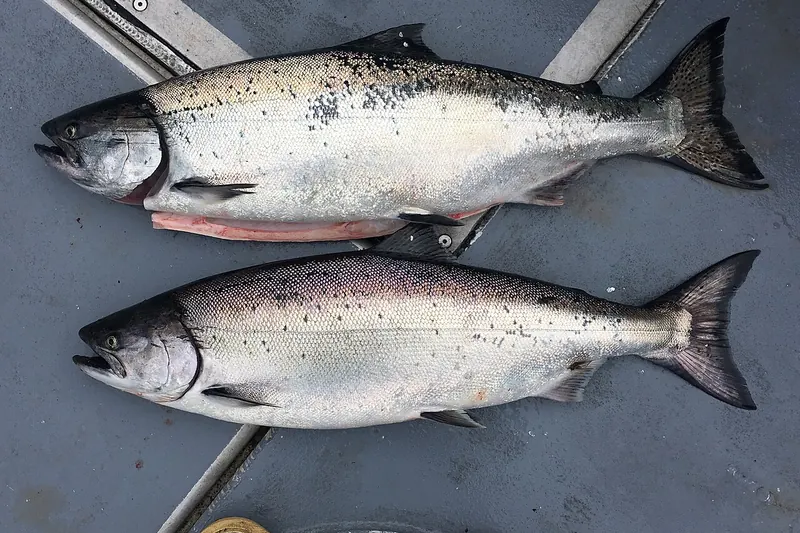
Chinook salmon, side view
Chinook salmon Oncorhynchus tshawytscha
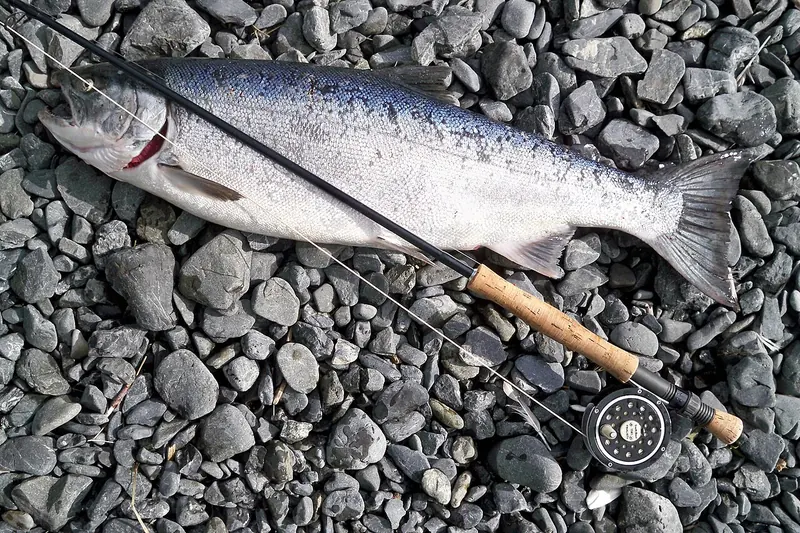
Coho salmon, side view
Coho salmon Oncorhynchus kisutch

The quick difference

Chinook salmon: Coho salmon: spots only on the upper tail lobe and a light gum line on the lower jaw (FishBase). Pink salmon: also has a spotted tail, but no silver on it; only the Chinook combines black spots and silver on the tail (Wikipedia). Atlantic salmon: lives in the Atlantic, but stocked Great Lakes Chinook share some waters with stocked Atlantic salmon (rule of thumb).

Coho salmon: Chinook salmon: black gum line and spots on both tail lobes (FishBase). Sockeye salmon: at sea without clear spots on back and tail, at spawning red body with green head (FishBase). Steelhead and rainbow trout: more densely spotted tail and pink lateral band (rule of thumb).

Side by side

How to recognise it

Chinook salmon
  • At sea blue-green to blue-black back, silvery sides, small black spots on the back and on both lobes of the tail (FishBase)
  • Black gum line on the lower jaw, in salt and fresh water (FishBase, Wikipedia)
  • In fresh water at spawning time olive brown, red or purple, males with a hooked jaw (kype) (FishBase, Wikipedia)
Coho salmon
  • At sea dark blue or greenish back, silver sides, small black spots on the back and only on the upper lobe of the tail (FishBase, Wikipedia)
  • Lower jaw gum line without dark pigment, light (FishBase, Wikipedia)
  • At spawning bright red sides, blue-green head and back, males with a hooked jaw (Wikipedia)

Size and age

Chinook salmonup to 150 cm · 61.4 kg · 9 years
Coho salmonup to 108 cm · 15.2 kg · 5 years

Habitat

Chinook salmonNorth Pacific and Arctic with tributaries from Point Hope, Alaska to the San Joaquin River in California, plus Honshu in Japan, the Sea of Japan, Bering Sea and Sea of Okhotsk; anadromous, at sea 0 to 375 m deep at 0 to 25 °C (FishBase). On the Asian side from Hokkaido to the Palyavaam River in northeast Siberia, well documented mainly on Kamchatka (Wikipedia). Introduced to the Great Lakes (since 1967, sustained mainly by annual stocking), Patagonia and New Zealand, where spawning runs established in rivers of Canterbury and North Otago (Wikipedia).
Coho salmonNorth Pacific from the Anadyr River in Russia to Hokkaido and from Point Hope, Alaska to Baja California, Mexico; anadromous, at sea 0 to 250 m deep at 0 to 25 °C (FishBase). Wikipedia gives Monterey Bay, California as the natural southern limit. Introduced to all the Great Lakes (large-scale stocking from 1966 in Lake Michigan, present in all Great Lakes by 1970) and many reservoirs in the US; natural reproduction there is mostly low (Wikipedia). German Wikipedia also mentions an introduction in northern France.

Spawning

Chinook salmonOn the spawning redds from September to December, in larger and deeper water than other salmon; the female lays her eggs in several nest pockets, guards the redd for 4 to 25 days and then dies, and the eggs hatch after 90 to 150 days (Wikipedia). According to FishBase the migration from the sea begins as early as December, so the first fish are near river mouths by spring; fish migrate up to 4,827 km upstream (FishBase), in the Yukon over 3,000 km (Wikipedia). Usually mature at 4 to 6 years (German Wikipedia).
Coho salmonAt three or four years the fish run upstream to spawn, sometimes into water only 5 cm deep; the female digs up to seven redds in gravel, after which the adults die (Wikipedia). In the south of the range fish enter fresh water in December and January, progressively earlier to the north; they wait at river mouths for rising water after rain (FishBase). Eggs hatch after six to seven weeks in late winter or early spring (Wikipedia).

Methods

Chinook salmonTrolling with downriggers at sea and in the Great Lakes, Drift fishing roe and baits in rivers, Casting spoons and spinners at river mouths and in pools, Mooching: drifting herring bait in coastal water (rule of thumb)
Coho salmonTrolling along the coast and in the Great Lakes, Casting from beaches and banks when schools feed in shallow water (Wikipedia), Fly fishing in salt water and rivers (Wikipedia), Drifting roe or a spinner in rivers (rule of thumb)

Baits

Chinook salmonHerring (whole or cut plug), Salmon roe, Large spinner, Spoon, Plug behind a flasher
Coho salmonSpinner, Spoon, Herring strip, Salmon roe, Streamer (fly)

On the table

Chinook salmonA highly prized food fish rich in omega-3.
Coho salmonA popular food fish.

Conservation status

Chinook salmonIUCN: Least Concern (2020; FishBase); Wikipedia, however, states that the species has not been assessed for the Red List. On the US West Coast, as of 2025 two populations are listed as endangered and seven as threatened under the Endangered Species Act, none in Alaska (NOAA Fisheries, accessed 21 Oct 2026). NOAA Fisheries manages salmon harvest at sea together with federal, state, tribal and Canadian officials; licence, minimum size and limits apply per state or under NOAA rules for federal waters, in Canada per province and federal rules. A fishing closure was imposed in the Yukon Delta in 2012 to protect the stocks (German Wikipedia). Listed populations often may not be kept: check the agency's current emergency orders before every trip.
Coho salmonIUCN: Least Concern (2020; FishBase). On the US West Coast, as of 2025 one population is listed as endangered and three as threatened under the Endangered Species Act; Alaska stocks are near or above target levels (NOAA Fisheries, accessed 21 Oct 2026). NOAA Fisheries manages salmon harvest at sea together with federal, state, tribal and Canadian officials; licence, minimum size and limits apply per state or under NOAA rules for federal waters, in Canada per province and federal rules. Many waters with listed populations have no-harvest rules: check the agency's current rules.

Next

Sources (10)

Last checked 2026-10-23. Found a mistake? Write to [email protected].

Know more?

Additions, photos of your catches or a mistake in the text: write to us and we will gladly credit you as a helper.

Send a tip