Bluegill guide
How to catch bluegill: spots, bait and hooks
Bluegill are the classic first fish on ponds and lakes across the US. A light rod, a small bobber and a piece of worm catch them best in late spring on the spawning beds.
Where and when: spawning beds in late spring
In spring and early summer bluegill move into the shallows to spawn and bite at their best. Iowa DNR says spawning peaks around 75 °F, usually near Memorial Day, and Missouri advises looking once the water passes 70 °F.
Nests sit close to shore in about 2 to 6 feet of water and look like round craters packed together. Cast past the colony and work your bait slowly through it, because the males guard the nests.
Summer, fall and winter
In late summer the bigger fish hold on weed edges, brush piles and flooded timber near deeper water, often in 6 to 12 feet according to Iowa DNR. Morning and evening are usually best.
In fall midday often gets better as the water cools. In winter the fish move deep and close to the bottom, and bites are very light.
Tackle: a light rod and a small bobber
An ultralight spinning rod with a small reel is all you need. State agencies recommend light line of 2 to 6 lb test.
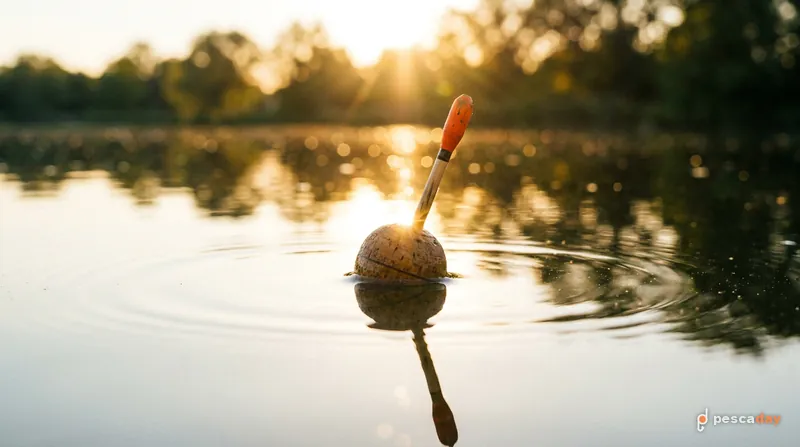
Use the smallest bobber that just floats your bait, otherwise the fish feels resistance and drops it. Set it about 1 to 3 feet deep, or to the depth of the nests.
Bait: worms, crickets and tiny jigs
Worms are the classic bait, but use only a piece of 1 to 2 inches that just covers the hook. Crickets, grasshoppers and mealworms work too.
For lures, tiny 1/64 to 1/32 ounce jigs with marabou or a twister tail are the standard. Tipping the jig with a bit of worm often adds bites, and black or brown are the go-to colors.
- Worm, just a short piece
- Cricket or grasshopper
- Mealworm
- Jig, 1/64 to 1/32 ounce
Technique and hook size
Bluegill rarely chase food, so fish your bait very slowly or almost still. When the bobber dips, set the hook right away.
State agencies recommend hook sizes 10 to 6, ideally long shank and thin wire. That makes it easy to unhook the small mouth, and needle nose pliers help.
- Hook size 10 to 6, long shank
- Line 2 to 6 lb test
- Small bobber, 1 to 3 feet deep
- Fish slowly, set the hook fast
Eating, and sunfish in Europe
Iowa DNR calls bluegill extremely good to eat, and each state sets its own limits. On private ponds you always need the owner's permission.
Europe has the related pumpkinseed, listed since 2019 as an invasive species of EU concern, so keeping, trading, transporting and releasing it is banned. The German management sheet says caught pumpkinseed should be removed, so check the local rule and never move live fish to another water.
Quick answers
What size hook for bluegill?
Missouri and Iowa recommend sizes 10 to 6, ideally long shank and thin wire.
When do bluegill bite best?
In late spring and early summer on the shallow spawning beds. In high summer, mostly morning and evening.
Can I release sunfish in Germany?
The pumpkinseed is on the EU invasive species list, and the management sheet calls for removing caught fish. Ask the local water manager for the rule.
Next
Sources (4)
- mdc.mo.gov/fishing/species/sunfish/sunfish-tips-bluegill-fishing
- iowadnr.gov/things-do/fishing/iowa-fish-species/bluegill
- en.wikipedia.org/wiki/List_of_invasive_alien_species_of_Union_concern
- hlnug.de/fileadmin/dokumente/naturschutz/artenschutz/Neobiota/Sonnenba
Last checked 2026-10-23. Found a mistake? Write to [email protected].
In Germany, closed seasons and minimum sizes are set by each state and can be stricter for single waters. All German rules by state, with the legal source. Outside Germany, the local rules apply: licence and agency by country.
Know more?
Additions, photos of your catches or a mistake in the text: write to us and we will gladly credit you as a helper.
Send a tip