Species
Chinook salmon
The Chinook or king salmon is the largest and most valuable Pacific salmon: a migratory fish between the North Pacific and rivers from California to Alaska, stocked in the Great Lakes since 1967 (English and German Wikipedia).
Oncorhynchus tshawytscha
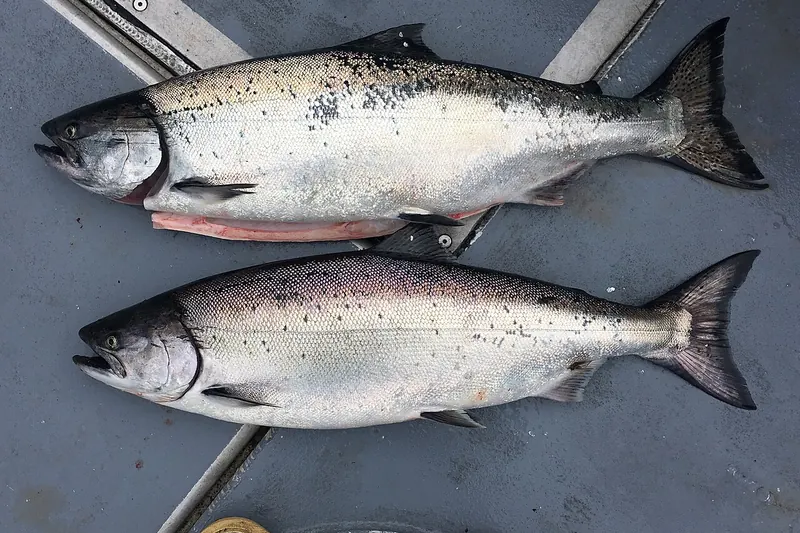
Photo: NickLongrich, Wikimedia Commons, CC BY-SA 4.0, adjusted to 3:2
- Spawning
- On the spawning redds from September to December, in larger and deeper water than other salmon; the female lays her eggs in several nest pockets, guards the redd for 4 to 25 days and then dies, and the eggs hatch after 90 to 150 days (Wikipedia). According to FishBase the migration from the sea begins as early as December, so the first fish are near river mouths by spring; fish migrate up to 4,827 km upstream (FishBase), in the Yukon over 3,000 km (Wikipedia). Usually mature at 4 to 6 years (German Wikipedia).
- Typical method
- Trolling with downriggers at sea and in the Great Lakes
- Top bait
- Herring (whole or cut plug)
How to recognise it
- At sea blue-green to blue-black back, silvery sides, small black spots on the back and on both lobes of the tail (FishBase)
- Black gum line on the lower jaw, in salt and fresh water (FishBase, Wikipedia)
- In fresh water at spawning time olive brown, red or purple, males with a hooked jaw (kype) (FishBase, Wikipedia)
Easily confused with: Coho salmon: spots only on the upper tail lobe and a light gum line on the lower jaw (FishBase). Pink salmon: also has a spotted tail, but no silver on it; only the Chinook combines black spots and silver on the tail (Wikipedia). Atlantic salmon: lives in the Atlantic, but stocked Great Lakes Chinook share some waters with stocked Atlantic salmon (rule of thumb).
How to catch it
Methods: Trolling with downriggers at sea and in the Great Lakes, Drift fishing roe and baits in rivers, Casting spoons and spinners at river mouths and in pools, Mooching: drifting herring bait in coastal water (rule of thumb)
Baits: Herring (whole or cut plug), Salmon roe, Large spinner, Spoon, Plug behind a flasher
Depends on the run of each river: there are spring, summer and fall runs (rule of thumb). Fish are on the spawning grounds from September to December (Wikipedia); at sea and in the Great Lakes trolling goes on through much of the year, check dates with the agency.
Habitat and food
North Pacific and Arctic with tributaries from Point Hope, Alaska to the San Joaquin River in California, plus Honshu in Japan, the Sea of Japan, Bering Sea and Sea of Okhotsk; anadromous, at sea 0 to 375 m deep at 0 to 25 °C (FishBase). On the Asian side from Hokkaido to the Palyavaam River in northeast Siberia, well documented mainly on Kamchatka (Wikipedia). Introduced to the Great Lakes (since 1967, sustained mainly by annual stocking), Patagonia and New Zealand, where spawning runs established in rivers of Canterbury and North Otago (Wikipedia).
Young fish in rivers eat mainly terrestrial insects, amphipods and small crustaceans; at sea mainly fish, plus crustaceans and other invertebrates (FishBase, Wikipedia). German Wikipedia lists sprat, mackerel and herring for adults.
Size and age
FishBase: max. 150 cm, commonly 70 cm, maximum published weight 61.4 kg, maximum age 9 years, mature at about 82 cm. Adults typically 60 to 90 cm (24 to 36 in) and 4.5 to 22.7 kg (10 to 50 lb), up to 59 kg (130 lb) (Wikipedia); German Wikipedia gives up to 150 cm and 36 kg for males and 120 cm and 20 kg for females. Sport-caught record according to Wikipedia: 44.1 kg (97 1/4 lb) from the Kenai River, Alaska, 1985; commercial record 57 kg (126 lb) near Rivers Inlet, British Columbia. Fish over 14 kg (30 lb) are called tyee (Wikipedia).
Protection and rules
In the USA, each state sets its own size limits, bag limits and seasons. Pescaday does not list these rules yet: check them with the fish and wildlife agency of the state you fish in. Fishing licence USA: agency by state
In Germany we found no minimum size or closed season for this species in any state fisheries regulation.
In the kitchen
A highly valued food fish rich in omega-3 fatty acids; the flesh is usually red, sometimes white, and red meat commands a higher price (FishBase, Wikipedia). Marketed fresh, smoked, frozen and canned (FishBase).
Sources (5)
Know more?
Additions, photos of your catches or a mistake in the text: write to us and we will gladly credit you as a helper.
Send a tip