Species
Coho salmon
The coho or silver salmon is one of the most popular sport fish in the Pacific Northwest and Canada: an acrobatic Pacific salmon that often hunts in shallow coastal water and is also stocked in the Great Lakes (English and German Wikipedia).
Oncorhynchus kisutch
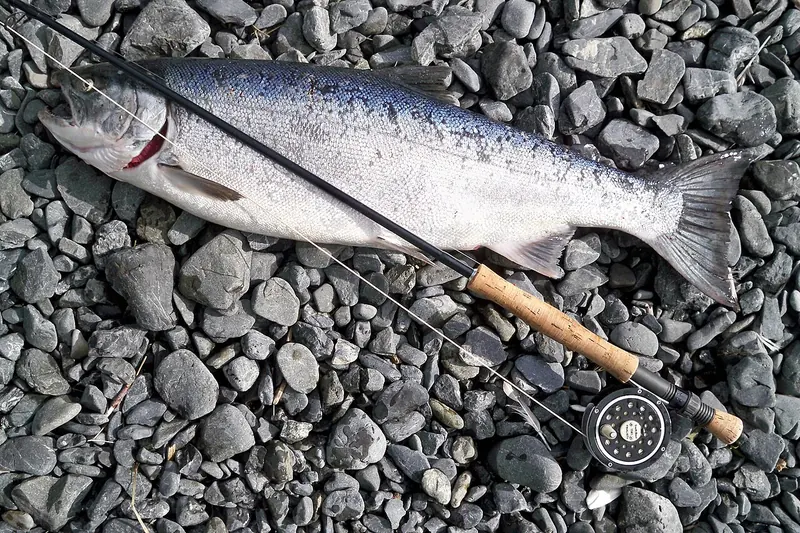
Photo: Yeckele, Wikimedia Commons, CC BY-SA 4.0, adjusted to 3:2
- Spawning
- At three or four years the fish run upstream to spawn, sometimes into water only 5 cm deep; the female digs up to seven redds in gravel, after which the adults die (Wikipedia). In the south of the range fish enter fresh water in December and January, progressively earlier to the north; they wait at river mouths for rising water after rain (FishBase). Eggs hatch after six to seven weeks in late winter or early spring (Wikipedia).
- Typical method
- Trolling along the coast and in the Great Lakes
- Top bait
- Spinner
How to recognise it
- At sea dark blue or greenish back, silver sides, small black spots on the back and only on the upper lobe of the tail (FishBase, Wikipedia)
- Lower jaw gum line without dark pigment, light (FishBase, Wikipedia)
- At spawning bright red sides, blue-green head and back, males with a hooked jaw (Wikipedia)
Easily confused with: Chinook salmon: black gum line and spots on both tail lobes (FishBase). Sockeye salmon: at sea without clear spots on back and tail, at spawning red body with green head (FishBase). Steelhead and rainbow trout: more densely spotted tail and pink lateral band (rule of thumb).
How to catch it
Methods: Trolling along the coast and in the Great Lakes, Casting from beaches and banks when schools feed in shallow water (Wikipedia), Fly fishing in salt water and rivers (Wikipedia), Drifting roe or a spinner in rivers (rule of thumb)
Baits: Spinner, Spoon, Herring strip, Salmon roe, Streamer (fly)
In North America a game fish in fresh and salt water from July to December (Wikipedia). In rivers fish move upstream on rising water after rain (FishBase).
Habitat and food
North Pacific from the Anadyr River in Russia to Hokkaido and from Point Hope, Alaska to Baja California, Mexico; anadromous, at sea 0 to 250 m deep at 0 to 25 °C (FishBase). Wikipedia gives Monterey Bay, California as the natural southern limit. Introduced to all the Great Lakes (large-scale stocking from 1966 in Lake Michigan, present in all Great Lakes by 1970) and many reservoirs in the US; natural reproduction there is mostly low (Wikipedia). German Wikipedia also mentions an introduction in northern France.
In fresh water plankton, midge larvae and terrestrial insects that fall into the water, at sea plankton and increasingly fish (Wikipedia), plus jellyfish and squid (FishBase). In the Great Lakes mainly alewife and smelt (Wikipedia).
Size and age
FishBase: max. 108 cm, females 65.5 cm, commonly 71 cm (females 59.5 cm), maximum published weight 15.2 kg, maximum age 5 years. Average 20 to 28 in (50.8 to 71 cm) and 7 to 11 lb (3.2 to 5.0 kg), occasionally up to 36 lb (16 kg) (Wikipedia); German Wikipedia gives up to 100 cm and 10 kg. Precocious males (jacks) return after only two years (English and German Wikipedia).
Protection and rules
In the USA, each state sets its own size limits, bag limits and seasons. Pescaday does not list these rules yet: check them with the fish and wildlife agency of the state you fish in. Fishing licence USA: agency by state
In Germany we found no minimum size or closed season for this species in any state fisheries regulation.
In the kitchen
A popular food fish (German Wikipedia), traded fresh, dried, salted, smoked, canned and frozen (FishBase). German Wikipedia states that practically all wild stocks are overfished and coho is farmed; NOAA Fisheries, by contrast, describes US wild-caught coho as sustainably managed.
Sources (5)
Know more?
Additions, photos of your catches or a mistake in the text: write to us and we will gladly credit you as a helper.
Send a tip