Comparison
Northern pike vs muskellunge: how to tell them apart
How to tell Northern pike from muskellunge, with features, size, habitat and baits side by side.
Choose a page
The quick difference
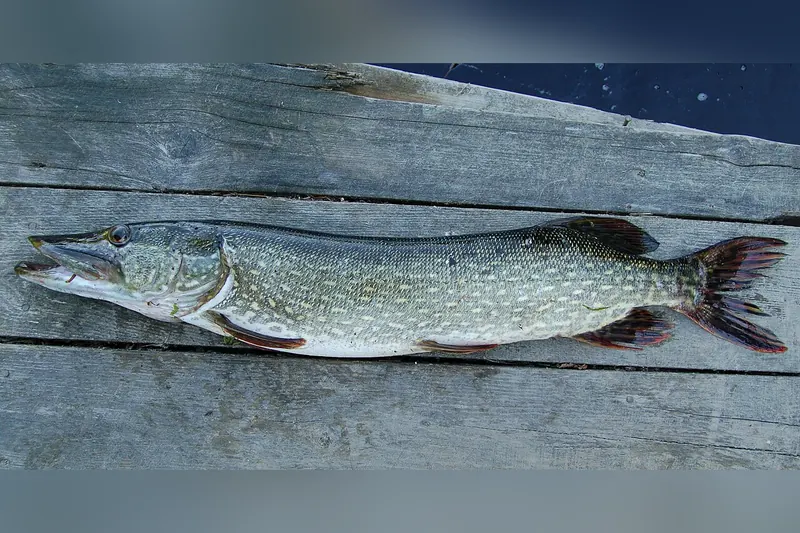
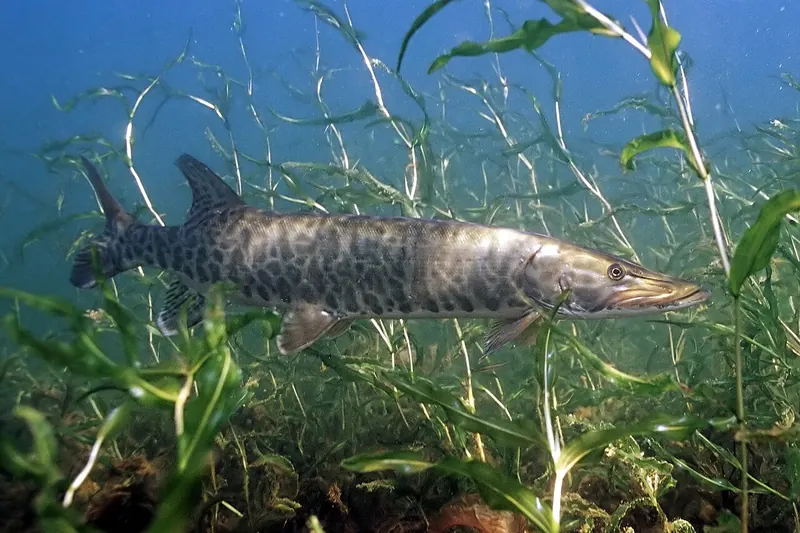
Muskellunge: Northern pike: dark body with light spots, while the muskie shows the reverse, a light body with dark markings; pike have rounded tail lobes and never more than six pores per side under the jaw (Wikipedia). German Wikipedia gives 5 to 10, mostly 6 to 9 jaw pores for the muskie, so the pore count is only a guide. Tiger muskie: sterile muskie and pike hybrid with many thin, broken bars (German Wikipedia).
Side by side
How to recognise it
Northern pike
- Long, cylindrical body with a flat, duck-bill mouth
- Dorsal and anal fins sit far back, close to the tail fin
- Green-brown back with pale spots, light to white belly
muskellunge
- Long pike-shaped body, light silver, brown or green base color with dark vertical bars or spots, sometimes unmarked (Wikipedia)
- Pointed tail lobes, cheeks and gill covers scaled only on the upper half (English and German Wikipedia)
- Dorsal and anal fins set far back; seven or more sensory pores on each side of the underside of the lower jaw (Wikipedia)
Size and age
Northern pikeup to 150 cm · 28.4 kg · 30 years
muskellungeup to 183 cm · 31.8 kg · 30 years
Habitat
Northern pikeA resident fish of lakes, ponds and calm river stretches, often close to the bank near reeds and plants. Some pike hunt in the open water of large lakes, and it also lives in brackish water.
muskellungeNative to the St. Lawrence and Great Lakes, the Red River (Hudson Bay basin) and the Mississippi basin, stocked elsewhere in the US (FishBase). It ranges south to the Tennessee River valley near Chattanooga and was introduced to the Saint John River in Maine in the late 1960s (Wikipedia). Lives in clear, vegetated lakes, quiet pools and backwaters of small to large rivers (FishBase) and prefers shallow, cool water with plenty of cover (German Wikipedia). In summer one fish uses two home ranges, a small shallow one and a larger deep one (Wikipedia).
Spawning
Northern pikeMarch to May (general guide, varies with water temperature and region)
muskellungeMid to late spring, somewhat later than northern pike, over shallow vegetated areas with rock or sand bottom; spawning lasts 5 to 10 days, mostly at night, the adults abandon the eggs and the larvae hatch within two weeks (Wikipedia). German Wikipedia gives mostly early May and 60,000 to 100,000 eggs per female, FishBase spring as the ice melts.
Methods
Northern pikeLure fishing (spinning), Static fishing with a dead bait fish, Fly fishing with streamers
muskellungeCasting large lures along weed edges and rock bars, Trolling large crankbaits, Fly fishing with large streamers (rule of thumb), Figure-eight the lure at the boat before lifting it out, because muskies often follow to the boat (rule of thumb)
Baits
Northern pikeSoft plastic shad, Spoon, Plug (crankbait), Dead bait fish
muskellungeLarge bucktail spinner, Jerkbait, Large soft swimbait, Topwater lure, Large streamer (fly)
On the table
Northern pikeLean, rather dry flesh with Y-bones along the back that can be removed in an orderly way.
muskellungeEdible but of little culinary importance; most anglers release it.
Conservation status
Northern pikeGerman Red List (freshwater fish 2023): not threatened. IUCN: not threatened (Least Concern, 2022).
muskellungeIUCN: Least Concern (2011; FishBase). Native populations are protected in parts of Tennessee and Ohio (FishBase); low reproduction and slow growth make populations vulnerable to overfishing (Wikipedia). Licence, minimum size and limits are set by each state or Canadian province. Example Minnesota: statewide minimum length of 54 inches since the 2015 season, with exceptions for border waters and waters designated by the DNR (Minnesota DNR news release of 2 June 2014, accessed 21 Oct 2026). In Maine, where it is not native, anglers are encouraged not to release muskies (Wikipedia). Careful when unhooking: large mouth with sharp teeth, use long pliers and a wire leader (rule of thumb).
Next
Sources (7)
- content.govdelivery.com/accounts/MNDNR/bulletins/bb61a7
- de.wikipedia.org/wiki/Hecht
- de.wikipedia.org/wiki/Muskellunge
- en.wikipedia.org/wiki/Muskellunge
- fishbase.de/summary/Esox-masquinongy.html
- fishbase.se/summary/Esox-lucius.html
- rote-liste-zentrum.de/detail/pdf/91207
Last checked 2026-10-23. Found a mistake? Write to [email protected].
Know more?
Additions, photos of your catches or a mistake in the text: write to us and we will gladly credit you as a helper.
Send a tip