Species
Northern pike
A fast ambush predator with a duck-bill mouth that strikes from cover and is one of the most popular predatory fish.
Esox lucius
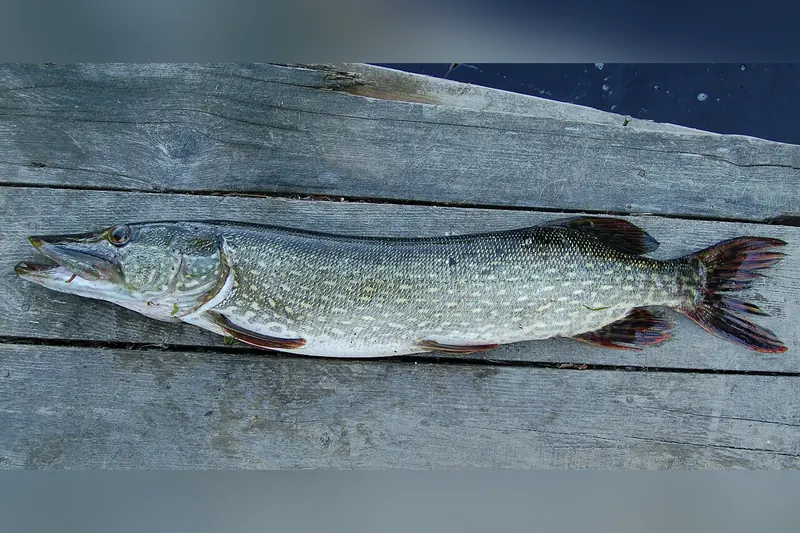
Photo: Arnstein Rønning, Wikimedia Commons, CC BY-SA 4.0, adjusted to 3:2
- Spawning
- March to May (general guide, varies with water temperature and region)
- German Red List
- not threatened
- Typical method
- Lure fishing (spinning)
- Top bait
- Soft plastic shad
How to recognise it
- Long, cylindrical body with a flat, duck-bill mouth
- Dorsal and anal fins sit far back, close to the tail fin
- Green-brown back with pale spots, light to white belly
Easily confused with: Young pike are sometimes mistaken for zander: the pike has just one dorsal fin set far back, the zander has two, the front one spiny.
How to catch it
Methods: Lure fishing (spinning), Static fishing with a dead bait fish, Fly fishing with streamers
Baits: Soft plastic shad, Spoon, Plug (crankbait), Dead bait fish
During the day and at dusk, especially in spring after spawning and in autumn.
Habitat and food
A resident fish of lakes, ponds and calm river stretches, often close to the bank near reeds and plants. Some pike hunt in the open water of large lakes, and it also lives in brackish water.
Eats mainly fish, including its own kind, plus frogs, young waterfowl and small mammals.
Size and age
Older pike usually 60 to 100 cm, in good conditions up to 150 cm and over 20 kg (Wikipedia). FishBase: max. 150 cm (females), heaviest published weight 28.4 kg, maximum age 30 years.
Protection and rules
Northern pike: closed season and minimum size by German state
These rules apply in Germany only. Fishing in the UK, the USA or elsewhere? The local rules apply there (link below).
- Baden-Württembergminimum size 50 cm · closed season 15.02. to 15.05.minimum size 50 cm · closed season 01.02. to 30.04. only in some waters
- Bavariaminimum size 50 cm · closed season 15.02. to 30.04.
- Berlinminimum size 45 cm · closed season 01.01. to 30.04.
- Brandenburgminimum size 45 cm · closed season 01.02. to 31.03.
- Bremenminimum size 60 cm · closed season 01.02. to 15.05.
- Hamburgminimum size 45 cm · closed season 01.02. to 31.05.
- Hessekeep only from 50 to 90 cm · closed season 01.02. to 15.04.
- Mecklenburg-Western Pomeraniaminimum size 45 cmminimum size 60 cm · closed season 01.03. to 30.04. (coast)
- Lower Saxonyminimum size 40 cm · closed season 01.02. to 15.04.minimum size 45 cm (coast)
- North Rhine-Westphaliaminimum size 45 cm · closed season 15.02. to 30.04.
- Rhineland-Palatinateminimum size 50 cm · closed season 01.02. to 31.05.minimum size 50 cm · closed season 01.01. to 14.06. only in some waters
- Saarlandminimum size 50 cm · closed season 15.02. to 31.05.minimum size 50 cm · closed season 01.01. to 14.06. only in some waters
- Saxonyminimum size 50 cm · closed season 01.02. to 30.04.
- Saxony-Anhaltminimum size 50 cm · closed season 15.02. to 30.04.
- Schleswig-Holsteinminimum size 45 cm · closed season 15.02. to 15.04.minimum size 45 cm · closed season 15.02. to 30.04. (coast)
- Thuringiaminimum size 50 cm · closed season 15.02. to 30.04.
From the official state fisheries regulations, retrieved 2026-10-11. All rules by state
In Germany, closed seasons and minimum sizes are set by each state and can be stricter for single waters. All German rules by state, with the legal source. Outside Germany, the local rules apply: licence and agency by country.
In the kitchen
Lean, rather dry flesh, good for dumplings or fillets; watch out for the Y-bones along the back, which you can remove in a neat strip.
Sources (3)
- de.wikipedia.org/wiki/Hecht
- fishbase.se/summary/Esox-lucius.html
- rote-liste-zentrum.de/detail/pdf/91207
Last checked 2026-10-18. Found a mistake? Write to [email protected].
Know more?
Additions, photos of your catches or a mistake in the text: write to us and we will gladly credit you as a helper.
Send a tip