pescaday

Comparison

Blue marlin vs white marlin: how to tell them apart

How to tell Blue marlin from white marlin, with features, size, habitat and baits side by side.
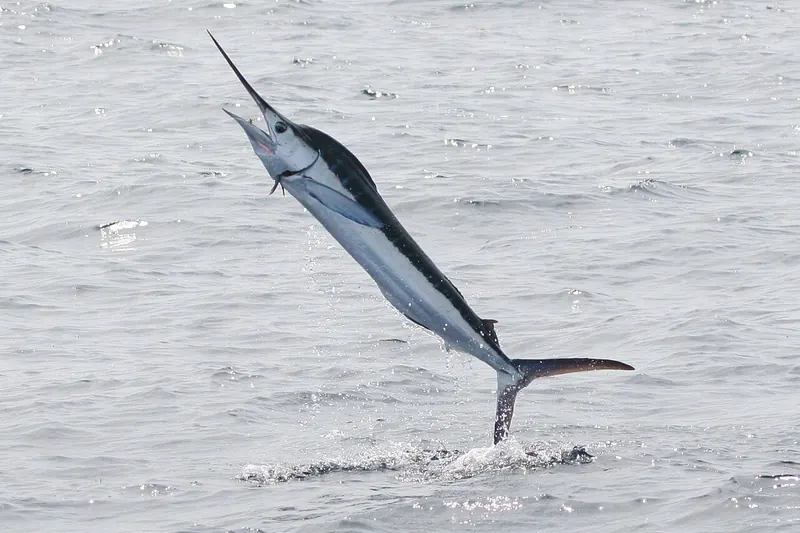
Blue marlin, side view
Blue marlin Makaira nigricans
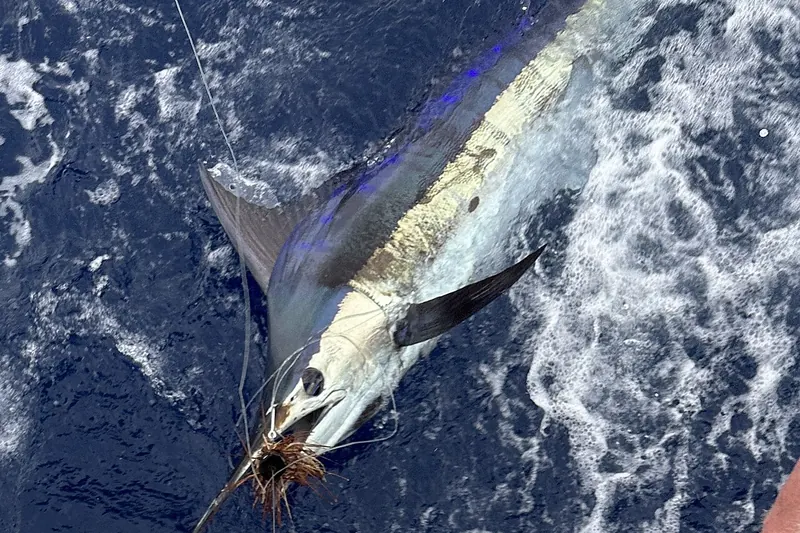
white marlin, side view
white marlin Kajikia albida

The quick difference

Blue marlin: White marlin: smaller, first dorsal fin rounded at the front and spotted black, pectoral fins with rounded tips (Wikipedia, Atlantic white marlin; FishBase). Sailfish: sail-like high dorsal fin. Swordfish: flat bill, no pelvic fins (German Wikipedia). If in doubt, release it, because the minimum size differs by species.

White marlin: Roundscale spearfish (Tetrapturus georgii), only separated genetically in 2001: in the spearfish the anus sits farther from the anal fin (more than half the anal fin length) and the scales are broad and round at the front (Wikipedia). The US minimum size is the same for both (NOAA Fisheries). Blue marlin: larger, first dorsal fin pointed and without spots (German Wikipedia, Blue marlin).

Side by side

How to recognise it

Blue marlin
  • Blue-black back, silvery white belly, about 15 rows of pale cobalt stripes (FishBase)
  • First dorsal fin pointed, lower than the body depth, without spots (German Wikipedia)
  • Long, stout bill, round in cross-section; lateral line forms a net, barely visible in large fish (German Wikipedia, FishBase)
white marlin
  • First dorsal fin tall and rounded at the front, dark blue with black spots (Wikipedia, FishBase)
  • Pectoral fins with rounded, wide tips (English and German Wikipedia)
  • Dark blue back with narrow pale bars, silvery white sides often blotched with brown (German Wikipedia, FishBase)

Size and age

Blue marlinup to 500 cm · 636.0 kg · 20 years
white marlinup to 300 cm · 82.5 kg

Habitat

Blue marlinTropical and temperate Atlantic, oceanic, from the surface down to 1000 m, at 22 to 31 °C (FishBase). Roughly 45° N to 35° S; scarcer in the eastern Atlantic, where it lives mostly off Africa between 25° N and 25° S (Wikipedia). Spends most of its time between the surface and 100 m, mostly near the surface at night; in summer its range expands north with warm currents such as the Gulf Stream (Wikipedia). In the northern Gulf of Mexico it prefers blue water (FishBase). FishBase lists the Indo-Pacific blue marlin (Makaira mazara) as a separate species, while many scientists and German Wikipedia treat it as one worldwide species, so Hawaiian fish count as the same species or not depending on the source.
white marlinAtlantic, roughly 45° N to 45° S in the southwest and 35° S in the southeast; records from the Mediterranean and off Brittany seem to be strays (FishBase). Oceanic, in deep blue water over 100 m, usually above the thermocline, 0 to 150 m, mostly 0 to 100 m, surface temperatures above 22 °C (FishBase). Northern limit roughly Cape Hatteras to the Bay of Biscay; likes fronts between water masses, upwelling zones, drop-offs and submarine canyons (German Wikipedia). Also in the Gulf of Mexico and the Caribbean (Wikipedia).

Spawning

Blue marlinIn the North Atlantic from July to October (German Wikipedia); English Wikipedia says late summer and autumn. A female may spawn up to four times a season, often releasing over seven million eggs of about 1 mm (Wikipedia). Mature at two to four years; larvae off the southern United States, Jamaica, the Bahamas, the Dominican Republic, Puerto Rico and Brazil (Wikipedia).
white marlinMigrates to subtropical waters to spawn, peak in early summer, at 20 to 29 °C (FishBase); German Wikipedia gives 24 to 29 °C. Known spawning grounds: Gulf of Mexico, Mona Passage, southwest of Bermuda and northwest of Grand Bahama; a female lays 190,000 to 586,000 eggs (Wikipedia).

Methods

Blue marlinOffshore trolling with large lures, Trolling rigged dead baitfish, Slow-trolling live bait along edges and floating debris (rule of thumb), Trolling teasers, then switching to a bait (bait and switch, rule of thumb)
white marlinTrolling baitfish and small lures along canyons and edges, Trolling teasers, then switching to a bait (bait and switch, rule of thumb), Natural baits on circle hooks, which are quicker to remove (Wikipedia), Keep the fish in the water to unhook it, which lowers post-release mortality (Wikipedia)

Baits

Blue marlinLarge skirted trolling lure, Rigged ballyhoo, Live small tuna or bonito, Mackerel, Squid
white marlinRigged ballyhoo, Small skirted trolling lure, Squid or squid imitation, Flying fish, Live mackerel (rule of thumb)

On the table

Blue marlinRich flesh, but Texas has issued a mercury consumption warning; usually released.
white marlinThe flesh is rated excellent, but sport anglers almost always release it.

Conservation status

Blue marlinIUCN: Vulnerable (assessed 10 May 2021; FishBase). USA, Atlantic and Gulf: a vessel fishing for marlin needs an HMS Angling permit or HMS Charter/Headboat permit; it covers everyone on board, costs 24 dollars and must be renewed every year (NOAA Fisheries, retrieved 21 Oct 2026). Minimum size 99 inches lower-jaw fork length; no per-angler bag limit, but combined US landings of blue marlin, white marlin and roundscale spearfish are capped at 250 fish a year; no billfish may be kept if a hammerhead or oceanic whitetip shark is on board (NOAA Fisheries, page updated 4 Aug 2025). Every angler also needs a state saltwater licence or registration, except in Hawaii, Puerto Rico and the US Virgin Islands (NOAA Fisheries). Pacific and other countries: separate rules, check with your operator and the authority before the trip.
white marlinIUCN: Least Concern (assessed 1 May 2021; FishBase); Wikipedia describes a steep decline from bycatch. USA, Atlantic and Gulf: HMS Angling permit or HMS Charter/Headboat permit for the vessel (NOAA Fisheries, retrieved 21 Oct 2026). Minimum size 66 inches lower-jaw fork length, the same for roundscale spearfish; no per-angler bag limit, but no more than 250 blue marlin, white marlin and roundscale spearfish combined may be landed per year in the whole US; none may be kept if a hammerhead or oceanic whitetip shark is on board (NOAA Fisheries, page updated 4 Aug 2025). According to Wikipedia, US federal rules require billfish that are released to stay in the water boatside; check the official text in the HMS Compliance Guide. A state saltwater licence is also required (NOAA Fisheries).

Next

Sources (9)

Last checked 2026-10-23. Found a mistake? Write to [email protected].

Know more?

Additions, photos of your catches or a mistake in the text: write to us and we will gladly credit you as a helper.

Send a tip