Species
Blue marlin
Blue marlin, the largest marlin of the Atlantic and the number one big game target: a loner of open blue water that fights long and jumps spectacularly.
Makaira nigricans
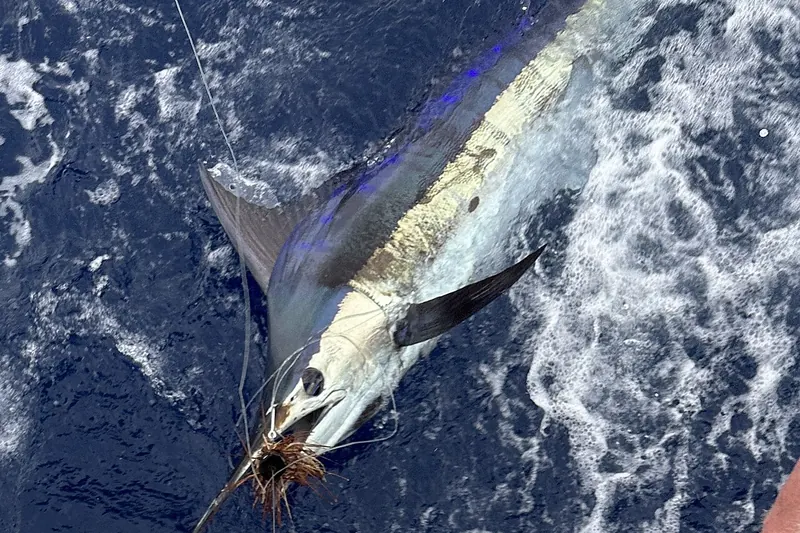
Photo: quokka2, Wikimedia Commons, CC BY 4.0, adjusted to 3:2
- Spawning
- In the North Atlantic from July to October (German Wikipedia); English Wikipedia says late summer and autumn. A female may spawn up to four times a season, often releasing over seven million eggs of about 1 mm (Wikipedia). Mature at two to four years; larvae off the southern United States, Jamaica, the Bahamas, the Dominican Republic, Puerto Rico and Brazil (Wikipedia).
- Typical method
- Offshore trolling with large lures
- Top bait
- Large skirted trolling lure
How to recognise it
- Blue-black back, silvery white belly, about 15 rows of pale cobalt stripes (FishBase)
- First dorsal fin pointed, lower than the body depth, without spots (German Wikipedia)
- Long, stout bill, round in cross-section; lateral line forms a net, barely visible in large fish (German Wikipedia, FishBase)
Easily confused with: White marlin: smaller, first dorsal fin rounded at the front and spotted black, pectoral fins with rounded tips (Wikipedia, Atlantic white marlin; FishBase). Sailfish: sail-like high dorsal fin. Swordfish: flat bill, no pelvic fins (German Wikipedia). If in doubt, release it, because the minimum size differs by species.
How to catch it
Methods: Offshore trolling with large lures, Trolling rigged dead baitfish, Slow-trolling live bait along edges and floating debris (rule of thumb), Trolling teasers, then switching to a bait (bait and switch, rule of thumb)
Baits: Large skirted trolling lure, Rigged ballyhoo, Live small tuna or bonito, Mackerel, Squid
In the western Atlantic most fish stay between 10° and 35° N from June to October (German Wikipedia), which is the main season for the US East Coast and the Gulf. In the northern Gulf of Mexico anglers catch most blue marlin when white marlin are scarce, and vice versa (German Wikipedia). It feeds by day (FishBase), preferably in the morning (German Wikipedia).
Habitat and food
Tropical and temperate Atlantic, oceanic, from the surface down to 1000 m, at 22 to 31 °C (FishBase). Roughly 45° N to 35° S; scarcer in the eastern Atlantic, where it lives mostly off Africa between 25° N and 25° S (Wikipedia). Spends most of its time between the surface and 100 m, mostly near the surface at night; in summer its range expands north with warm currents such as the Gulf Stream (Wikipedia). In the northern Gulf of Mexico it prefers blue water (FishBase). FishBase lists the Indo-Pacific blue marlin (Makaira mazara) as a separate species, while many scientists and German Wikipedia treat it as one worldwide species, so Hawaiian fish count as the same species or not depending on the source.
Mainly fish, plus octopus and squid, feeding by day (FishBase). Smaller tunas such as frigate mackerel, bullet tuna and skipjack are common prey; it also takes white marlin and tunas of around 45 kg, 100 lb (Wikipedia). In a Japanese study 130 of 227 prey items showed injuries from the bill (Wikipedia).
Size and age
FishBase: max. 500 cm, commonly around 290 cm, maximum published weight 636 kg, maximum age 20 years (carbon-14 dating). Wikipedia gives a maximum published weight of 818 kg and ages of 18 years for males and up to 27 for females, which contradicts FishBase. Females grow up to four times heavier than males, which rarely exceed 160 kg (Wikipedia). IGFA all-tackle record according to Wikipedia: 636 kg (1,402 lb 2 oz) from Vitória, Brazil; German Wikipedia still gives an older figure of 581.51 kg.
Protection and rules
In the USA, each state sets its own size limits, bag limits and seasons. Pescaday does not list these rules yet: check them with the fish and wildlife agency of the state you fish in. Fishing licence USA: agency by state
In Germany we found no minimum size or closed season for this species in any state fisheries regulation.
In the kitchen
The meat is rich in fat and valued for sashimi in Japan, sometimes sold smoked (Wikipedia); German Wikipedia calls it excellent. In 2017 Texas Parks and Wildlife issued a mercury consumption advisory for all blue marlin caught off Texas (Wikipedia). In sport fishing marlin are usually released (rule of thumb).
Sources (8)
- fishbase.se/summary/Makaira-nigricans.html
- en.wikipedia.org/wiki/Atlantic_blue_marlin
- de.wikipedia.org/wiki/Blauer_Marlin
- en.wikipedia.org/wiki/Atlantic_white_marlin
- fishbase.se/summary/Kajikia-albida.html
- fisheries.noaa.gov/permit/atlantic-highly-migratory-species-angling-pe
- fisheries.noaa.gov/atlantic-highly-migratory-species/recreational-atla
- fisheries.noaa.gov/southeast/rules-regulations/fishing-regulations-and
Last checked 2026-10-22. Found a mistake? Write to [email protected].
Know more?
Additions, photos of your catches or a mistake in the text: write to us and we will gladly credit you as a helper.
Send a tip