Comparison
Crucian carp vs Prussian carp: how to tell them apart
How to tell Crucian carp from Prussian carp, with features, size, habitat and baits side by side.
The quick difference
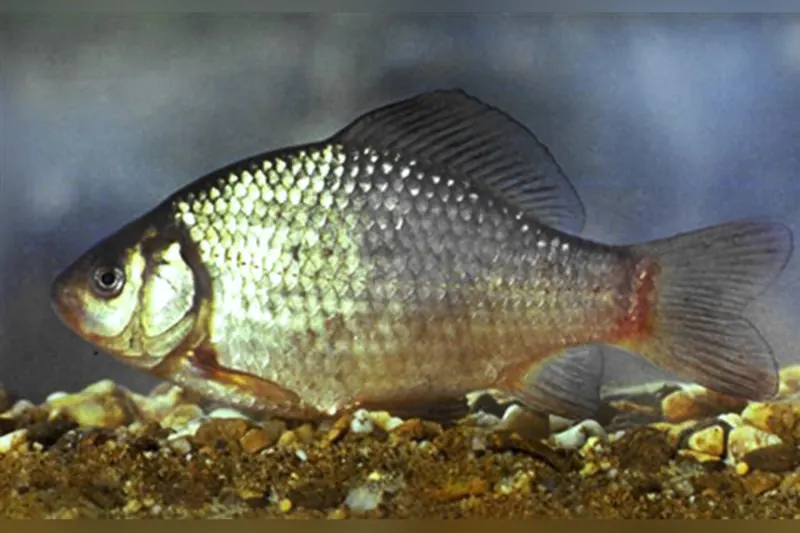
Crucian carp: Easily confused with the Prussian carp: the crucian carp has an outward-curved dorsal fin and usually 32 to 34 scales along the lateral line, the Prussian carp a straight or concave dorsal fin; in the Prussian carp the lining of the body cavity is almost black. The lack of barbels sets it apart from the common carp.
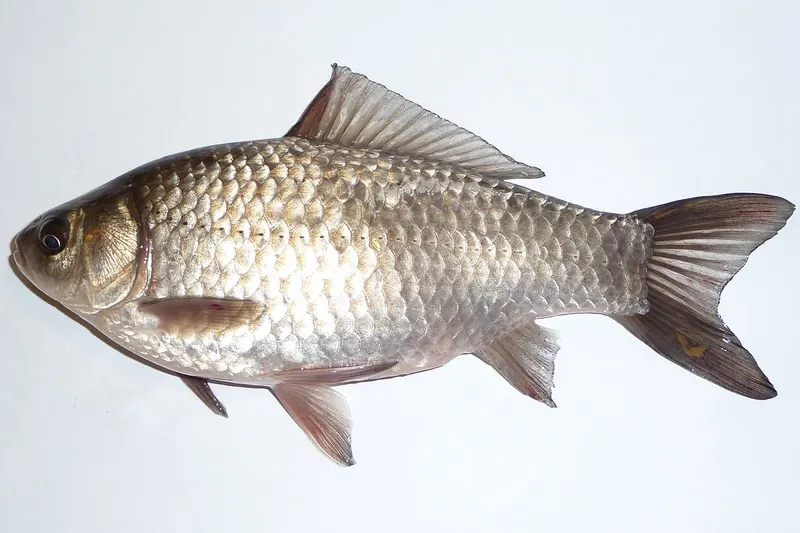
Prussian carp: Very similar to the crucian carp: the Prussian carp has a straight or concave dorsal fin, 27 to 33 scales along the lateral line and a dark body cavity lining, the crucian carp a convex dorsal fin and a pale lining. The lack of barbels sets it apart from the common carp.
Side by side
How to recognise it
- Deep, carp-like body without barbels
- Dorsal fin curved outwards (convex), tail fin only slightly notched
- Brownish back with a greenish sheen, fins often slightly reddish
- Deep body without barbels and with a silvery grey-green sheen
- Dorsal fin straight or slightly curved inwards (concave)
- Lining of the body cavity almost black (visible when gutting)
Size and age
Habitat
Spawning
Methods
Baits
On the table
Conservation status
Next
Sources (7)
- de.wikipedia.org/wiki/Giebel_(Fisch)
- de.wikipedia.org/wiki/Karausche
- en.wikipedia.org/wiki/Crucian_carp
- fishbase.se/summary/Carassius-carassius.html
- fishbase.se/summary/Carassius-gibelio.html
- rote-liste-zentrum.de/detail/pdf/91170
- rote-liste-zentrum.de/detail/pdf/91172
Last checked 2026-10-23. Found a mistake? Write to [email protected].
Know more?
Additions, photos of your catches or a mistake in the text: write to us and we will gladly credit you as a helper.
Send a tip