Species
Tusk
A sturdy member of the cod order with a single long dorsal fin that lives over deep rocky and gravel ground and takes baits when boat fishing in Norway. In North America it is called cusk.
Brosme brosme
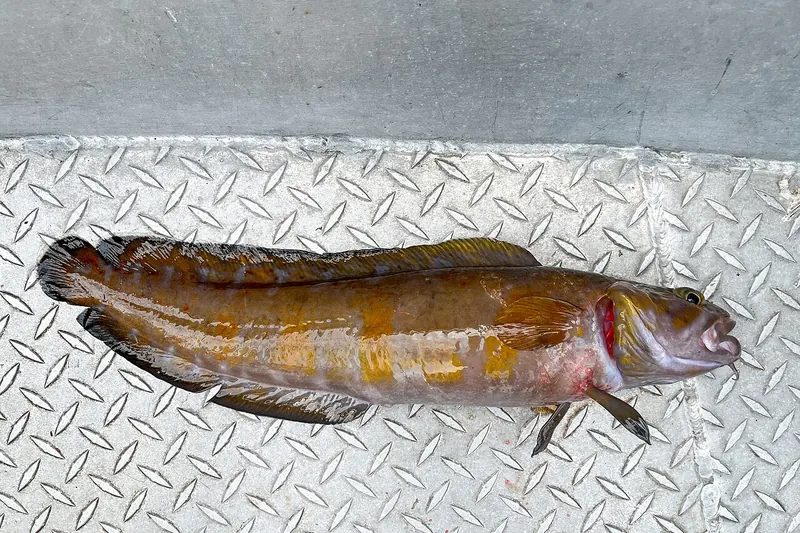
Photo: Mikael Nyman, Wikimedia Commons, CC BY 4.0, adjusted to 3:2
- Spawning
- At about 100 to 200 m depth; the sources give no months
- Typical method
- Bottom fishing with natural bait from a boat
- Top bait
- Fish strip
How to recognise it
- One barbel on the lower jaw, upper jaw slightly protruding
- Only one long dorsal fin that reaches the tail fin, as does the anal fin
- Unpaired fins with a black edge and white rim, body brown to grey
Easily confused with: The ling is slimmer and has two dorsal fins. The tusk has a single continuous dorsal fin with a black and white edge (German Wikipedia).
How to catch it
Methods: Bottom fishing with natural bait from a boat, Pirk fishing over rocky ground, Natural bait on a paternoster rig
Baits: Fish strip, Mackerel fillet, Pirk, Soft lure on the bottom
When boat fishing over deep rocky, gravel or stony ground, in the northeast Atlantic mostly at 150 to 450 m (German Wikipedia). The tusk hardly migrates and mainly changes depth.
Habitat and food
North Atlantic from Iceland via the northern North Sea and the Scandinavian coast to Spitsbergen and Murmansk, in the west from New Jersey to Newfoundland (Wikipedia, FishBase). On the bottom at 20 to 1,000 m, in the northeast Atlantic mostly 150 to 450 m, at 0 to 10 °C; prefers rock, gravel and steep slopes, avoids soft sand and shallow coastal water (German Wikipedia).
Mainly crustaceans and molluscs, plus bottom fish (German Wikipedia); FishBase lists crustaceans, shellfish, flatfish, gurnards and starfish.
Size and age
Up to 110 cm, in the east Atlantic mostly 60 to 95 cm; mature at 8 to 10 years and 40 to 50 cm, maximum age about 20 years (German Wikipedia). FishBase: max. 120 cm, common 50 cm, heaviest published weight 30.0 kg, maximum age 20 years.
Fishing tips and destinations
Protection and rules
We found no minimum size or closed season for this species in any state fisheries regulation. Local water rules may still apply.
In Germany, closed seasons and minimum sizes are set by each state and can be stricter for single waters. All German rules by state, with the legal source. Outside Germany, the local rules apply: licence and agency by country.
In the kitchen
Firm white flesh with a mild taste that German Wikipedia compares to lobster; mostly sold as fillets, in Scandinavia also dried as stockfish. FishBase: sold fresh, frozen or dried and salted.
Sources (3)
Last checked 2026-10-20. Found a mistake? Write to [email protected].
Know more?
Additions, photos of your catches or a mistake in the text: write to us and we will gladly credit you as a helper.
Send a tip