Species
Tope
A slender grey shark with a long, pointed snout, called school shark or soupfin shark elsewhere. Critically endangered worldwide: catch and release only.
Galeorhinus galeus
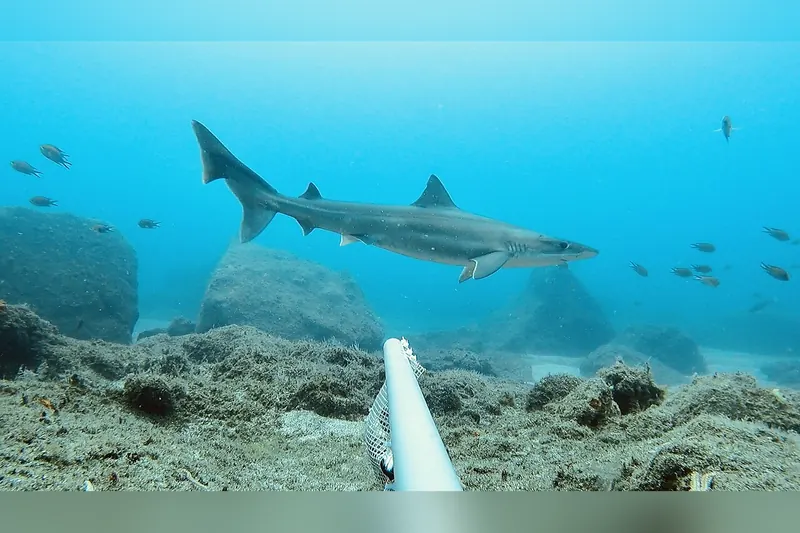
Photo: AshlieJMcivor, Wikimedia Commons, CC BY-SA 4.0, adjusted to 3:2
- Spawning
- Live-bearing (ovoviviparous): gestation about 12 months, 6 to 52 pups per litter (FishBase), on average about 28 to 38 (English Wikipedia), 30 to 36 cm at birth (FishBase). Females give birth in sheltered bays and estuaries, where the young stay in nursery areas (English Wikipedia). Mature at 8 to 13 years (males) and 11 to 18 years (females) (English Wikipedia).
- Typical method
- Boat fishing on the bottom with a whole baitfish or a large fish strip (rule of thumb)
- Top bait
- Whole or half mackerel
How to recognise it
- Slender grey shark body with a long, pointed snout and a large crescent-shaped mouth, white belly
- Second dorsal fin about as large as the anal fin and set right above it; no spines in front of the dorsal fins
- Terminal lobe of the tail notched and as long as the rest of the fin; juveniles with black marks on the fins
Easily confused with: The spurdog has a spine in front of each dorsal fin, white spots and no anal fin (English Wikipedia, spiny dogfish). Smooth-hounds (Mustelus) are similar in shape but have flat, pavement-like teeth instead of small blade-like teeth (rule of thumb). Note: the German name "Hundshai" is regionally also used for the spurdog (GBIF).
How to catch it
Methods: Boat fishing on the bottom with a whole baitfish or a large fish strip (rule of thumb), Drifting over sandbanks and channels (rule of thumb), Long, abrasion-resistant leader because of the rough skin (rule of thumb), Unhook in the water or briefly on a wet mat and release quickly (rule of thumb)
Baits: Whole or half mackerel, Herring, Squid, Large fish strip, Whole baitfish
Tope travel far: fish tagged in the UK have been recaptured at the Azores, the Canaries and off Iceland (English Wikipedia). At higher latitudes small schools are highly migratory (FishBase); in the northeast Atlantic mainly inshore in the warmer months (rule of thumb).
Habitat and food
Worldwide in cold to warm temperate seas (FishBase); uncommon in the northeast Atlantic and Mediterranean, also in the southwest Atlantic from Patagonia to southern Brazil, off Namibia and South Africa, in the northeast Pacific from British Columbia to Baja California, off Chile and Peru, southern Australia and New Zealand, at 10 to 20 °C (English Wikipedia). Lives mainly near the bottom on the shelf and upper slope, from 0 to 1,100 m, usually 2 to 471 m (FishBase); German Wikipedia gives down to 550 m, English Wikipedia about 800 m. Also in the open ocean.
Mainly fish, both bottom and midwater species, plus crustaceans, cephalopods, worms and echinoderms (FishBase, German Wikipedia). Takes whatever is most abundant; off California mainly sardines, flatfish, rockfish and squid (English Wikipedia).
Size and age
FishBase: max. 193 cm (total length) in males, 195.0 cm in females, common 160 cm, maximum published weight 44.7 kg, maximum age 55 years. German Wikipedia gives about two metres for adults; mature males measure 135 to 175 cm, females 150 to 195 cm (English Wikipedia).
Protection and rules
We found no minimum size or closed season for this species in any state fisheries regulation. Local water rules may still apply.
In Germany, closed seasons and minimum sizes are set by each state and can be stricter for single waters. All German rules by state, with the legal source. Outside Germany, the local rules apply: licence and agency by country.
In the kitchen
Not recommended: according to German Wikipedia the meat carries high levels of pollutants and heavy metals. Traditionally eaten in Andalusia (cazón) and Greece (galéos) (English Wikipedia). Release it because of its status.
Sources (7)
- fishbase.de/summary/Galeorhinus-galeus.html
- en.wikipedia.org/wiki/School_shark
- de.wikipedia.org/wiki/Hundshai
- eur-lex.europa.eu/legal-content/DE/TXT/?uri=CELEX:32026R0249
- gesetze-rechtsprechung.sh.juris.de/perma?d=jlr-NNLSH00002ADBNN00000000
- api.gbif.org/v1/species/2418259/vernacularNames
- api.gbif.org/v1/species/5216368/vernacularNames
Last checked 2026-10-22. Found a mistake? Write to [email protected].
Know more?
Additions, photos of your catches or a mistake in the text: write to us and we will gladly credit you as a helper.
Send a tip