Species
Shorthorn sculpin
A bulky bottom fish with a large spiny head and a huge mouth, also called bull-rout or father-lasher. A common catch around rocks, piers and harbour walls in the North Sea and Baltic, not venomous but spiny.
Myoxocephalus scorpius
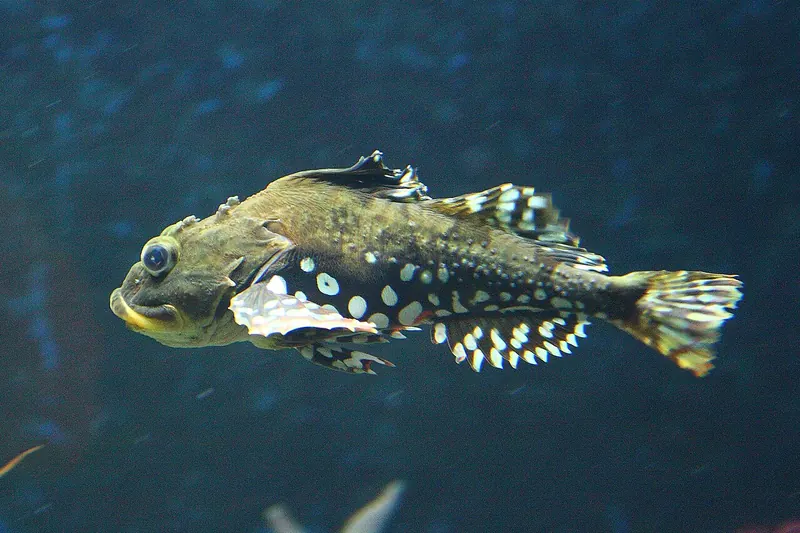
Photo: Cephas, Wikimedia Commons, CC BY-SA 3.0, adjusted to 3:2
- Spawning
- In winter, December to March according to English Wikipedia. About 2,500 eggs are laid in a clump between stones and guarded by the male; larvae hatch after about 5 weeks (German and English Wikipedia, FishBase). Mature at 2 years (German Wikipedia); FishBase gives 17.8 cm as mean length at first maturity (range 15 to 30 cm).
- Typical method
- Bottom fishing from piers, harbour walls and rock armour (rule of thumb)
- Top bait
- Ragworm
How to recognise it
- Large, broad, spiny head with a very large mouth, body tapering towards the tail
- Greenish brown to grey with dark blotches, often milky white spots above the pectoral fins; fins with dark bands (FishBase)
- Belly cherry red in males and light orange in females, both with white spots; preopercle spiny, the longest spine not reaching the edge of the gill cover (FishBase, German Wikipedia)
Easily confused with: The long-spined sea scorpion (Taurulus bubalis) is smaller and has a longer preopercular spine that reaches the edge of the gill cover (rule of thumb; distinguishing feature after German Wikipedia). The shorthorn sculpin itself is not venomous but can be mistaken for venomous scorpionfish (English Wikipedia).
How to catch it
Methods: Bottom fishing from piers, harbour walls and rock armour (rule of thumb), Light bottom rig close to rocks and weed (rule of thumb), Night fishing, as it is mostly nocturnal (German Wikipedia), Unhook carefully and mind the gill cover spines (rule of thumb)
Baits: Ragworm, Lugworm, Fish strip, Shrimp, Crab
In the cold season, as the shorthorn sculpin tolerates cold well and spawns inshore in winter (English and German Wikipedia); preferably at night (German Wikipedia).
Habitat and food
North Atlantic and Arctic: from southeast Greenland, Jan Mayen and Iceland via the British Isles to the Bay of Biscay, the North Sea, Baltic, Spitsbergen and the southern Barents Sea with the White Sea; in the west from James Bay to New York (FishBase). Lives on rock with sand or mud and among seaweed, from 0 to 451 m (FishBase, English Wikipedia); German Wikipedia gives down to 200 m. Also occurs in the brackish Baltic and survives temperatures around freezing thanks to antifreeze proteins (English Wikipedia).
Fish, larger crustaceans, occasionally bristle worms and amphipods (FishBase, German Wikipedia). A mostly nocturnal predator (German Wikipedia).
Size and age
FishBase: max. 78.0 cm (total length), common 24.0 cm (standard length), maximum age 18 years. German and English Wikipedia give up to 60 cm, the largest fish in the Arctic and subarctic (English Wikipedia). The sources differ on maximum length.
Protection and rules
We found no minimum size or closed season for this species in any state fisheries regulation. Local water rules may still apply.
In Germany, closed seasons and minimum sizes are set by each state and can be stricter for single waters. All German rules by state, with the legal source. Outside Germany, the local rules apply: licence and agency by country.
In the kitchen
Hardly used as food; none of the three sources describes a preparation (FishBase only lists fishery use). With its spines and big head there is little fillet; it is usually released (rule of thumb).
Sources (5)
- fishbase.de/summary/Myoxocephalus-scorpius.html
- en.wikipedia.org/wiki/Myoxocephalus_scorpius
- de.wikipedia.org/wiki/Seeskorpion
- gesetze-rechtsprechung.sh.juris.de/perma?d=jlr-NNLSH00002ADBNN00000000
- landesrecht-mv.de/bsmv/document/jlr-NNLMV000075CFNN00000000090
Last checked 2026-10-22. Found a mistake? Write to [email protected].
Know more?
Additions, photos of your catches or a mistake in the text: write to us and we will gladly credit you as a helper.
Send a tip