Species
Pouting
A small, deep-bodied member of the cod family with dark bars and a long chin barbel, also called bib. A frequent biter around wrecks, piers and rocks, especially in the southern North Sea and the English Channel.
Trisopterus luscus
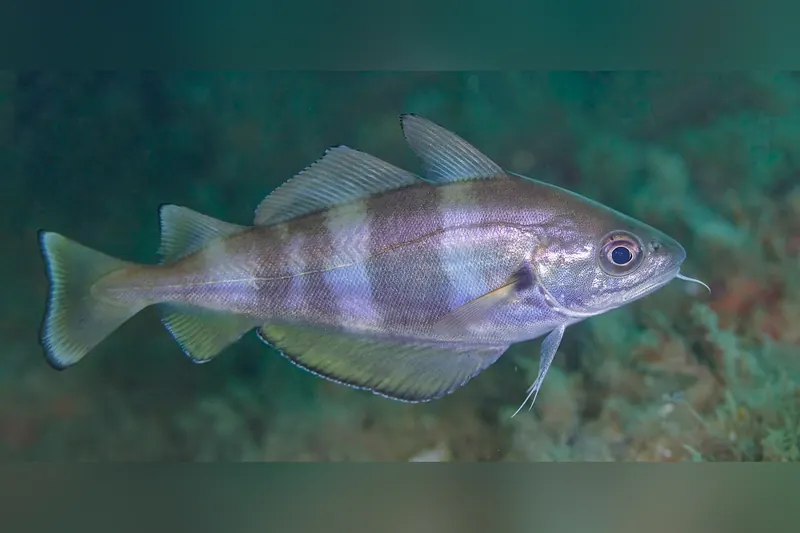
Photo: Diego Delso, Wikimedia Commons, CC BY-SA 4.0, adjusted to 3:2
- Spawning
- Moves inshore to 50 m or less to spawn (FishBase); south of the British Isles and in the Mediterranean in winter (German Wikipedia). Mature at 1 to 2 years (German Wikipedia), mean length at first maturity 22.1 cm, range 21 to 25 cm (FishBase).
- Typical method
- Bottom fishing from piers, groynes and rock walls (rule of thumb)
- Top bait
- Ragworm
How to recognise it
- Fairly deep, short cod-like body, light brown with four or five broad, faint dark bars on the sides
- Well-developed chin barbel, projecting upper jaw, large eyes
- Dark spot at the upper edge of the pectoral fin base; three dorsal and two anal fins, front pelvic rays slightly elongated
Easily confused with: The closely related poor cod (Trisopterus minutus) stays smaller and lacks clear bars. Young cod are mottled rather than barred, whiting is slimmer, haddock has a black lateral line (rule of thumb).
How to catch it
Methods: Bottom fishing from piers, groynes and rock walls (rule of thumb), Boat fishing over wrecks and rough ground with a paternoster (rule of thumb), Light jigging with a teaser (rule of thumb), Surf fishing over mixed ground at dusk (rule of thumb)
Baits: Ragworm, Lugworm, Fish strip, Shrimp or crab, Mussel or clam meat
Year round close to shore, where the smaller fish live (English Wikipedia); bigger fish more from boats over wrecks and deeper ground. They spawn inshore in winter (German Wikipedia, FishBase).
Habitat and food
Northeast Atlantic from Norway to Morocco including the British Isles and the Skagerrak, plus the western Mediterranean (FishBase); German Wikipedia names the southern North Sea and the coast down to West Africa. Lives over the shelf on mud, sand and rock, mostly at 30 to 100 m (FishBase, German Wikipedia); German Wikipedia gives 650 m as the greatest depth, English Wikipedia 300 m. Small fish stay close to shore, large ones move further out (English Wikipedia).
Mainly bottom crustaceans, plus small fish, molluscs and bristle worms (FishBase, German Wikipedia). A scavenger that takes almost anything it finds on the bottom (English Wikipedia).
Size and age
FishBase: max. 46.0 cm (total length), common 30.0 cm, maximum age 4 years. English Wikipedia says seldom over 30 cm, rare fish nearly twice that, and 4 years as the average lifespan; about 15 cm after the first year.
Protection and rules
We found no minimum size or closed season for this species in any state fisheries regulation. Local water rules may still apply.
In Germany, closed seasons and minimum sizes are set by each state and can be stricter for single waters. All German rules by state, with the legal source. Outside Germany, the local rules apply: licence and agency by country.
In the kitchen
A tasty food fish if eaten no later than the day after capture; highly valued in France (German Wikipedia). Now also sold whole and used in fish fingers (English Wikipedia). Gut and chill it straight away (rule of thumb).
Sources (4)
- fishbase.de/summary/Trisopterus-luscus.html
- en.wikipedia.org/wiki/Trisopterus_luscus
- de.wikipedia.org/wiki/Franzosendorsch
- gesetze-rechtsprechung.sh.juris.de/perma?d=jlr-NNLSH00002ADBNN00000000
Last checked 2026-10-22. Found a mistake? Write to [email protected].
Know more?
Additions, photos of your catches or a mistake in the text: write to us and we will gladly credit you as a helper.
Send a tip