Species
Haddock
A North Atlantic cod relative with a black lateral line and a dark blotch above the pectoral fin. A classic catch on party boats and private boats in the North Sea and off Norway.
Melanogrammus aeglefinus
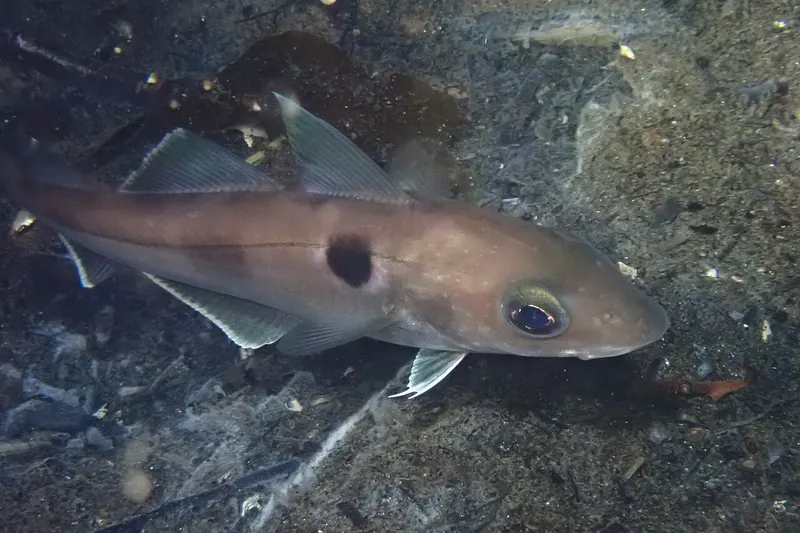
Photo: Vsevolod Rudyi, Wikimedia Commons, CC BY 4.0, adjusted to 3:2
- Spawning
- In the northeast Atlantic from February to June, peaking in March and April, at 50 to 150 m (English Wikipedia, FishBase); German Wikipedia gives March to June at 5 to 7 °C. In the North Sea mature at 3 to 4 years and 30 to 40 cm (German Wikipedia); English Wikipedia gives 2 years for males and 3 for females in the North Sea.
- Typical method
- Boat fishing with a bait rig on the bottom (rule of thumb)
- Top bait
- Lugworm
How to recognise it
- Black, unbroken lateral line on a grey to almost black back, silvery white sides
- Large dark blotch above the pectoral fin just below the lateral line (the "devil's thumbprint")
- Three dorsal and two anal fins, the first dorsal tall and triangular; upper jaw longer than the lower, small chin barbel
Easily confused with: Cod have a pale lateral line, are mottled and carry a larger barbel; whiting and pouting lack the black lateral line. The dark blotch above the pectoral fin is the surest haddock feature (English Wikipedia, FishBase).
How to catch it
Methods: Boat fishing with a bait rig on the bottom (rule of thumb), Paternoster with two or three snoods over sand and gravel (rule of thumb), Light jigging with a teaser (rule of thumb), Drifting over shell banks in Norway (rule of thumb)
Baits: Lugworm, Ragworm, Mussel or clam meat, Herring or mackerel strip, Small jig with soft plastic teaser
Year round from a boat over deeper ground, as adults mostly hold at 80 to 200 m (FishBase); closer to shore mainly in the colder months (rule of thumb).
Habitat and food
North Atlantic and adjacent Arctic: in the northeast from the Bay of Biscay to Spitsbergen, the Barents Sea and Novaya Zemlya, most abundant north of the English Channel; large stocks in the North Sea, off the Faroes, Iceland and Norway; in the west from western Greenland to Cape Hatteras (English Wikipedia). In the Baltic east to Bornholm (German Wikipedia). Lives close to rock, sand, gravel or shell bottoms at 10 to 450 m, usually 10 to 200 m, adults mostly at 80 to 200 m and 4 to 10 °C (FishBase).
Mainly small bottom animals: crustaceans, molluscs, echinoderms such as sea urchins and brittle stars, worms, plus fish such as sandeels, capelin and herring (FishBase, English Wikipedia). German Wikipedia highlights herring and capelin spawn.
Size and age
FishBase: max. 112 cm (total length), common 35.0 cm, maximum published weight 16.8 kg, maximum age 20 years. English Wikipedia gives 94 cm and 11 kg as the longest recorded haddock, rarely over 80 cm, lifespan around 14 years; German Wikipedia up to 1 m and 14 kg. The sources differ considerably.
Protection and rules
We found no minimum size or closed season for this species in any state fisheries regulation. Local water rules may still apply.
In Germany, closed seasons and minimum sizes are set by each state and can be stricter for single waters. All German rules by state, with the legal source. Outside Germany, the local rules apply: licence and agency by country.
In the kitchen
Very lean: 16.3 g protein and 0.45 g fat per 100 g (German Wikipedia). Sold fresh, as fillets and, especially in Britain, smoked, for example as Finnan haddie or Arbroath smokie (English and German Wikipedia); steamed, fried, grilled, boiled or baked (FishBase).
Sources (4)
- fishbase.de/summary/Melanogrammus-aeglefinus.html
- en.wikipedia.org/wiki/Haddock
- de.wikipedia.org/wiki/Schellfisch
- gesetze-rechtsprechung.sh.juris.de/perma?d=jlr-NNLSH00002ADBNN00000000
Last checked 2026-10-22. Found a mistake? Write to [email protected].
Know more?
Additions, photos of your catches or a mistake in the text: write to us and we will gladly credit you as a helper.
Send a tip