Species
European sprat
A small, silvery schooling fish of the herring family, also called brisling. Famous smoked as Kiel sprats, and for anglers mainly a baitfish that comes up on herring feathers.
Sprattus sprattus
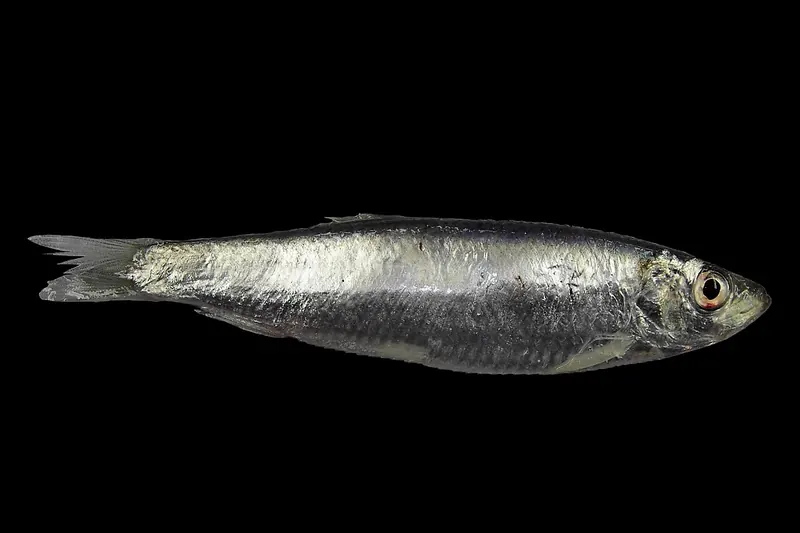
Photo: Hans Hillewaert, Wikimedia Commons, CC BY-SA 4.0, adjusted to 3:2
- Spawning
- Some sprat spawn almost year round, but mainly in spring and summer, near the coast or up to 100 km offshore at 10 to 20 m; each female releases 6,000 to 14,000 floating eggs (FishBase, German Wikipedia). In the Baltic and northeast Atlantic the peak is April to August, in the Mediterranean December to April (English Wikipedia). Mature after about two years (German Wikipedia), mean length at first maturity 10.1 cm (FishBase).
- Typical method
- Herring feathers (sabiki) with small hooks from piers and jetties (rule of thumb)
- Top bait
- Herring feathers with small flash flies
How to recognise it
- Small, laterally compressed body, blue to greenish back, silvery flanks with no dark spots
- Keel of sharp scales along the belly, lower jaw slightly projecting
- Pelvic fins start directly below or in front of the dorsal fin origin; deeply forked tail (English and German Wikipedia)
Easily confused with: Young herring look very similar; in sprat the pelvic fins start below or in front of the dorsal fin (English Wikipedia), in herring behind it, and herring have a smoother belly (rule of thumb). Off southern Europe sardine and anchovy are similar (rule of thumb).
How to catch it
Methods: Herring feathers (sabiki) with small hooks from piers and jetties (rule of thumb), Casting bubble or small float with a mini sabiki when schools are near the surface (rule of thumb), Drop net or bait net where permitted (rule of thumb), As a baitfish for cod, bass, mackerel and garfish (rule of thumb)
Baits: Herring feathers with small flash flies, Small fish skin strips on a sabiki, Very small soft fly hooks, Tiny pieces of shrimp
Evening and night, when schools rise to the surface (FishBase, German Wikipedia); in spring and summer they come inshore to spawn (FishBase).
Habitat and food
Northeast Atlantic from the North Sea and adjacent waters north to the Lofoten and west of the British Isles, the Baltic, south to Morocco, plus the northern Mediterranean (Gulf of Lion, Adriatic) and the Black Sea (FishBase). The Baltic holds the subspecies S. s. balticus (German and English Wikipedia). Schools in open water at 10 to 150 m, often near the coast and in estuaries, tolerating salinities as low as 4 parts per thousand; rises to the surface at night (FishBase, English Wikipedia).
Planktonic crustaceans, mainly copepods such as Calanus, Pseudocalanus and Temora; juveniles eat their eggs and larvae plus diatoms (English Wikipedia, FishBase).
Size and age
FishBase: max. 25.1 cm (standard length), common 12.0 cm, maximum age 6 years. English and German Wikipedia give a maximum of 16 cm, usually 8 to 12 cm (English Wikipedia). The sources differ markedly on maximum length.
Protection and rules
We found no minimum size or closed season for this species in any state fisheries regulation. Local water rules may still apply.
In Germany, closed seasons and minimum sizes are set by each state and can be stricter for single waters. All German rules by state, with the legal source. Outside Germany, the local rules apply: licence and agency by country.
In the kitchen
Oily and an important European food fish: smoked as Kiel sprats, pickled in the Baltic as Reval kilo, salted as (false) anchovies; dusted in flour and fried (German Wikipedia). Canned smoked sprats are sold in many European countries (English Wikipedia).
Sources (6)
- fishbase.de/summary/Sprattus-sprattus.html
- en.wikipedia.org/wiki/European_sprat
- de.wikipedia.org/wiki/Europ%C3%A4ische_Sprotte
- eur-lex.europa.eu/legal-content/DE/TXT/?uri=CELEX:32026R0249
- eur-lex.europa.eu/legal-content/DE/TXT/?uri=CELEX:32025R2454
- gesetze-rechtsprechung.sh.juris.de/perma?d=jlr-NNLSH00002ADBNN00000000
Last checked 2026-10-22. Found a mistake? Write to [email protected].
Know more?
Additions, photos of your catches or a mistake in the text: write to us and we will gladly credit you as a helper.
Send a tip