Species
Viviparous eelpout
A small, eel-like bottom fish with a fin fringe and green bones, also called viviparous blenny or European eelpout. It gives birth to live young and readily takes worms around Baltic rocks and piers.
Zoarces viviparus
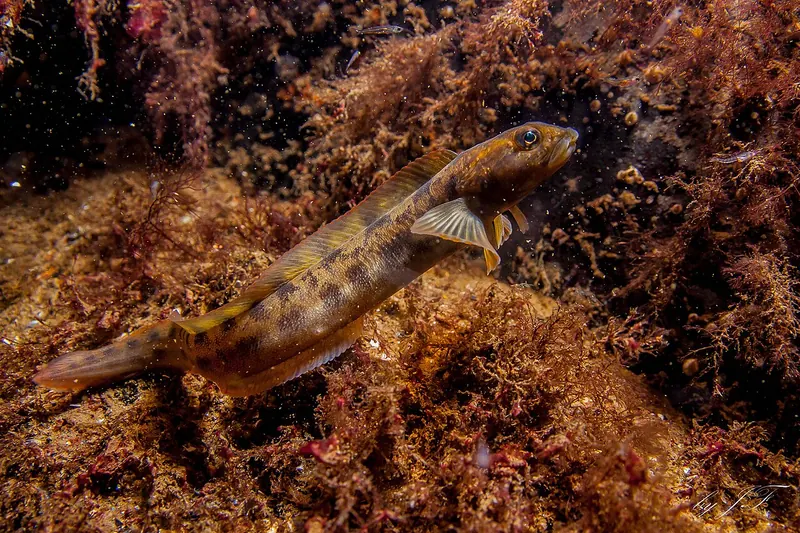
Photo: Julian Fahrbach (CrazyBiker 84), Wikimedia Commons, CC BY-SA 3.0 de, adjusted to 3:2
- Spawning
- Live-bearing: mating in August and September with internal fertilization (FishBase, English Wikipedia). Young are born from November at the earliest, mostly in spring, at 2.5 to 5 cm (German Wikipedia); FishBase gives 30 to 400 young of 35 to 55 mm and a total gestation of five months, English Wikipedia about six months. Mature mostly in the second year at 15 to 18 cm (German Wikipedia).
- Typical method
- Bottom fishing from piers, rock armour and harbour walls (rule of thumb)
- Top bait
- Ragworm
How to recognise it
- Elongated, eel-like body with a broad head and thick lips, slimy skin with tiny scales
- Dorsal, tail and anal fins joined into one fringe, with a clear notch of short, hard rays before the tail; large rounded pectoral fins with yellowish edges
- Greyish brown to olive brown with rows of dark blotches, yellowish belly; bones turn green when cooked
Easily confused with: Resembles a small burbot. The rock gunnel (Pholis gunnellus) and the snake blenny (Ophidion barbatum) are also slim bottom dwellers, but lack a fin fringe running into an arrowhead-shaped tail like this (English Wikipedia). True eels have a more pointed head and no pelvic fins (rule of thumb).
How to catch it
Methods: Bottom fishing from piers, rock armour and harbour walls (rule of thumb), Light bottom rig with a small hook close to rocks and weed (rule of thumb), Pole or float fishing in shallow, stony bays (rule of thumb), Unhook gently and release quickly, the species usually survives this well (German Wikipedia)
Baits: Ragworm, Lugworm, Small piece of mussel, Shrimp, Small fish strip
Spring to late summer in shallow, stony water (rule of thumb). Schleswig-Holstein has a closed season from 15 September to 31 January (Annex 1 No. 2 KüFVO, see protection), which covers the gestation period (FishBase, German Wikipedia).
Habitat and food
Northeast Atlantic from the White Sea and the Murmansk coast south to the English Channel (Somme), along the east coasts of Scotland and England, the Irish Sea, Orkney, Shetland and shallow waters of the North Sea and Baltic (FishBase). English Wikipedia says it is absent from Ireland's Atlantic coast, and it has not reached Iceland; with warming it is retreating north from the Channel and the Wadden Sea (German Wikipedia). Lives hidden under stones, among weed, seagrass and mussels, in rock pools down to 40 m, usually 2 to 20 m; also in brackish water (FishBase, English Wikipedia).
Snails, midge larvae, crustaceans and fish eggs and fry (FishBase); German Wikipedia lists any accessible bottom animals, including mussels.
Size and age
FishBase: max. 52.0 cm (total length), common 30.0 cm, maximum published weight 510 g, maximum age 10 years. Today fish over 35 cm are rarely found (German Wikipedia).
Protection and rules
We found no minimum size or closed season for this species in any state fisheries regulation. Local water rules may still apply.
In Germany, closed seasons and minimum sizes are set by each state and can be stricter for single waters. All German rules by state, with the legal source. Outside Germany, the local rules apply: licence and agency by country.
In the kitchen
The bones turn green when cooked; this was once taken as a sign of poison, but the colour is harmless (German Wikipedia, FishBase). FishBase names the mineral vivianite as the cause, German Wikipedia the pigment biliverdin. Since it is known to be safe, it is a popular catch (German Wikipedia).
Sources (7)
- fishbase.de/summary/Zoarces-viviparus.html
- en.wikipedia.org/wiki/Viviparous_eelpout
- de.wikipedia.org/wiki/Aalmutter
- gesetze-rechtsprechung.sh.juris.de/perma?d=jlr-NNLSH00002ADBNN00000000
- landesrecht-mv.de/bsmv/document/jlr-NNLMV000075CFNN00000000090
- landesrecht-mv.de/bsmv/document/jlr-NNLMV000075CFNN00000000088
- voris.wolterskluwer-online.de/browse/document/9ba895b6-842c-3ba7-8df0-
Last checked 2026-10-22. Found a mistake? Write to [email protected].
Know more?
Additions, photos of your catches or a mistake in the text: write to us and we will gladly credit you as a helper.
Send a tip