Species
Brill
An oval, left-eyed flatfish with smooth scales, the smaller relative of the turbot. It hunts small fish on the bottom and is a prized bycatch for surf and boat anglers.
Scophthalmus rhombus
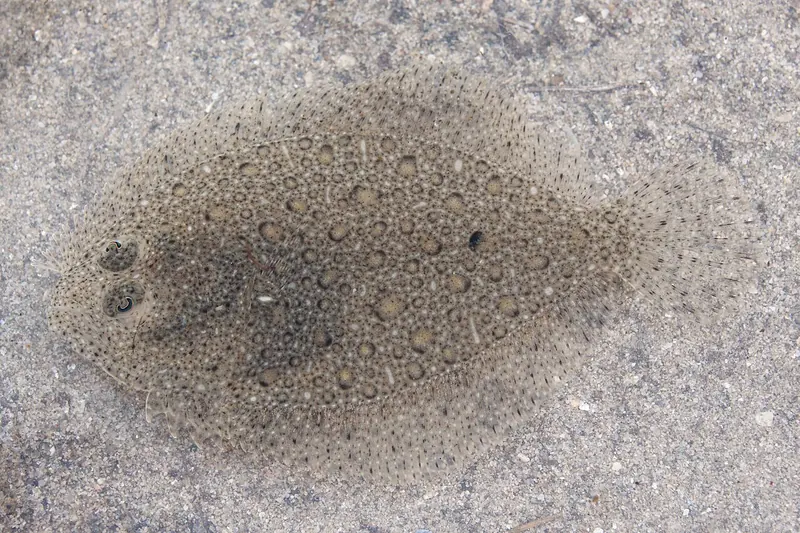
Photo: Holger Krisp, Wikimedia Commons, CC BY 4.0, adjusted to 3:2
- Spawning
- Spring to summer; the eggs drift in open water buoyed by oil droplets, larvae hatch after about two weeks (German Wikipedia). Males mature from about 25 cm, females at about 30 to 40 cm (German Wikipedia); FishBase gives 37 cm as mean length at first maturity (range 33 to 41 cm).
- Typical method
- Surf fishing over sand (rule of thumb)
- Top bait
- Sandeel
How to recognise it
- Oval body, both eyes on the left side, upturned mouth
- Eyed side with small smooth scales and no bony knobs, sandy, olive green or dark brown with light and dark spots
- Dorsal fin starts in front of the eyes, part of it is not joined by fin membrane and looks frilly (English Wikipedia); lateral line S-shaped
Easily confused with: Often confused with turbot, which is almost round and has bony knobs instead of smooth scales; the two species can hybridize (English and German Wikipedia). Plaice, flounder, dab and sole have their eyes on the right.
How to catch it
Methods: Surf fishing over sand (rule of thumb), Drifting from a boat over sand and gravel (rule of thumb), Bottom fishing with fish strip or worm (rule of thumb), Small soft plastic worked slowly along the bottom (rule of thumb)
Baits: Sandeel, Herring or mackerel strip, Ragworm, Lugworm, Small soft plastic
Summer, when the fish move into shallower water over sand (rule of thumb). In the Baltic off Schleswig-Holstein there is a closed season from 1 June to 31 July (Annex 1 No. 8 KüFVO, see protection).
Habitat and food
Eastern Atlantic from 68° N to Morocco, also reported from Iceland, plus the Mediterranean and Black Sea (FishBase); in the Baltic only in the west as far as Rügen (German Wikipedia). Lives on sand, mud, gravel or mixed ground, at 5 to 50 m according to FishBase and about 5 to 70 m according to German Wikipedia.
Bottom-living small fish and larger crustaceans (FishBase), plus molluscs (German Wikipedia).
Size and age
FishBase: max. 75.0 cm (total length), common 30.0 cm, maximum published weight 8.0 kg, maximum age 6 years. German Wikipedia gives up to 70 cm and up to 7 kg; English Wikipedia 75 cm and 8 kg, but on average less than half that.
Protection and rules
We found no minimum size or closed season for this species in any state fisheries regulation. Local water rules may still apply.
In Germany, closed seasons and minimum sizes are set by each state and can be stricter for single waters. All German rules by state, with the legal source. Outside Germany, the local rules apply: licence and agency by country.
In the kitchen
A tasty, valuable food fish, mostly landed as bycatch (German Wikipedia). The flesh is lighter in texture and less rich than turbot (English Wikipedia); steamed, fried, grilled, boiled or baked (FishBase).
Sources (6)
- fishbase.de/summary/Scophthalmus-rhombus.html
- en.wikipedia.org/wiki/Brill_(fish)
- de.wikipedia.org/wiki/Glattbutt
- gesetze-rechtsprechung.sh.juris.de/perma?d=jlr-NNLSH00002ADBNN00000000
- landesrecht-mv.de/bsmv/document/jlr-NNLMV000075CFNN00000000090
- voris.wolterskluwer-online.de/browse/document/9ba895b6-842c-3ba7-8df0-
Last checked 2026-10-22. Found a mistake? Write to [email protected].
Know more?
Additions, photos of your catches or a mistake in the text: write to us and we will gladly credit you as a helper.
Send a tip