Species
California yellowtail
California yellowtail, usually just called yellowtail: a powerful, fast amberjack with a bright yellow tail, hunted in Southern California and Baja California around kelp forests, islands and floating kelp paddies.
Seriola dorsalis
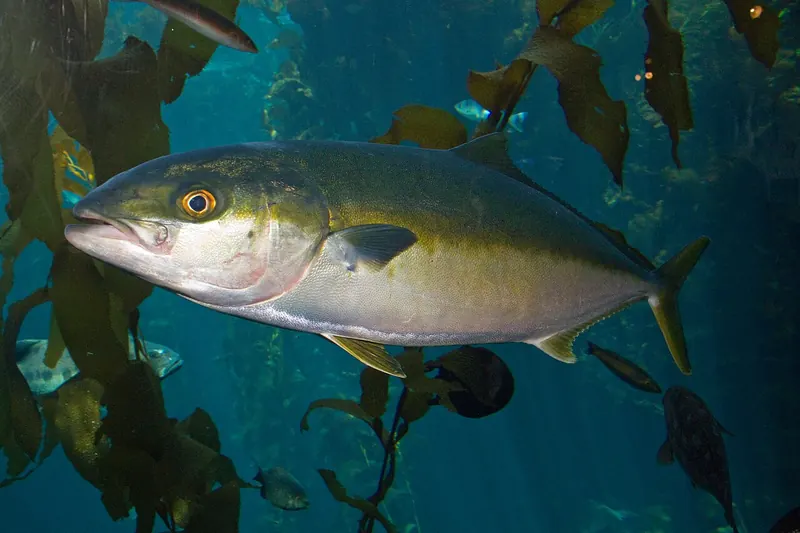
Photo: brian gratwicke, Wikimedia Commons, CC BY 2.0, adjusted to 3:2
- Spawning
- Spring and summer, March to September; aggregate broadcast spawners, and according to English Wikipedia eggs are also attached to kelp, though most knowledge comes from aquaculture. Mature at 2 to 3 years (English Wikipedia).
- Typical method
- Live bait on hook and line, the usual method according to English Wikipedia
- Top bait
- Live sardine
How to recognise it
- Spindle shaped body, blue green back, silver sides and belly
- Bronze to yellowish stripe along the lateral line, bright yellow, deeply forked tail
- Two dorsal fins, the first short with three to seven spines (English Wikipedia)
Easily confused with: The yellowtail amberjack (Seriola lalandi) looks the same and was treated as the same species until genetic work separated them; it lives farther south in the Pacific (English Wikipedia). For anglers on the US West Coast practically every yellowtail is S. dorsalis.
How to catch it
Methods: Live bait on hook and line, the usual method according to English Wikipedia, Fishing floating kelp paddies and kelp edges, Surface iron or jig into feeding schools (rule of thumb), Slow trolling off the islands (rule of thumb)
Baits: Live sardine, Live anchovy, Live mackerel, Squid, Metal jig
The warm months, when the water is 18 to 24 °C and fish feed harder (English Wikipedia); often caught at Santa Catalina, San Clemente, the Coronado Islands and off La Jolla. Early evening as the sun sets is a common time (English Wikipedia).
Habitat and food
West coast of North America from Point Conception in California to Cabo San Lucas at the tip of Baja California, plus the Gulf of California; believed to move north in summer (English Wikipedia). Inshore and pelagic: off rocky points and kelp forests just below the surface, in summer also under floating kelp paddies; smaller fish tend to be farther offshore (English Wikipedia). Prefers 21 to 22 °C, found at 18 to 24 °C, and goes deeper below 18 °C (English Wikipedia). Formerly included in S. lalandi, now a separate species based on genetic work; FishBase still lists S. dorsalis as a synonym of S. lalandi (FishBase, English Wikipedia).
Non discriminating predator: mackerel, sardines, anchovies, squid, crab and smelt; often feeds in schools at the surface but also deeper, and feeds more heavily in the warm months (English Wikipedia).
Size and age
English Wikipedia: average 50 to 120 cm and 12 to 18 lb (5.4 to 8.2 kg), the heaviest fish caught weighed 80 lb (36.3 kg), and one of the largest observed was estimated at over 155 cm; fish caught off Southern California usually weigh 10 to 20 lb and are 3 to 7 years old. FishBase gives max. 250 cm, common 80 cm, 96.8 kg and 12 years for S. lalandi in the broad sense; these values do not necessarily apply to S. dorsalis.
Protection and rules
In the USA, each state sets its own size limits, bag limits and seasons. Pescaday does not list these rules yet: check them with the fish and wildlife agency of the state you fish in. Fishing licence USA: agency by state
In Germany we found no minimum size or closed season for this species in any state fisheries regulation.
In the kitchen
Sought after food fish with both white and red muscle, sold at high prices in restaurants (English Wikipedia).
Sources (3)
- en.wikipedia.org/wiki/Seriola_dorsalis
- fishbase.se/summary/Seriola-dorsalis.html
- wildlife.ca.gov/Fishing/Ocean/Regulations/Fishing-Map/Southern
Last checked 2026-10-22. Found a mistake? Write to [email protected].
Know more?
Additions, photos of your catches or a mistake in the text: write to us and we will gladly credit you as a helper.
Send a tip