Species
Yellowmouth barracuda
Yellowmouth barracuda: a slender schooling predator with dark bars reaching below the lateral line that is becoming more common in the Mediterranean and hits lures off current swept headlands.
Sphyraena viridensis
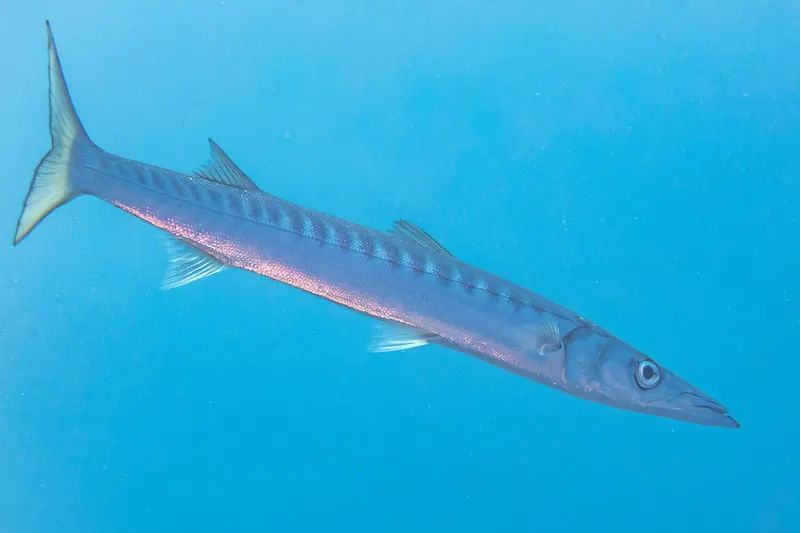
Photo: Diego Delso, Wikimedia Commons, CC BY-SA 4.0, adjusted to 3:2
- Spawning
- The sources give no spawning season. The summer schools probably also serve mating, with smaller males gathering around larger females (English Wikipedia).
- Typical method
- Casting slim plugs and stickbaits from headlands and jetties
- Top bait
- Slim floating plug
How to recognise it
- Many dark bars on the upper half of the body that reach below the lateral line at the front; they fade in dead fish (FishBase, English Wikipedia)
- No scales on the preopercle (FishBase)
- Slender with a pointed snout and a jutting lower jaw with two rows of long fangs; juveniles dark yellow to greenish
Easily confused with: The European barracuda (Sphyraena sphyraena) has scales on the preopercle, its bars do not extend below the lateral line, and it grows larger (English Wikipedia). The tropical great barracuda (Sphyraena barracuda) has black blotches instead of bars (rule of thumb).
How to catch it
Methods: Casting slim plugs and stickbaits from headlands and jetties, Slow trolling small plugs along the coast, Live baitfish where the current runs, Fishing at dawn, dusk and at night under lights (rule of thumb)
Baits: Slim floating plug, Stickbait, Live horse mackerel (prey according to English Wikipedia), Soft plastic on a jig head (rule of thumb)
In summer schools hold where currents are strong, in winter only juveniles stay in shallow bays (English Wikipedia). Dawn and dusk are considered best (rule of thumb).
Habitat and food
Subtropical eastern Atlantic around the Azores, Madeira, Cape Verde and the Canary Islands; in the Mediterranean recorded for example off Lebanon, Israel, Algeria, Corsica and Sicily, in the Adriatic and Aegean, and north to Cornwall (English Wikipedia). Its exact range is unclear because most records do not separate it from the European barracuda (FishBase). Coastal open water, 0 to 100 m deep (FishBase). In summer schools of up to 200, usually 30 to 40 fish gather where currents are strong, with larger fish deeper down to 30 m; in winter only small groups of juveniles in shallow bays (English Wikipedia).
Fish, cephalopods and crustaceans (FishBase). In a study in the Azores its diet was fish only, mainly blue jack mackerel (in 72.4 percent of stomachs), plus bogue, ornate wrasse and axillary seabream; the barracudas hunted alone or in groups, and a chase lasted 8 to 40 seconds (English Wikipedia).
Size and age
FishBase: max. 128 cm fork length, common 40 cm standard length, maximum published weight 8.2 kg. English Wikipedia: usually 35 to 40 cm, up to 65 cm standard length, up to 1.19 m off the Azores; rod caught record 10.2 kg (22 lb 8 oz) off Lanzarote in 2007. That record is above the FishBase maximum weight.
Protection and rules
Size limits, bag limits, seasons and licences are set by each country, in the USA by each state. Pescaday does not list these rules: check them with your operator and the national authority before you fish. Notes with sources are given above under conservation status. Licence pages: Spain, France, Italy, Croatia, Greece, Portugal. Fishing travel guide
In the kitchen
Landed in small quantities in the eastern Mediterranean with trammel nets and beach seines and sold in Turkish markets, mostly as bycatch; as numbers grow it may become more important for fisheries (English Wikipedia). The sources say nothing about preparation.
Sources (6)
- fishbase.se/summary/Sphyraena-viridensis.html
- en.wikipedia.org/wiki/Sphyraena_viridensis
- de.wikipedia.org/wiki/Liste_der_Mittelmeerfische
- de.wikipedia.org/wiki/Barrakudas
- legislation.gov.uk/eur/2019/1241/annex/IX/2020-01-31
- legislation.gov.uk/eur/2006/1967/article/17/2020-01-31
Last checked 2026-10-22. Found a mistake? Write to [email protected].
Know more?
Additions, photos of your catches or a mistake in the text: write to us and we will gladly credit you as a helper.
Send a tip