Species
Yellowfin tuna
Yellowfin tuna, called ahi in Hawaii: a fast schooling predator of warm seas with bright yellow finlets, popular from North Carolina through the Gulf of Mexico to San Diego.
Thunnus albacares
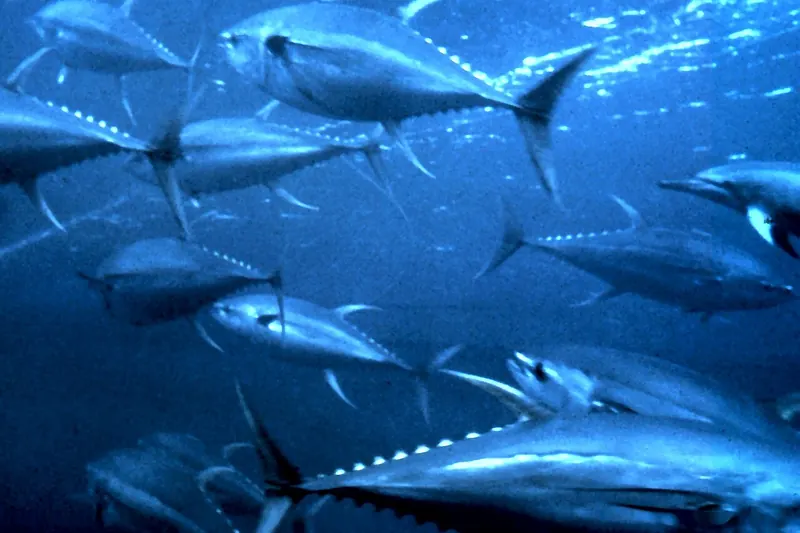
Photo: OAR/National Undersea Research Program (NURP), Wikimedia Commons, Public domain, adjusted to 3:2
- Spawning
- All year in the tropics, with a summer peak at higher latitudes; spawns every few days over the season (FishBase). Mean length at maturity 103.3 cm, range 78 to 158 cm (FishBase).
- Typical method
- Trolling feather jigs and small lures, a long tradition in Hawaii (Wikipedia)
- Top bait
- Feather jig
How to recognise it
- Second dorsal fin, anal fin and finlets bright yellow, finlets with a narrow black edge (FishBase)
- Large fish have sickle-shaped long second dorsal and anal fins, over 20 percent of fork length (FishBase, Wikipedia)
- Silvery belly with about 20 broken, nearly vertical lines (FishBase)
Easily confused with: Bigeye tuna (Thunnus obesus): also called ahi in Hawaii (Wikipedia); the same US minimum size applies (NOAA Fisheries). Bluefin tuna: shorter pectoral fins; albacore: much longer pectoral fins (Wikipedia). Note: in French yellowfin is called albacore (Wikipedia).
How to catch it
Methods: Trolling feather jigs and small lures, a long tradition in Hawaii (Wikipedia), Chumming from an anchored boat on banks, as developed off Bermuda (Wikipedia), Look for dolphins, floating debris and anchored fish aggregating devices (FADs), where tuna often hold (Wikipedia), Poppers and jigs for schools at the surface (rule of thumb)
Baits: Feather jig, Small skirted trolling lure, Live sardine or mackerel, Squid, Popper or metal jig
Shallower at night, deeper by day (Wikipedia). In southern California yellowfin show up mainly in warm years, especially during El Niño (Wikipedia). Ask the charter boats about the season in each area on the East Coast and in the Gulf (rule of thumb).
Habitat and food
Worldwide in tropical and subtropical seas, absent from the Mediterranean; 1 to 1602 m deep, usually 1 to 250 m, at 15 to 31 °C (FishBase). Oceanic, above and below the thermocline, sensitive to low oxygen and therefore rarely below 250 m in the tropics (FishBase). Mostly in the top 100 m; in one study 90 percent of readings were shallower than 88 m at night and 190 m by day, and single fish dived to 1592 m (Wikipedia). Comes close inshore at islands such as Hawaii and Bermuda and, when the water suits, over the shelf (Wikipedia).
Fish, crustaceans and squid (FishBase), such as flying fish, sauries, mackerel, lanternfish, anchovies and sardines; large fish eat frigate mackerel and skipjack (Wikipedia).
Size and age
FishBase: max. 239 cm fork length, commonly around 150 cm, maximum published weight 200 kg, maximum age 18 years. German Wikipedia gives up to 240 cm and 200 kg. IGFA all-tackle record according to Wikipedia: 200.94 kg (443 lb), 2024 off Cabo San Lucas, Mexico; the previous record was 193.68 kg (427 lb), 2012 in the same area. Swims at up to 20.8 m/s (Wikipedia).
Protection and rules
In the USA, each state sets its own size limits, bag limits and seasons. Pescaday does not list these rules yet: check them with the fish and wildlife agency of the state you fish in. Fishing licence USA: agency by state
In Germany we found no minimum size or closed season for this species in any state fisheries regulation.
In the kitchen
Highly valued for sashimi, sold fresh, frozen, canned and smoked (FishBase). Eaten raw as sashimi, grilled or seared rare (Wikipedia); in Hawaii it is the base of ahi poke (German Wikipedia).
Sources (7)
- fishbase.se/summary/Thunnus-albacares.html
- en.wikipedia.org/wiki/Yellowfin_tuna
- de.wikipedia.org/wiki/Gelbflossen-Thun
- fisheries.noaa.gov/permit/atlantic-highly-migratory-species-angling-pe
- fisheries.noaa.gov/atlantic-highly-migratory-species/recreational-atla
- fisheries.noaa.gov/permit/pacific-highly-migratory-species-permits
- fisheries.noaa.gov/southeast/rules-regulations/fishing-regulations-and
Last checked 2026-10-22. Found a mistake? Write to [email protected].
Know more?
Additions, photos of your catches or a mistake in the text: write to us and we will gladly credit you as a helper.
Send a tip