Species
Yellow perch
The yellow perch is the close North American cousin of the European perch: a schooling fish of the Great Lakes and the Northeast, popular on the ice and on the plate (English and German Wikipedia).
Perca flavescens
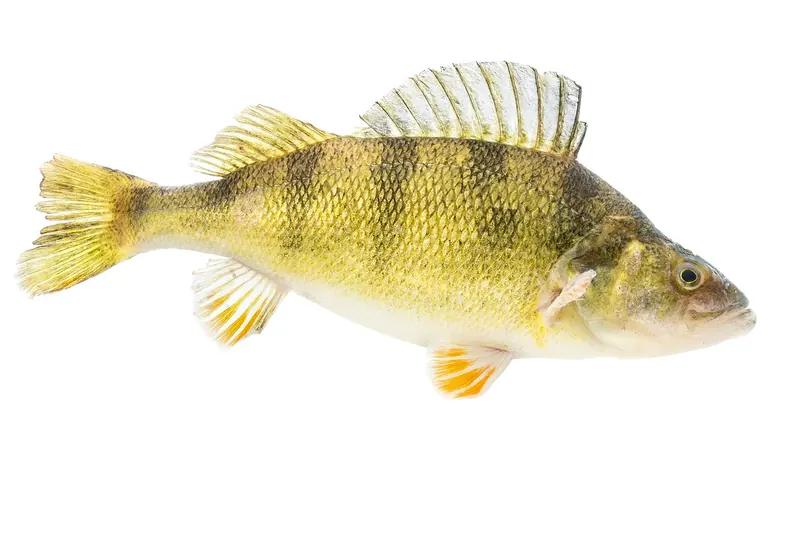
Photo: USFWS Mountain Prairie, Wikimedia Commons, Public domain, adjusted to 3:2
- Spawning
- In spring, according to FishBase between February and July in the northern hemisphere. Wikipedia gives 6.7 to 12.8 °C water temperature in one place and 2.0 to 18.6 °C in another; perch spawn in schools in shallow water, mostly at night or early morning. The eggs hang in a gelatinous strand (on average 23,000 eggs, 2,000 to 90,000, up to 2 m long) on plants and wood, without parental care; they usually hatch after 8 to 10 days (Wikipedia).
- Typical method
- Ice fishing with a small jig or jigging spoon
- Top bait
- Worm
How to recognise it
- Green to olive-gold back, 6 to 8 dark vertical bars on a yellow to yellow-green flank (Wikipedia)
- Two separate dorsal fins, the first with 12 to 14 spines and usually a dark blotch at the rear (Wikipedia)
- Lower fins yellow to silvery white, red or yellow in males at spawning time (Wikipedia)
Easily confused with: European perch (Perca fluviatilis): very similar, but the yellow perch has less reddish pelvic fins, a more green-gold than green-silver color and a fainter blotch on the first dorsal (German Wikipedia). Walleye and sauger: longer, with large canine teeth and no clear yellow bars (rule of thumb). On menus, white perch, rock bass and sunfish are sometimes sold as perch (Wikipedia).
How to catch it
Methods: Ice fishing with a small jig or jigging spoon, Float fishing with a worm or small minnow, Light spinning with small soft plastics on jig heads, retrieved slowly (Wikipedia), Vertical jigging over weed beds once the school is found (rule of thumb)
Baits: Worm, Small minnow, live or dead, Small grub or twister on a jig head, Small casting spoon, Cricket
A daytime schooling fish: schools break up at dusk and reform at dawn, and feeding peaks just before dark (Wikipedia). A favorite target for ice fishing in winter (rule of thumb).
Habitat and food
Native to the Atlantic, Arctic, Great Lakes and Mississippi basins from Nova Scotia to the Mackenzie River and south to Ohio, Illinois and Nebraska, on the Atlantic slope south to the Savannah River in Georgia; lives in lakes, ponds, pools and rivers, also brackish water, mostly in clear water near vegetation, 0 to 56 m deep, usually down to 9 m (FishBase). Widely introduced, also to China and Japan (Wikipedia). Most common in the littoral zone of large and small lakes, occasionally deeper than 15 m; preferred temperature 17 to 25 °C (Wikipedia).
Larvae eat zooplankton, one-year-olds midge larvae, older perch aquatic insects, fish eggs, crayfish, mysid shrimp and juvenile fish; in perch over 32 g about 20 percent of the diet is small fish, and feeding peaks just before dark (Wikipedia). FishBase: feeds during the day.
Size and age
FishBase: max. 50 cm, commonly 19.1 cm, maximum published weight 1.9 kg, maximum age 11 years, mature at about 19 cm. Adults usually 10 to 25 cm (4 to 10 in), many live 9 to 10 years (Wikipedia). IGFA record according to Wikipedia: 1.9 kg (4 lb 3 oz) from Bordentown, New Jersey, May 1865, the longest-standing freshwater record in North America.
Protection and rules
In the USA, each state sets its own size limits, bag limits and seasons. Pescaday does not list these rules yet: check them with the fish and wildlife agency of the state you fish in. Fishing licence USA: agency by state
In Germany we found no minimum size or closed season for this species in any state fisheries regulation.
In the kitchen
Considered one of the finest-flavored panfish, mild in taste (Wikipedia); marketed fresh or frozen and eaten pan-fried, broiled or baked (FishBase). In the US a classic for the fish fry (rule of thumb).
Sources (4)
- fishbase.de/summary/Perca-flavescens.html
- en.wikipedia.org/wiki/Yellow_perch
- de.wikipedia.org/wiki/Amerikanischer_Flussbarsch
- api.gbif.org/v1/species/2382004/vernacularNames
Last checked 2026-10-22. Found a mistake? Write to [email protected].
Know more?
Additions, photos of your catches or a mistake in the text: write to us and we will gladly credit you as a helper.
Send a tip