Species
Thornback ray
A diamond-shaped skate with a row of nail-like thorns along its back and tail, also called roker. Europe's most common ray, but now rare in German waters: release any you catch with care.
Raja clavata
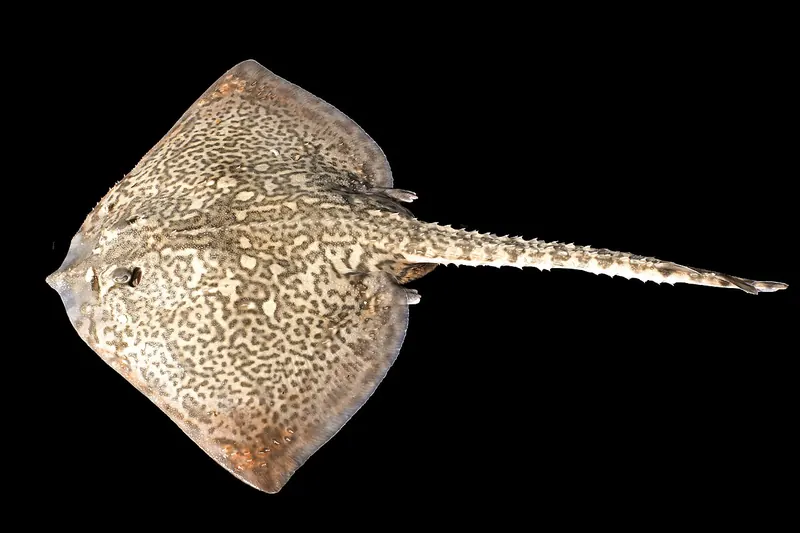
Photo: Hans Hillewaert, Wikimedia Commons, CC BY-SA 4.0, adjusted to 3:2
- Spawning
- Egg-laying: mating season February to September, peaking in June; in northwest Europe egg cases are laid in spring on shallow sand, mud or gravel (FishBase, English Wikipedia). Up to 170 egg cases per female and year, 48 to 74 on average; cases 5.0 to 9.0 cm long, pups hatch after 4 to 5 months at 11 to 13 cm (FishBase). Mature at 7 to 8 years (FishBase).
- Typical method
- Surf fishing over sand and mud, especially at night (rule of thumb)
- Top bait
- Mackerel strip
How to recognise it
- Flat, diamond-shaped disc with pointed wings and a short, rounded snout
- Central row of 30 to 50 nail-like thorns from the nape to the first dorsal fin, adults also with large thorns with swollen bases ("bucklers") on the disc (FishBase)
- Upper side rough and brown with light and dark spots, tail banded light and dark with two small dorsal fins, underside white
Easily confused with: About 13 skate species occur in the North Sea and adjacent Atlantic (English Wikipedia). The thornback stands out by its coarse thorns with swollen bases on back and tail; spotted and blonde rays have a smoother upper side (rule of thumb). The common skate (Dipturus batis) is much larger, has a long pointed snout (rule of thumb) and may not be retained in the EU (Regulation (EU) 2026/249, Art. 23).
How to catch it
Methods: Surf fishing over sand and mud, especially at night (rule of thumb), Boat fishing on the bottom with fish strip (rule of thumb), Running ledger with a long leader, give the bite time (rule of thumb), Unhook in the water or on a wet surface, never lift by the tail (rule of thumb)
Baits: Mackerel strip, Herring strip, Sandeel, Crab, Squid
At night, as the thornback is nocturnal (FishBase). Around the mating peak in June, females move into shallower inshore water about a month before the males (FishBase).
Habitat and food
Eastern Atlantic and southwest Indian Ocean from Iceland to Madagascar including the Mediterranean (FishBase); according to German Wikipedia from Norway to Namibia, in the North Sea, Skagerrak, Kattegat and the southwestern Black Sea. On mud, sand and gravel, most common in coastal waters of 10 to 60 m, overall from 5 to 1,020 m (FishBase); German Wikipedia gives 20 to 300 m. Tolerates low salinity, but does not mate in the Baltic (FishBase). Nocturnal (FishBase).
All kinds of bottom animals, preferably crustaceans, plus fish (FishBase). Juveniles eat small crustaceans such as amphipods and shrimp, adults crabs, shrimp and small fish (English Wikipedia).
Size and age
FishBase: max. 105 cm (total length) in males, 139.0 cm in females, common 85.0 cm, maximum published weight 18.0 kg, maximum age 15 years. German Wikipedia gives males up to 70 cm and females up to 120 cm, English Wikipedia adults up to 1 m, mostly under 85 cm, and 2 to 4 kg. The sources differ.
Protection and rules
We found no minimum size or closed season for this species in any state fisheries regulation. Local water rules may still apply.
In Germany, closed seasons and minimum sizes are set by each state and can be stricter for single waters. All German rules by state, with the legal source. Outside Germany, the local rules apply: licence and agency by country.
In the kitchen
Marketed fresh and frozen (FishBase); mainly the wings are eaten (rule of thumb). Given its decline in German waters and the ban in the Skagerrak and Kattegat, better released (rule of thumb).
Sources (5)
- fishbase.de/summary/Raja-clavata.html
- en.wikipedia.org/wiki/Thornback_ray
- de.wikipedia.org/wiki/Nagelrochen
- eur-lex.europa.eu/legal-content/DE/TXT/?uri=CELEX:32026R0249
- gesetze-rechtsprechung.sh.juris.de/perma?d=jlr-NNLSH00002ADBNN00000000
Last checked 2026-10-22. Found a mistake? Write to [email protected].
Know more?
Additions, photos of your catches or a mistake in the text: write to us and we will gladly credit you as a helper.
Send a tip