Species
Summer flounder
Summer flounder, better known to anglers as fluke: a left eyed flatfish of the US East Coast with sharp teeth that ambushes prey from the sand and is one of the most popular inshore fish between North Carolina and Massachusetts.
Paralichthys dentatus
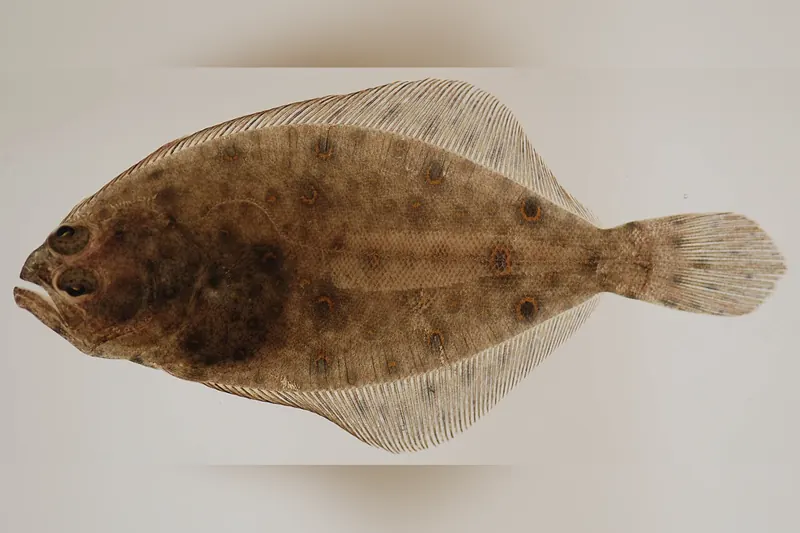
Photo: Smithsonian Environmental Research Center, Wikimedia Commons, CC BY 2.0, adjusted to 3:2
- Spawning
- Fall and early winter during the offshore migration, peaking in October and November; eggs hatch over the continental shelf (NOAA Fisheries). Mature at age 2 to 3 (NOAA Fisheries); FishBase gives 28 cm length at first maturity.
- Typical method
- Drifting from a boat over sandy bottom
- Top bait
- Live mummichog (killifish)
How to recognise it
- Flatfish with both eyes on the left side of the body
- Usually 5 to 14 eyespots on the dark upper side (English Wikipedia)
- Large mouth with well developed, sharp teeth in both jaws
Easily confused with: In the south it mixes with its close relative, the southern flounder (Paralichthys lethostigma), which lacks the eyespots (English Wikipedia). It can match its upper side very precisely to the bottom (English Wikipedia), so the spots are not always equally clear.
How to catch it
Methods: Drifting from a boat over sandy bottom, Bottom rig with live baitfish or cut bait, Bucktail jig tipped with a fish or squid strip, Casting from shore, beaches and inlets
Baits: Live mummichog (killifish), Silversides or sand lance, Squid strips, Cut bait such as menhaden, Soft plastic on a jig head
From spring into fall near beaches, in bays and in inlets (English Wikipedia); in fall fish move to deeper water to spawn (NOAA Fisheries). Drifting on a moving tide often beats slack water (rule of thumb).
Habitat and food
Northwest Atlantic from Maine, rarely Nova Scotia, to southern Florida (FishBase); especially abundant from North Carolina to Massachusetts (English Wikipedia). On the bottom at 10 to 183 m, usually down to 37 m (FishBase). Prefers hard sand to burrow in but also uses salt marsh creeks, seagrass beds and sand flats in bays, lagoons and estuaries (FishBase). In spring fish leave deeper water for beaches, inlets, bays, canals and creeks and stay until fall or early winter (English Wikipedia).
Adults are mostly fish eaters that lie buried with only the head showing: sand lance, menhaden, silversides, mummichogs, small bluefish and porgies, plus squid, shrimp and crabs. It also feeds in midwater and chases prey to the surface (English Wikipedia).
Size and age
FishBase: max. 94 cm, maximum published weight 12.0 kg, maximum age 9 years. English Wikipedia: usually 15 to 20 inches (38 to 51 cm) and 1 to 3 lb, exceptionally up to 26 lb; females grow larger and older, observed to 17 years (males 15). NOAA Fisheries: males over 2 feet, females up to 3 feet, lifespan about 12 to 14 years. The sources differ clearly on maximum age; Wikipedia also gives 9 kg for 26 lb, which does not match (26 lb is about 11.8 kg).
Protection and rules
In the USA, each state sets its own size limits, bag limits and seasons. Pescaday does not list these rules yet: check them with the fish and wildlife agency of the state you fish in. Fishing licence USA: agency by state
In Germany we found no minimum size or closed season for this species in any state fisheries regulation.
In the kitchen
Excellent food fish with firm, mild, white flesh (English Wikipedia); steamed, fried, boiled and baked, and exported fresh to Japan for sashimi (FishBase).
Sources (4)
- fishbase.se/summary/Paralichthys-dentatus.html
- en.wikipedia.org/wiki/Summer_flounder
- api.gbif.org/v1/species/2408866/vernacularNames
- fisheries.noaa.gov/species/summer-flounder
Last checked 2026-10-22. Found a mistake? Write to [email protected].
Know more?
Additions, photos of your catches or a mistake in the text: write to us and we will gladly credit you as a helper.
Send a tip