Species
Striped red mullet
Striped red mullet, also called surmullet: a red and yellow striped bottom fish with two long chin barbels that it uses to probe the bottom for worms and crustaceans; a prized food fish all around the Mediterranean.
Mullus surmuletus
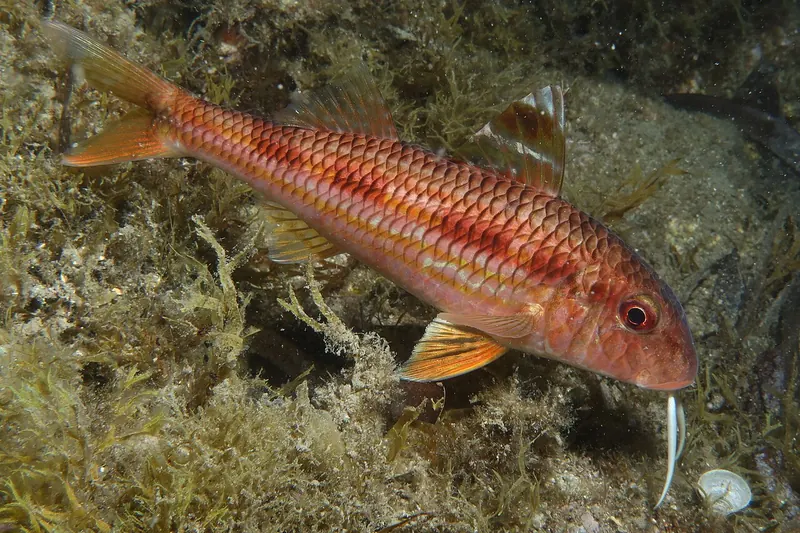
Photo: (c) Julien Renoult, some rights reserved (CC BY), Wikimedia Commons, CC BY 4.0, adjusted to 3:2
- Spawning
- May to July (FishBase), April to July according to German Wikipedia; eggs and larvae drift in open water and can be carried far. Mature at three years (German Wikipedia), mean length at maturity 16.1 cm (FishBase).
- Typical method
- Light bottom fishing over sand and rubble with a small hook
- Top bait
- Ragworm
How to recognise it
- Two long chin barbels, longer than the pectoral fins
- Red and yellowish brown lengthwise stripes on the sides, silvery white belly
- First dorsal fin with a dark stripe, head profile less steep than in the red mullet (FishBase, German Wikipedia)
Easily confused with: The red mullet (Mullus barbatus) is often not told apart (English Wikipedia); it has a steeper head profile and no striped first dorsal fin (German and English Wikipedia). Despite the English name, it is only distantly related to the grey mullets (English Wikipedia).
How to catch it
Methods: Light bottom fishing over sand and rubble with a small hook, Light float rig with the bait just above the bottom, Fishing sandy patches from jetties and rocks, Light boat fishing at 5 to 60 m (depth from FishBase, method rule of thumb)
Baits: Ragworm, Small shrimp, Mussel meat, Small piece of squid (rule of thumb)
Year round near the coast; especially active during spawning from April to July (German Wikipedia for the season, activity rule of thumb). Calm, clear water over sand patches between rocks is considered good (rule of thumb).
Habitat and food
Eastern Atlantic from western Norway and the English Channel (rare in the North Sea) to Dakar in Senegal and the Canary Islands, plus the Mediterranean and Black Sea (FishBase). German Wikipedia says the range has been spreading north for decades as water temperatures rise. On the bottom over rubble and rough ground but also sand and mud, usually 5 to 60 m deep; in the eastern Ionian Sea also at 305 to 409 m (FishBase). Juveniles in large schools, adults in small groups (German Wikipedia).
Bottom animals: shrimp, amphipods, bristle worms, mollusks and small bottom fish (FishBase). It searches with its barbels, which carry taste and touch cells; wrasses and seabreams often follow it to eat the animals it stirs up (German Wikipedia).
Size and age
FishBase: max. 40 cm standard length, common 25 cm, maximum published weight 1.0 kg, maximum age 11 years; English and German Wikipedia give the same lengths and weight. Females grow slightly larger than males (German Wikipedia).
Protection and rules
Size limits, bag limits, seasons and licences are set by each country, in the USA by each state. Pescaday does not list these rules: check them with your operator and the national authority before you fish. Notes with sources are given above under conservation status. Licence pages: Spain, France, Italy, Croatia, Greece, Portugal. Fishing travel guide
In the kitchen
A commercially important food fish (English Wikipedia), sold fresh and frozen, steamed, pan fried, broiled or baked (FishBase).
Sources (5)
Know more?
Additions, photos of your catches or a mistake in the text: write to us and we will gladly credit you as a helper.
Send a tip