Species
Snoek (barracouta)
Snoek, pronounced "snook", called barracouta in Australia and New Zealand. A long, slim snake mackerel with fangs from the cool seas of the Southern Hemisphere, a classic angling and braai fish at the Cape in South Africa.
Thyrsites atun
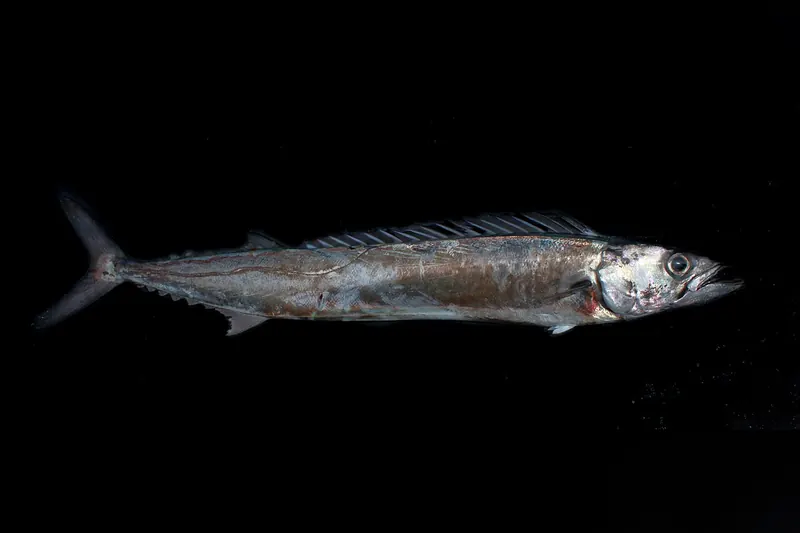
Photo: Brian Gratwicke, Wikimedia Commons, CC BY 2.0, adjusted to 3:2
- Spawning
- Off South Africa in winter and spring, May to November with a peak from June to October, along the shelf break of the western Agulhas Bank and the west coast at 150 to 400 m (Wikipedia). Different stocks spawn at different times (FishBase). Matures on average at 55 cm (FishBase); in South Africa half are mature at three years and about 73 cm fork length (Wikipedia).
- Typical method
- Boat fishing with handline or rod over the shoals (Wikipedia: originally a pure line fishery)
- Top bait
- Sardine (pilchard)
How to recognise it
- Very long, slim and strongly compressed, blue-black to blue-silver, paler belly
- Long black first dorsal fin, small finlets behind the dorsal and anal fins
- Pointed head with a clearly longer lower jaw and long curved fangs at the front of the upper jaw; a single lateral line that drops sharply behind the first dorsal fin
Easily confused with: Despite the name barracouta it is not closely related to barracudas (Wikipedia); barracudas have two widely separated dorsal fins and no finlets (rule of thumb). The escolar looks similar but is less slender (German Wikipedia).
How to catch it
Methods: Boat fishing with handline or rod over the shoals (Wikipedia: originally a pure line fishery), Fast-retrieved lures and jigs (rule of thumb, it attacks anything that moves), Drifting with sardine or cut bait (rule of thumb), Wire or short heavy leader because of the teeth (rule of thumb)
Baits: Sardine (pilchard), Metal jig, Spoon, Cut bait
When the shoals move inshore; this depends on the stock and water temperature, with 13 to 18 °C preferred (FishBase). Ask locally about the exact months (rule of thumb).
Habitat and food
Cool seas of the Southern Hemisphere: Uruguay, Argentina and Tierra del Fuego, Tristan da Cunha, South Africa, St. Paul and Amsterdam islands, Tasmania and southern Australia, New Zealand, southern Peru and Chile (FishBase). On the African coast from Moçâmedes in Angola via Namibia and the Northern and Western Cape to Algoa Bay, mostly between the Kunene River and Cape Agulhas (Wikipedia). Lives over continental shelves and around islands at 0 to 550 m, usually 100 to 500 m, at 13 to 18 °C (FishBase); schools near the bottom or in midwater, sometimes at the surface at night (FishBase). Main destinations for anglers are South Africa (Western Cape) and Namibia.
A near apex predator: adults off South Africa eat mainly sardines and anchovies, further offshore also round herring, hake and horse mackerel; juveniles take lanternfish, krill and amphipods (Wikipedia). FishBase lists krill, squid and fish such as anchovy and pilchard. According to Wikipedia it attacks anything that moves near it.
Size and age
FishBase: max. 200 cm (standard length), commonly 75 cm, maximum published weight 6 kg, maximum age 10 years. German Wikipedia gives up to 2 m and just over 6 kg because the fish is so slender. After one year it is 33 to 44 cm long (Wikipedia).
Protection and rules
Size limits, bag limits, seasons and licences are set by each country, in the USA by each state. Pescaday does not list these rules: check them with your operator and the national authority before you fish. Notes with sources are given above under conservation status. Fishing travel guide
In the kitchen
Oily and very bony, though the large bones come out easily after cooking; the scales are so fine that no scaling is needed (Wikipedia). In South Africa it is braaied, smoked, salted and air-dried or eaten as smoorsnoek and snoek bredie (Wikipedia); smoked snoek is especially popular (German Wikipedia).
Sources (5)
Know more?
Additions, photos of your catches or a mistake in the text: write to us and we will gladly credit you as a helper.
Send a tip