Species
Sheepshead
Sheepshead, also called convict fish: a black and white barred porgy with almost human looking incisor teeth that crunches barnacles and crabs off pilings and jetties and is known as a skilled bait thief.
Archosargus probatocephalus
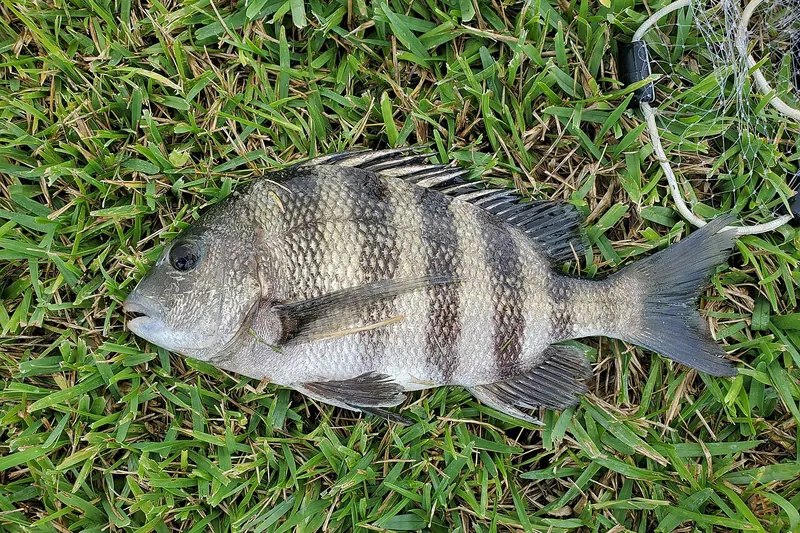
Photo: Dominic, Wikimedia Commons, CC BY 4.0, adjusted to 3:2
- Spawning
- Off the southeastern US mainly in early spring; in the Gulf of Mexico larvae are seen in late winter and spring, and adults move farther offshore to spawn (English Wikipedia). In Texas spawning takes place in February and March in the Gulf near jetties, rock piles and reefs (TPWD).
- Typical method
- Fishing straight down along bridge pilings, jetties and piers
- Top bait
- Fiddler crab
How to recognise it
- Five or six dark vertical bars on a silvery body, fading with age (English Wikipedia)
- Broad, flat incisor teeth at the front of the mouth, rows of molar like teeth behind
- Deep, laterally compressed body with one long dorsal fin with 12 spines (English Wikipedia)
Easily confused with: Young black drum also have vertical bars, but they have chin barbels and no obvious incisors (English Wikipedia, Black drum). Some authorities treat the southern sheepshead (A. aries) as a separate species, FishBase does not (English Wikipedia).
How to catch it
Methods: Fishing straight down along bridge pilings, jetties and piers, Small, sharp hook, because sheepshead are skilled bait stealers, Over rocky bottom and obstructions from a boat, Bottom rig with a short leader tight to the piling (rule of thumb)
Baits: Fiddler crab, Shrimp, Sand flea (mole crab), Clams and mussels, Hermit crab
On the Texas Gulf coast fish gather around jetties, rock piles and reefs to spawn in February and March (TPWD); late winter into spring is therefore the main season around structure (rule of thumb).
Habitat and food
Western Atlantic from Nova Scotia and the northern Gulf of Mexico to Brazil; according to FishBase absent from Bermuda, the Bahamas and the West Indies, while English Wikipedia includes the Caribbean. Inshore around rocks, pilings, jetties, mangrove roots and piers, also in tidal creeks; tolerates and even prefers brackish water and sometimes enters fresh water and warm springs in winter (English Wikipedia, FishBase).
Omnivore: larger juveniles and adults eat blue crabs and other crustaceans, shellfish and small fish, occasionally plants; the teeth crush shells and pry barnacles off rocks and pilings. Juveniles eat zooplankton, polychaete worms and midge larvae (English Wikipedia).
Size and age
FishBase: max. 91 cm, common around 35 cm, maximum published weight 9.6 kg. English Wikipedia: average 3 to 4 lb (1.4 to 1.8 kg), some fish 10 to 15 lb (4.5 to 6.8 kg). German Wikipedia: up to 90 cm and at most 9 kg, on average only about 20 cm and up to 2 kg. FishBase gives no maximum age.
Protection and rules
In the USA, each state sets its own size limits, bag limits and seasons. Pescaday does not list these rules yet: check them with the fish and wildlife agency of the state you fish in. Fishing licence USA: agency by state
In Germany we found no minimum size or closed season for this species in any state fisheries regulation.
In the kitchen
Excellent food fish, sold fresh and frozen, broiled or baked (FishBase). Large sharp spines and a razor edged gill cover make handling and cleaning difficult (TPWD).
Sources (4)
Know more?
Additions, photos of your catches or a mistake in the text: write to us and we will gladly credit you as a helper.
Send a tip