Species
African sharptooth catfish
African sharptooth catfish. A tough, air-breathing catfish with eight barbels that lives almost everywhere in Africa and even crawls overland to new waters.
Clarias gariepinus
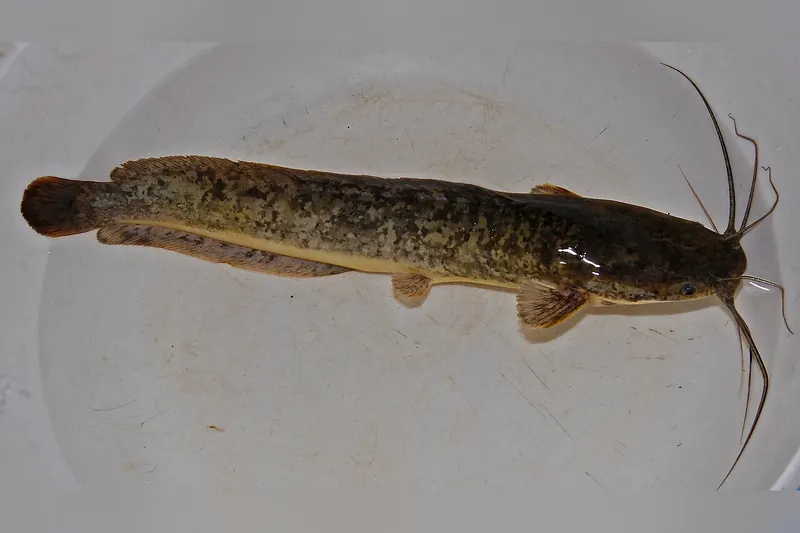
Photo: W.A. Djatmiko (Wie146), Wikimedia Commons, CC BY-SA 3.0, adjusted to 3:2
- Spawning
- In the rainy season: the fish migrate into flooded plains, rivers and temporary streams, spawn mostly at night in shallow water and then return (FishBase, Wikipedia). A female can lay up to 60,000 eggs per kg of body weight, and larvae hatch after about 33 hours at 25 °C (German Wikipedia, FishBase). Females mature at 40 to 45 cm, males at 35 to 40 cm (FishBase).
- Typical method
- Bottom fishing with natural bait, especially at night (rule of thumb; 70 percent night feeding per German Wikipedia)
- Top bait
- Nightcrawler
How to recognise it
- Long and eel-like, flat bony head with a broad mouth and four pairs of barbels
- Very long dorsal fin from the nape almost to the tail, no adipose fin, only the pectoral fins have spines
- Dark grey to black or mottled above, creamy white belly; two dark lengthwise bands on the underside of the head
Easily confused with: Clarias anguillaris looks very similar; the two are only reliably told apart by the shoulder-girdle bone (cleithrum) and the gill-raker count, 16 to 50 in C. anguillaris and 24 to 110 in the sharptooth catfish (German Wikipedia). The vundu (Heterobranchus longifilis) has a large adipose fin behind the dorsal fin (FishBase).
How to catch it
Methods: Bottom fishing with natural bait, especially at night (rule of thumb; 70 percent night feeding per German Wikipedia), Float fishing along shallow, muddy banks (rule of thumb), Casting soft plastics or spinners, it also takes lures (rule of thumb), Fly fishing for catfish feeding at the surface (rule of thumb)
Baits: Nightcrawler, Chicken liver, Cut fish, Dough or bread bait, Soft plastic
At night and at dusk, as it feeds mainly at night (German Wikipedia). In the rainy season fish gather on flooded areas and inflows (FishBase); ask your operator about the best times in each country (rule of thumb).
Habitat and food
Almost all of Africa except the Maghreb, Upper and much of Lower Guinea, the Cape province and probably Nogal; in Asia in Jordan, Israel, Lebanon, Syria and southern Turkey; widely introduced for aquaculture (FishBase). Lives mainly in quiet water: vegetated edges of rivers and lakes, pools, irrigation and sewage canals, preferring shallow, swampy areas with soft mud, but also fast rivers; 0 to 80 m deep and 8 to 35 °C (FishBase). It breathes air, can crawl overland at night and survives dry seasons in the mud (FishBase, English and German Wikipedia). Important for anglers in South Africa, Botswana, Zimbabwe, Zambia, Kenya, Uganda and Egypt, among others.
Omnivorous bottom feeder but essentially a predator: crustaceans, insects and fish (FishBase), plus snails, crabs, shrimp, birds, reptiles, amphibians, small mammals, carrion, fruit and seeds; it has been known to swallow moorhens (Wikipedia). It takes 70 percent of its food at night, and groups hunt young cichlids together (German Wikipedia).
Size and age
FishBase: max. 170 cm, commonly 90 cm, maximum published weight 60 kg, maximum age 15 years. English Wikipedia gives an average adult length of 1 to 1.5 m, German Wikipedia mostly 70 to 90 cm. Wikipedia calls it Africa's second-largest catfish after the vundu, although FishBase gives higher maximums for it.
Protection and rules
Size limits, bag limits, seasons and licences are set by each country, in the USA by each state. Pescaday does not list these rules: check them with your operator and the national authority before you fish. Notes with sources are given above under conservation status. Fishing travel guide
In the kitchen
Tasty flesh, a highly recommended food fish in Africa, sold fresh or frozen and broiled, fried or baked (FishBase, German Wikipedia). It is farmed worldwide in ponds and recirculating systems, including in Europe (German Wikipedia).
Sources (3)
- fishbase.se/summary/Clarias-gariepinus.html
- en.wikipedia.org/wiki/Clarias_gariepinus
- de.wikipedia.org/wiki/Afrikanischer_Raubwels
Last checked 2026-10-22. Found a mistake? Write to [email protected].
Know more?
Additions, photos of your catches or a mistake in the text: write to us and we will gladly credit you as a helper.
Send a tip