Species
Pacific halibut
Pacific halibut: the largest flatfish of the North Pacific and the target of countless charter trips in Alaska and British Columbia, a strong fighter with firm, white flesh.
Hippoglossus stenolepis
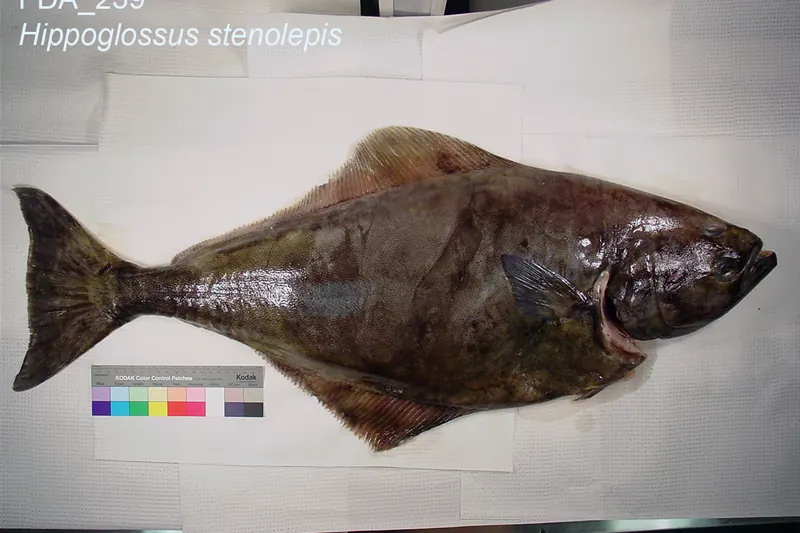
Photo: The U.S. Food and Drug Administration, Wikimedia Commons, Public domain, adjusted to 3:2
- Spawning
- Winter, from November to March with a peak from December through February, along the shelf edge at 183 to 457 m; females lay 0.5 to 4 million eggs depending on size, and larvae drift for up to six months (English Wikipedia). Maturity: males at 7 to 8, females at 8 to 12 years (English Wikipedia); NOAA Fisheries gives 8 and 12 years.
- Typical method
- Bottom fishing from a boat with stout saltwater gear
- Top bait
- Herring
How to recognise it
- Diamond shaped flatfish with both eyes on the dark right side; white underside
- Broad, slightly crescent shaped tail, unlike most flatfishes
- Lateral line with a high arch over the pectoral fin
Easily confused with: Only the closely related Atlantic halibut, which lives in the Atlantic, grows larger (English Wikipedia). The crescent shaped tail sets it apart from other flatfishes in the region (English Wikipedia).
How to catch it
Methods: Bottom fishing from a boat with stout saltwater gear, Bait on a wire spreader or sliding sinker rig, Sinkers from 4 oz to 4 lb depending on depth and current (English Wikipedia), Heavy jigs and soft plastics near the bottom (rule of thumb)
Baits: Herring, Squid, Octopus, Cod pieces or other small bottom fish
Over 65 percent of Alaska's sport effort and harvest comes from Cook Inlet, Southeast Alaska, the Kodiak area and the mouth of Deep Creek (English Wikipedia). In summer fish move shallower near the coast, in winter they go deep to spawn (English Wikipedia, FishBase); summer is therefore the main angling season (rule of thumb).
Habitat and food
North Pacific from Hokkaido and the Sea of Okhotsk to the southern Chukchi Sea and Point Camalú, Baja California (FishBase); fishing is concentrated in the Gulf of Alaska, the Bering Sea and off the west coast of Canada, with small catches off Washington, Oregon and California (English Wikipedia). On the bottom over many types of ground from 0 to 1,200 m (FishBase); older fish winter deep along the shelf edge and move to coastal water of 27 to 274 m in summer (FishBase, German Wikipedia). Prefers 3 to 8 °C (English Wikipedia). Strong swimmers that migrate long distances (English Wikipedia).
Eats a wide range of fish such as cod, flatfish and pollock, plus octopus, crab, shrimp and clams; it also leaves the bottom for salmon, sand lance and herring, and even seal remains have been found in stomachs (English Wikipedia, FishBase).
Size and age
FishBase: max. 258 cm (females 267 cm), maximum published weight 363.0 kg, maximum age 55 years. English Wikipedia: females up to 230 kg and over 8 ft, reports up to 363 kg; anglers' fish usually weigh 15 to 20 lb, and fish over 150 lb are caught regularly. Alaska sport record: 459 lb (208 kg), 1996 near Dutch Harbor (English Wikipedia). NOAA Fisheries: fish over 30 years old are rare.
Protection and rules
In the USA, each state sets its own size limits, bag limits and seasons. Pescaday does not list these rules yet: check them with the fish and wildlife agency of the state you fish in. Fishing licence USA: agency by state
In Germany we found no minimum size or closed season for this species in any state fisheries regulation.
In the kitchen
Firm, white flesh (English Wikipedia); sold fresh, dried, salted, smoked and frozen, and steamed, fried, boiled or baked (FishBase). Several Pacific Coast native groups smoke and dry halibut for winter (English Wikipedia).
Sources (4)
- fishbase.se/summary/Hippoglossus-stenolepis.html
- en.wikipedia.org/wiki/Pacific_halibut
- de.wikipedia.org/wiki/Pazifischer_Heilbutt
- fisheries.noaa.gov/species/pacific-halibut
Last checked 2026-10-22. Found a mistake? Write to [email protected].
Know more?
Additions, photos of your catches or a mistake in the text: write to us and we will gladly credit you as a helper.
Send a tip