Species
Nile tilapia
Nile tilapia, called bulti in Egypt. A deep-bodied cichlid with a striped tail, the most important farmed tilapia and in Africa a popular target for float and dough bait.
Oreochromis niloticus
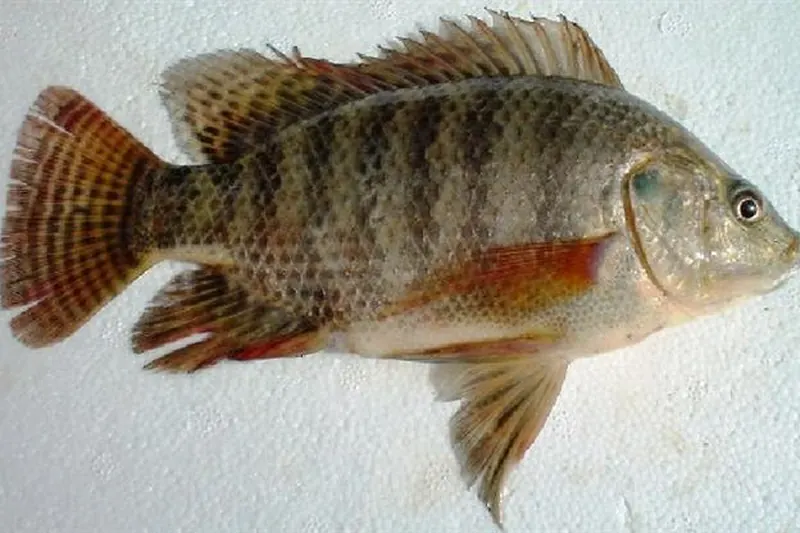
Photo: Magdy A. Saleh, Wikimedia Commons, CC BY 3.0, adjusted to 3:2
- Spawning
- Spawns only when the water is above 20 °C, then several times a year about every 30 days (FishBase). Males dig spawning pits in shallow water 0.6 to 2 m deep, and the female carries up to 200 eggs and the larvae in her mouth (FishBase); Wikipedia says eggs and fry stay in the mouth for 12 days, FishBase gives about a week for the eggs. Matures at 3 to 6 months depending on temperature (FishBase).
- Typical method
- Float fishing with light tackle and a small hook (rule of thumb)
- Top bait
- Dough or bread
How to recognise it
- Regular vertical stripes across the whole tail fin, at every age
- Deep, laterally compressed body, grey to brownish with 6 to 9 vertical olive-green bars on the sides (German Wikipedia)
- Dorsal fin edge grey or black, breeding males reddish on the head and fins
Easily confused with: The blue tilapia (Oreochromis aureus) is often confused with it: it lacks the tail stripes, has a red edge to the dorsal fin, and breeding males are bluish. Many farmed and released fish are hybrids and cannot be identified reliably by appearance (Wikipedia).
How to catch it
Methods: Float fishing with light tackle and a small hook (rule of thumb), Feeder fishing on the bottom (rule of thumb), Fly fishing with small nymphs (rule of thumb), Fishing by day, as the species feeds mainly in daylight (FishBase)
Baits: Dough or bread, Sweetcorn, Redworm or maggot, Small nymph (fly)
By day in warm water (rule of thumb based on FishBase: feeds mainly by day, spawns only above 20 °C). Mouthbrooding females do not bite (rule of thumb).
Habitat and food
Native to the coastal rivers of Israel, the Nile basin with lakes Albert, Edward and Tana, lakes Kivu, Tanganyika and Turkana, the Awash and Omo, Lake Baringo and, in West Africa, the Senegal, Gambia, Volta, Niger, Benue and Lake Chad (FishBase); absent from the Maghreb and almost all of southern Africa (Wikipedia). Widely introduced for aquaculture and often invasive (FishBase, Wikipedia). Lives in rivers, streams, lakes, ponds, irrigation and sewage canals down to 20 m (FishBase), from sea level to 1,830 m altitude, tolerating brackish water but not full sea water long-term (Wikipedia). Natural temperature range 13.5 to 33 °C (FishBase). Important for anglers in Egypt, Uganda, Kenya and Ethiopia, among others.
Mainly herbivorous: phytoplankton and algae, in some populations also aquatic plants, plus detritus and insect larvae; juveniles are more omnivorous (FishBase, Wikipedia). Feeds mainly by day (FishBase).
Size and age
FishBase: max. 60 cm (standard length), maximum published weight 4.3 kg, maximum age 9 years. English Wikipedia gives over 5 kg and over 10 years, German Wikipedia over 4 kg. Males grow larger and faster than females (Wikipedia).
Protection and rules
Size limits, bag limits, seasons and licences are set by each country, in the USA by each state. Pescaday does not list these rules: check them with your operator and the national authority before you fish. Notes with sources are given above under conservation status. Fishing travel guide
In the kitchen
One of the most common food fish in Egypt (bulti), usually fried or grilled whole (Wikipedia). A major farmed fish worldwide, about 4.13 million tonnes in 2017 according to the FAO (German Wikipedia). Cook thoroughly: undercooked fish can transmit the fluke Haplorchis (German Wikipedia).
Sources (3)
- fishbase.se/summary/Oreochromis-niloticus.html
- en.wikipedia.org/wiki/Nile_tilapia
- de.wikipedia.org/wiki/Nilbuntbarsch
Last checked 2026-10-22. Found a mistake? Write to [email protected].
Know more?
Additions, photos of your catches or a mistake in the text: write to us and we will gladly credit you as a helper.
Send a tip