Species
Mediterranean moray
Mediterranean moray: a snake shaped, nocturnal predator of rocky shores with long, sharp teeth that hides in crevices by day; a bycatch when bottom fishing at night that needs careful handling.
Muraena helena
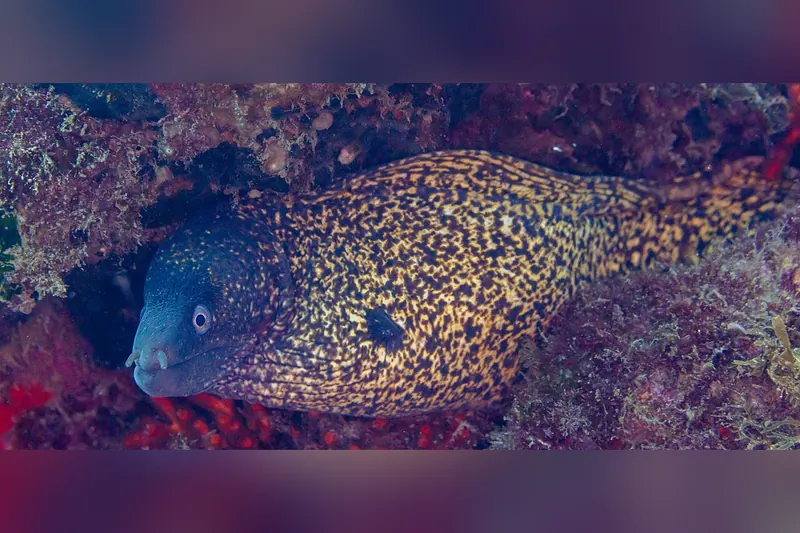
Photo: Diego Delso, Wikimedia Commons, CC BY-SA 4.0, adjusted to 3:2
- Spawning
- In summer (German Wikipedia; in the Adriatic after maturing in the warm months, English Wikipedia). It moves to deeper offshore water to spawn (FishBase), deeper than 600 m according to German Wikipedia. About 60,000 eggs (English Wikipedia); the larvae drift in the plankton for up to 2 years (German Wikipedia). Mature at 3 to 10 years at about 80 cm (German Wikipedia), FishBase gives a mean of 75.5 cm.
- Typical method
- Bottom fishing at night from rocky shores and jetties with fish bait
- Top bait
- Sardine
How to recognise it
- Eel shaped, scaleless body with slimy skin, no pectoral or pelvic fins
- Dorsal, tail and anal fins joined in one continuous fold (German Wikipedia)
- Chocolate brown with irregular yellow, cream or white spots, long mouth with sharp conical teeth
Easily confused with: The conger eel (Conger) has pectoral fins and is plain grey without spots (rule of thumb). Other morays are scarce in the Mediterranean; the Mediterranean moray is considered the most adaptable species of the rocky shore (German Wikipedia).
How to catch it
Methods: Bottom fishing at night from rocky shores and jetties with fish bait, Boat fishing over rocky ground with cut bait, Heavy leader that survives the teeth (rule of thumb), Remove the hook with long pliers, never by hand near the mouth (rule of thumb)
Baits: Sardine, Cut bait, Squid or octopus, Dead baitfish
Nocturnal, starts hunting at dusk (FishBase, German Wikipedia). Evenings and nights along rocky shores with many crevices (rule of thumb).
Habitat and food
Eastern Atlantic from the British Isles to Senegal and the Mediterranean (FishBase), plus the Canary Islands, Azores, Madeira and Cape Verde (English and German Wikipedia). Rocky bottoms with crevices, caves and overhangs, 1 to 801 m deep, usually 100 to 300 m (FishBase); German Wikipedia says from shallow water a few meters deep down to 100 to 300 m. Solitary and territorial with several hiding places (English and German Wikipedia).
Mainly bottom fish, plus cephalopods and crustaceans, also carrion (FishBase, English and German Wikipedia). It hunts at night mostly by smell; to pull prey out of crevices or tear off pieces it ties its own body into a knot for leverage (German Wikipedia). Off Sardinia it hunts together with the dusky grouper (English and German Wikipedia).
Size and age
FishBase: max. 150 cm total length, common 80 cm, maximum published weight 6.5 kg, maximum age 38 years; German Wikipedia gives the same values and a usual age of 12 to 15 years. English Wikipedia says over 15 kg, which contradicts the 6.5 kg in FishBase.
Protection and rules
Size limits, bag limits, seasons and licences are set by each country, in the USA by each state. Pescaday does not list these rules: check them with your operator and the national authority before you fish. Notes with sources are given above under conservation status. Licence pages: Spain, France, Italy, Croatia, Greece, Portugal. Fishing travel guide
In the kitchen
Very popular in ancient Rome, today a minor food fish; boiled, fried or baked (German Wikipedia, FishBase). Like all eels its blood contains toxic proteins, so the meat must be heated to at least 75 °C; it can accumulate pollutants such as organochlorine pesticides (German Wikipedia). The skin can be made into leather (FishBase).
Sources (5)
Know more?
Additions, photos of your catches or a mistake in the text: write to us and we will gladly credit you as a helper.
Send a tip