Species
Leerfish
Leerfish, also called garrick: a large silvery inshore predator with a strikingly wavy lateral line that hunts mullet in the surf and is a prized target for lure and live bait anglers.
Lichia amia
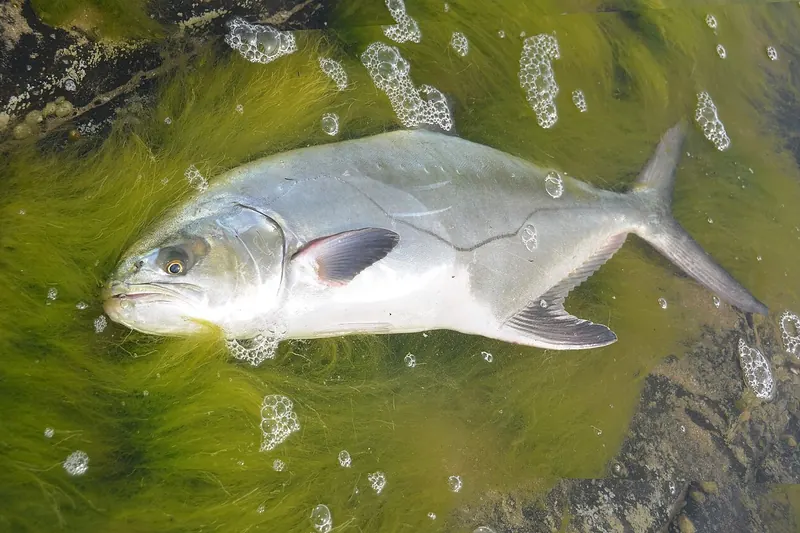
Photo: JOHN LANGRIDGE, Wikimedia Commons, CC BY 4.0, adjusted to 3:2
- Spawning
- Eggs drift in open water (FishBase). In South Africa the species grows up mainly in estuaries and moves to the sea after maturing (English Wikipedia). The sources give no spawning season for the Mediterranean.
- Typical method
- Live mullet as bait (English Wikipedia: favorite prey)
- Top bait
- Live mullet
How to recognise it
- Strongly wavy lateral line: curving up over the pectoral fin and down behind it, without scutes (FishBase)
- Brown above, silvery white below the lateral line, tips of dorsal and anal fins black
- First dorsal fin of 7 short, nearly free spines, pointed snout; juveniles up to about 12 cm with dark bars (FishBase)
Easily confused with: The German name "Gabelmakrele" is ambiguous: German Wikipedia redirects it to the bluefish (Pomatomus saltatrix) and also uses it for the pompano Trachinotus ovatus; GBIF lists it for both Trachinotus ovatus and Lichia amia. The wavy lateral line identifies the leerfish for sure (FishBase).
How to catch it
Methods: Live mullet as bait (English Wikipedia: favorite prey), Casting topwater lures and plugs in the surf, Slow trolling along the coast, Fishing estuary mouths and harbor entrances (rule of thumb)
Baits: Live mullet, Small live baitfish, Topwater lure (popper, stickbait), Floating plug, Large soft plastic (rule of thumb)
In the surf zone, where the groups hunt small fish (English Wikipedia). It pays to fish where mullet gather at estuary mouths and harbors (rule of thumb).
Habitat and food
Eastern Atlantic from the southern Bay of Biscay to South Africa including the Mediterranean, and in the western Indian Ocean to Maputo Bay in Mozambique (FishBase); English Wikipedia adds the western Black Sea. Coastal open water, 0 to 50 m deep, also in estuaries; in Namibia occasionally in the lower Kunene and Orange rivers (FishBase). Hunts in small groups in the surf zone (English Wikipedia). The South African and Angolan populations are genetically distinct (English Wikipedia).
Mainly fish, especially mullet; juveniles eat more crustaceans (FishBase, English Wikipedia).
Size and age
FishBase: max. 200 cm total length, common 100 cm, maximum published weight 50 kg; matures from about 60 cm. English Wikipedia: up to 1.5 m and over 30 kg. The sources differ and give no maximum age.
Protection and rules
Size limits, bag limits, seasons and licences are set by each country, in the USA by each state. Pescaday does not list these rules: check them with your operator and the national authority before you fish. Notes with sources are given above under conservation status. Licence pages: Spain, France, Italy, Croatia, Greece, Portugal. Fishing travel guide
In the kitchen
Caught commercially and used as a food fish (FishBase); the sources say nothing about preparation. Many anglers release large fish (rule of thumb).
Sources (7)
- fishbase.se/summary/Lichia-amia.html
- en.wikipedia.org/wiki/Leerfish
- de.wikipedia.org/wiki/Trachinotus
- de.wikipedia.org/w/index.php?title=Gabelmakrele&redirect=no
- api.gbif.org/v1/species/2391092/vernacularNames
- legislation.gov.uk/eur/2019/1241/annex/IX/2020-01-31
- legislation.gov.uk/eur/2006/1967/article/17/2020-01-31
Last checked 2026-10-22. Found a mistake? Write to [email protected].
Know more?
Additions, photos of your catches or a mistake in the text: write to us and we will gladly credit you as a helper.
Send a tip