Species
King mackerel
King mackerel, also called kingfish: a fast, migratory coastal predator of the western Atlantic and one of the most popular trolling targets from North Carolina to Texas, with its own tournament circuits.
Scomberomorus cavalla
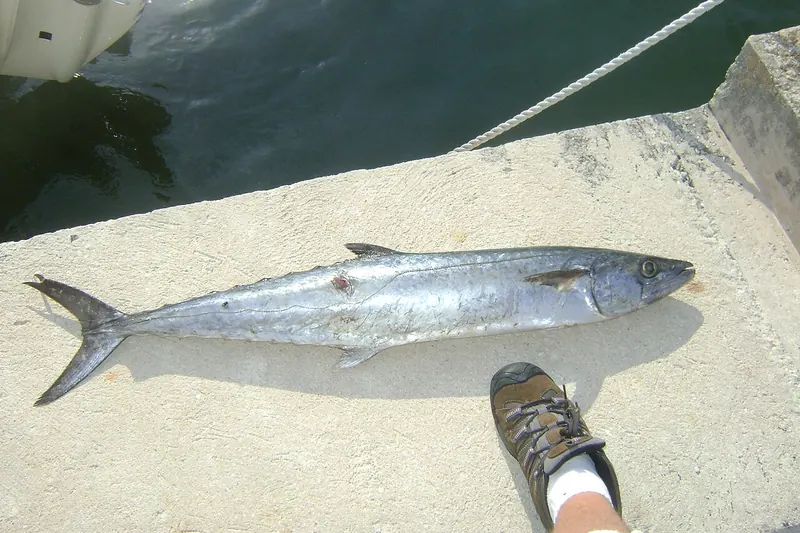
Photo: Stephen Ewen, Wikimedia Commons, CC BY-SA 3.0, adjusted to 3:2
- Spawning
- Depending on size a female sheds 50,000 to several million eggs over the spawning season, and larvae hatch after about 24 hours (Wikipedia); larvae in surface water of 26.3 to 31 °C (FishBase). Mean length at maturity 64.8 cm (FishBase).
- Typical method
- Trolling live or dead baitfish, spoons, jigs and lures (Wikipedia)
- Top bait
- Live menhaden (pogy)
How to recognise it
- Lateral line drops sharply below the second dorsal fin (FishBase, Wikipedia)
- First dorsal fin without a black patch, usually folded into a groove (Wikipedia, FishBase)
- Olive back, silver sides with a rosy sheen; young fish under about 5 kg with yellowish-brown to bronze spots (Wikipedia, FishBase)
Easily confused with: Spanish mackerel (Scomberomorus maculatus) and cero (Scomberomorus regalis): lateral line slopes gradually, black patch at the front of the first dorsal fin; Spanish mackerel have yellow spots at all sizes, cero also yellow stripes along the side (Wikipedia). Name trap in German: German Wikipedia uses "Königsmakrele" for the cero, while Catalogue of Life and WoRMS use it for S. cavalla (GBIF). Spanish and king mackerel have different federal minimum sizes (50 CFR 622.380).
How to catch it
Methods: Trolling live or dead baitfish, spoons, jigs and lures (Wikipedia), Live bait rig with two hooks on a wire leader: one through the nose, a treble in the back, because kings often hit the tail (Wikipedia), Slow trolling, the bait must swim naturally (Wikipedia), Drifting over reefs, wrecks and inlets (rule of thumb)
Baits: Live menhaden (pogy), Blue runner or cigar minnow, Squid, Spoon, Diving trolling plug
Migrates with water temperature in large schools: north in summer, south in winter (Wikipedia). From November to March the Atlantic and Gulf stocks mix south of the Florida Keys (Wikipedia).
Habitat and food
Western Atlantic from Canada via Massachusetts to São Paulo, Brazil (FishBase), common in the coastal zone from North Carolina to Brazil, occasionally as far north as the Gulf of Maine (Wikipedia). Coastal open water, 5 to 140 m, usually 5 to 15 m, often on outer reefs (FishBase); the main fishery is at 12 to 45 m, and large fish over 9 kg also enter inlets and harbours and go down to 180 m at the edge of the Gulf Stream (Wikipedia). Prefers 20 to 29 °C (Wikipedia).
Mainly fish, plus penaeid shrimp and squid (FishBase). Depending on area and season squid, menhaden and other herrings, jacks, cutlassfish, weakfish, grunts, anchovies, blue runners and cigar minnows (Wikipedia).
Size and age
FishBase: max. 184 cm, commonly around 70 cm fork length, maximum published weight 45 kg, maximum age 26 years. According to Wikipedia usually 5 to 14 kg, over 40 kg possible; at seven years females average 10 kg and males 5 kg, and almost every fish over 7 kg is a female.
Protection and rules
In the USA, each state sets its own size limits, bag limits and seasons. Pescaday does not list these rules yet: check them with the fish and wildlife agency of the state you fish in. Fishing licence USA: agency by state
In Germany we found no minimum size or closed season for this species in any state fisheries regulation.
In the kitchen
Mostly sold fresh as fillets, steaks or whole; the raw flesh is greyish because of its high fat content, good for grilling, frying, baking and, for large fish, smoking (Wikipedia). The FDA advises children and pregnant women not to eat it because of mercury (Wikipedia); FishBase reports ciguatera in some areas.
Sources (9)
- fishbase.se/summary/Scomberomorus-cavalla.html
- en.wikipedia.org/wiki/King_mackerel
- de.wikipedia.org/wiki/Scomberomorus_cavalla
- de.wikipedia.org/wiki/K%C3%B6nigsmakrele
- api.gbif.org/v1/species/2374282/vernacularNames
- ecfr.gov/current/title-50/chapter-VI/part-622/subpart-Q/section-622.38
- ecfr.gov/current/title-50/chapter-VI/part-622/subpart-Q/section-622.38
- fisheries.noaa.gov/species/king-mackerel
- fisheries.noaa.gov/southeast/rules-regulations/fishing-regulations-and
Last checked 2026-10-22. Found a mistake? Write to [email protected].
Know more?
Additions, photos of your catches or a mistake in the text: write to us and we will gladly credit you as a helper.
Send a tip