Species
Atlantic horse mackerel
Atlantic horse mackerel, also called scad: a slim schooling fish with a row of bony scutes along the lateral line, a food fish in southern Europe and a common bait fish (FishBase).
Trachurus trachurus
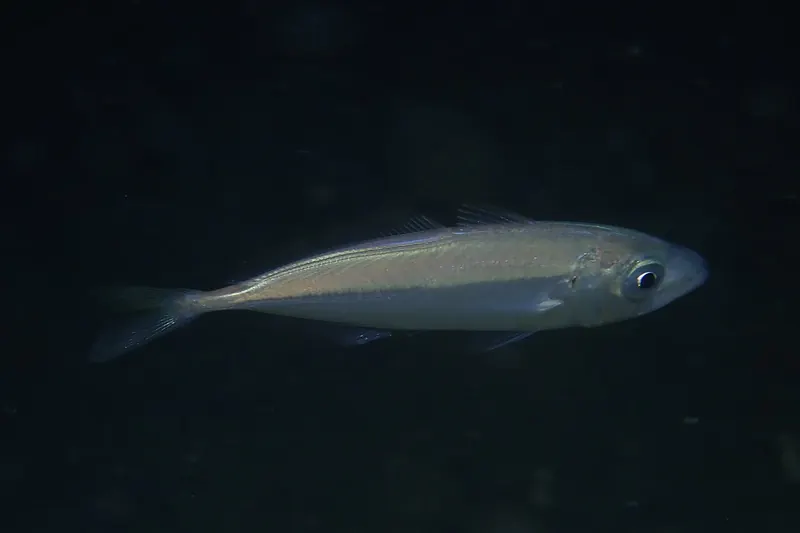
Photo: jujurenoult, Wikimedia Commons, CC BY 4.0, adjusted to 3:2
- Spawning
- A batch spawner, up to 140,000 eggs per female, larvae 5 mm at hatching (FishBase, English Wikipedia). The western stock spawns in early spring between the Bay of Biscay and Ireland, the North Sea stock in summer in the southern North Sea (FishBase); off Ireland June to August with a peak in July, off Mauritania November to January (English Wikipedia). The sources give no spawning season for the Mediterranean. Matures at 25 cm and 3 to 4 years (German Wikipedia), FishBase gives a mean of 22.9 cm.
- Typical method
- Sabiki rig with small feathers or flashers from jetties and boats
- Top bait
- Sabiki rig with small feathers or flashers
How to recognise it
- Curved row of 33 to 40 bony scutes along the lateral line, the scutes taller than the eye diameter (English and German Wikipedia)
- Distinct black spot on the gill cover
- Back blue green to dark blue, silver flanks, tall first dorsal fin (FishBase)
Easily confused with: The Mediterranean horse mackerel (Trachurus mediterraneus) is very similar but has much smaller scales along the lateral line (German Wikipedia); juveniles often school with it and with the blue jack mackerel Trachurus picturatus (English Wikipedia). The Atlantic mackerel (Scomber) has no scutes but small finlets behind the dorsal and anal fins (rule of thumb).
How to catch it
Methods: Sabiki rig with small feathers or flashers from jetties and boats, Light spinning with small spoons, Float fishing with cut bait in harbors, Night fishing under harbor lights (rule of thumb; commercial fishers attract them with lights, English Wikipedia)
Baits: Sabiki rig with small feathers or flashers, Small spoon, Cut bait, Shrimp, Small soft plastic (rule of thumb)
In summer close inshore over sand, in winter farther out and deeper (German Wikipedia). Evenings and nights under harbor lights (rule of thumb).
Habitat and food
Eastern Atlantic from Norway to the Cape of Good Hope and on to southern Mozambique, plus the Baltic, North Sea, Mediterranean and Black Sea (FishBase). If the Cape horse mackerel (Trachurus capensis) is counted as a separate species, this one is limited to the northeastern Atlantic (English Wikipedia). In open water over sand, 0 to 1050 m deep, usually 100 to 200 m (FishBase); in summer close inshore over sand, in winter farther out down to 500 m (German Wikipedia). Migrates north in summer and returns as the water cools (English Wikipedia).
Copepods, shrimp, small fish and squid (English Wikipedia); in the Aegean mainly copepods, krill and mysids, and in fish over 16.9 cm mostly fish larvae and fish (English Wikipedia). German Wikipedia mentions herring and sprat. Juveniles often shelter under jellyfish and also feed on their tentacles (German Wikipedia).
Size and age
FishBase: max. 70 cm total length, common 22 cm fork length, maximum published weight 2.0 kg. English Wikipedia: max. 60 cm fork length, usually about 25 cm, up to 1.5 kg; maximum age 24 years in South Africa and 40 years in the northeastern Atlantic. German Wikipedia: 40 to 70 cm, usually just over 20 cm.
Protection and rules
Size limits, bag limits, seasons and licences are set by each country, in the USA by each state. Pescaday does not list these rules: check them with your operator and the national authority before you fish. Notes with sources are given above under conservation status. Licence pages: Spain, France, Italy, Croatia, Greece, Portugal. Fishing travel guide
In the kitchen
Sold fresh, frozen, salted and dried, smoked or canned; fried, broiled or baked; pleasant flavor and oily, delicate flesh rich in omega 3 fatty acids (English Wikipedia). On the Iberian Peninsula often made into escabeche, an important ingredient of Sicilian cooking, and exported to Japan as aji for sushi (English Wikipedia). North Sea catches go mostly to fishmeal (German Wikipedia).
Sources (5)
- fishbase.se/summary/Trachurus-trachurus.html
- en.wikipedia.org/wiki/Atlantic_horse_mackerel
- de.wikipedia.org/wiki/Bastardmakrele
- legislation.gov.uk/eur/2019/1241/annex/IX/2020-01-31
- legislation.gov.uk/eur/2006/1967/article/17/2020-01-31
Last checked 2026-10-22. Found a mistake? Write to [email protected].
Know more?
Additions, photos of your catches or a mistake in the text: write to us and we will gladly credit you as a helper.
Send a tip