Species
Gilthead seabream
Gilthead seabream, sold as dorade or orata: the best known seabream of the Mediterranean, with a golden band between the eyes and strong molar teeth that crack mussels and crabs.
Sparus aurata
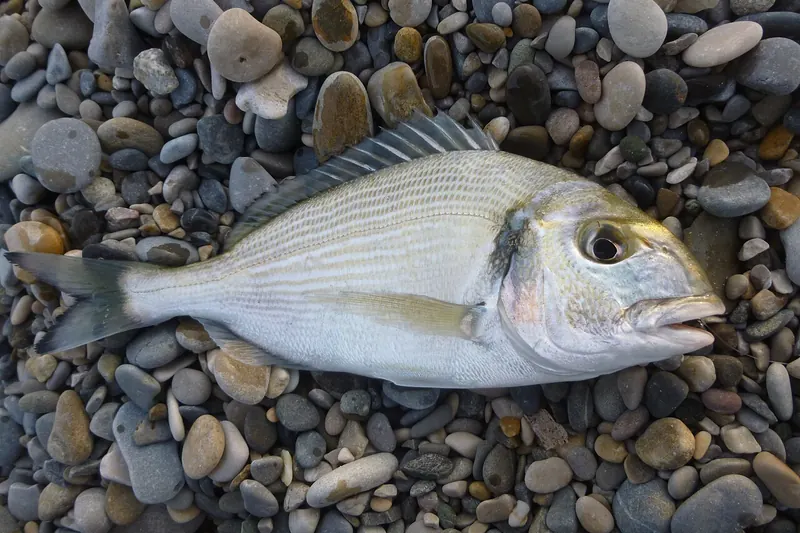
Photo: Jessy138, Wikimedia Commons, CC BY-SA 4.0, adjusted to 3:2
- Spawning
- Usually October to December, in several batches over the whole period (FishBase). The gilthead changes sex: it matures as a male in its first or second year and becomes a female after its second or third year (FishBase).
- Typical method
- Bottom fishing from the shore, jetties and rocks with natural bait
- Top bait
- Mussel meat
How to recognise it
- Golden bar across the forehead between the eyes
- Large dark spot at the top of the gill cover, gill cover edge reddish
- Deep, compressed body, silver with a blue grey back, thick lips
Easily confused with: Sargo breams (Diplodus) have a black spot on the tail base or dark vertical bars and lack the golden forehead band. In the literature the name is confused with the Pacific species Pagrus auratus; reports from New Zealand refer to that species (FishBase).
How to catch it
Methods: Bottom fishing from the shore, jetties and rocks with natural bait, Surf casting from sandy beaches, Light boat fishing over sand and seagrass, Fishing in lagoons and harbor mouths (rule of thumb)
Baits: Mussel meat, Crabs and small crustaceans, Ragworm, Shrimp, Squid strips (rule of thumb)
In spring giltheads move into lagoons and estuaries, in late fall they spawn (FishBase). They feed by day, but in heavily fished areas they become more active at night (German Wikipedia). After a storm, when the surf washes out mussels, the coast is considered especially productive (rule of thumb).
Habitat and food
Eastern Atlantic from the British Isles past the Strait of Gibraltar to Cape Verde and around the Canary Islands, plus the whole Mediterranean; also reported from the Black Sea (FishBase). Over sand, in seagrass beds and in the surf zone, usually 1 to 30 m deep, adults down to 150 m (FishBase). In spring often in brackish coastal lagoons and estuaries (FishBase). German Wikipedia gives 5 to 150 m and also mentions reefs and rocky shores. Mostly solitary or in small groups and sedentary (FishBase).
Mainly mussels and oysters, plus snails and crabs such as shore crabs; also squid, cuttlefish, small fish such as silversides, sardines and anchovies, and some plant material (FishBase, English and German Wikipedia). It cracks the hard shells with its molar teeth.
Size and age
FishBase: max. 70 cm total length, common 35 cm standard length, maximum published weight 17.2 kg, maximum age 14 years; mean length at maturity 36.5 cm. German Wikipedia says usually 25 to 35 cm and up to 2.5 kg.
Protection and rules
Size limits, bag limits, seasons and licences are set by each country, in the USA by each state. Pescaday does not list these rules: check them with your operator and the national authority before you fish. Notes with sources are given above under conservation status. Licence pages: Spain, France, Italy, Croatia, Greece, Portugal. Fishing travel guide
In the kitchen
Considered the finest seabream for the table: mild, sweet white flesh that breaks into small flakes (English Wikipedia); grilled, pan fried, baked, steamed or raw (German Wikipedia). Most dorade on sale is farmed: about 140,000 tonnes in 2010 against 6,100 to 9,600 tonnes of wild catch per year in 2000 to 2009 (English Wikipedia). English Wikipedia names Turkey ahead of Greece as the largest producer, German Wikipedia Greece and Croatia.
Sources (6)
- fishbase.se/summary/Sparus-aurata.html
- en.wikipedia.org/wiki/Gilt-head_bream
- de.wikipedia.org/wiki/Goldbrasse
- legislation.gov.uk/eur/2019/1241/annex/IX/2020-01-31
- legislation.gov.uk/eur/2006/1967/article/17/2020-01-31
- eur-lex.europa.eu/legal-content/EN/TXT/?uri=CELEX:32019R1241
Last checked 2026-10-22. Found a mistake? Write to [email protected].
Know more?
Additions, photos of your catches or a mistake in the text: write to us and we will gladly credit you as a helper.
Send a tip