Species
Giant trevally
Giant trevally, GT to anglers, ulua in Hawaii. The largest jack of its genus: a thickset reef predator that smashes poppers on the surface and draws anglers to the Seychelles, Mozambique, Zanzibar and Oman.
Caranx ignobilis
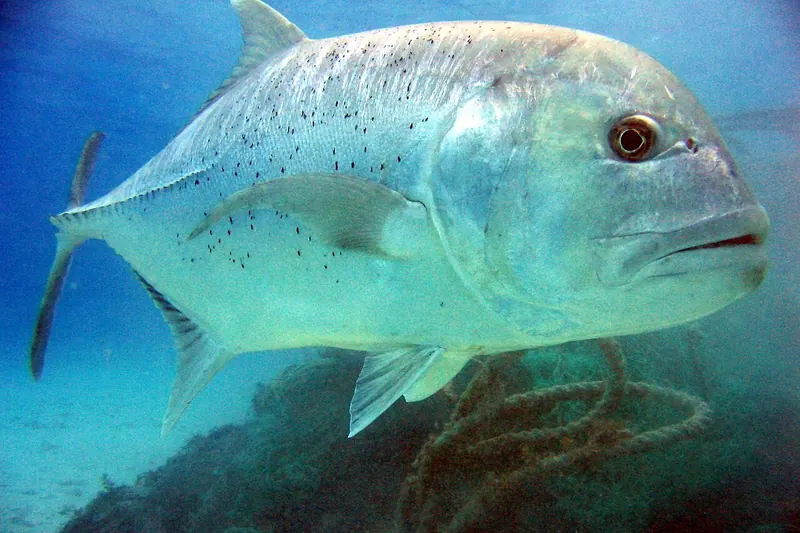
Photo: Dr. Dwayne Meadows, NOAA/NMFS/OPR, Wikimedia Commons, Public domain, adjusted to 3:2
- Spawning
- In the warmer months, in southern Africa from July to March with a peak from November to March, also timed by the lunar cycle; large schools spawn over reefs and banks (Wikipedia). Matures at 54 to 61 cm and three to four years (Wikipedia), FishBase gives 60 cm.
- Typical method
- Popping and stickbait fishing along reef edges (Wikipedia)
- Top bait
- Large popper
How to recognise it
- Steep, blunt head profile, deep and laterally compressed body
- Strong scutes along the lateral line in front of the deeply forked tail
- Silver-grey, large males often almost black; no black spot on the gill cover, breast scaleless except for a patch in front of the pelvic fins
Easily confused with: The Atlantic crevalle jack (Caranx hippos) looks similar and was long confused with it (Wikipedia), but lives in the Atlantic. The smaller bluefin trevally (Caranx melampygus) has blue fins and hybridises with the giant trevally in Hawaii (FishBase, Wikipedia). In South African estuaries juveniles often school with the brassy trevally (Caranx papuensis) (Wikipedia).
How to catch it
Methods: Popping and stickbait fishing along reef edges (Wikipedia), Jigging over banks and drop-offs (Wikipedia), Fly fishing on the flats, for example in the Seychelles (rule of thumb), Bait fishing with baitfish or squid on strong tackle (Wikipedia)
Baits: Large popper, Stickbait, Metal jig, Live baitfish, Large streamer (fly)
Most active at dawn and dusk (Wikipedia, for South Africa and Hawaii). The best travel season depends on the venue; ask your operator before booking (rule of thumb).
Habitat and food
Indo-Pacific from the Red Sea and East Africa to Hawaii and the Marquesas, north to southern Japan, south to northern Australia (FishBase); its western limit is the southern tip of South Africa, plus island groups such as the Maldives, Seychelles and Madagascar (Wikipedia). Reefs, lagoons, bays, flats and channels at 10 to 188 m (FishBase); older fish move to outer reefs and drop-offs, often deeper than 80 m (Wikipedia). Juveniles live in estuaries, even upper river reaches and coastal lakes, in South Africa at salinities of 0.5 to 38 ppt (Wikipedia). Destinations for anglers include the Seychelles, Mozambique, Tanzania (Zanzibar), South Africa, Oman and the Maldives.
Apex predator that eats mainly fish, plus crustaceans, cephalopods and molluscs (Wikipedia); also crabs and spiny lobsters at night (FishBase). Off South Africa it hunts mainly by day, especially at dawn and dusk, off Zanzibar mostly at night. On Farquhar Atoll (Seychelles) it leaps for fledgling sooty terns (Wikipedia).
Size and age
FishBase: max. 170 cm, commonly 100 cm, maximum published weight 80 kg; English and German Wikipedia give the same maximums. Fish over 50 kg are not uncommon in sport fishing according to Wikipedia. Otolith growth curves put a fish of about 1 m at around eight years and a 1.7 m fish at around 24 years (Wikipedia).
Protection and rules
Size limits, bag limits, seasons and licences are set by each country, in the USA by each state. Pescaday does not list these rules: check them with your operator and the national authority before you fish. Notes with sources are given above under conservation status. Fishing travel guide
In the kitchen
Table quality is rated from poor to excellent; large fish can carry ciguatera toxin, which is why it is rarely eaten in Hawaii (English and German Wikipedia, FishBase). Large GTs are best released (rule of thumb).
Sources (5)
- fishbase.se/summary/Caranx-ignobilis.html
- en.wikipedia.org/wiki/Giant_trevally
- de.wikipedia.org/wiki/Caranx_ignobilis
- acts.co.za/marine-living-resources-act-1998/r1111_annexure_7__recreati
- acts.co.za/marine-living-resources-act-1998/13__permits.php
Last checked 2026-10-22. Found a mistake? Write to [email protected].
Know more?
Additions, photos of your catches or a mistake in the text: write to us and we will gladly credit you as a helper.
Send a tip