Species
Gag grouper
Gag grouper, or simply gag: a gray, marbled grouper of the reefs and hard bottom off the US Southeast and in the Gulf of Mexico, prized as a food fish and therefore tightly regulated.
Mycteroperca microlepis
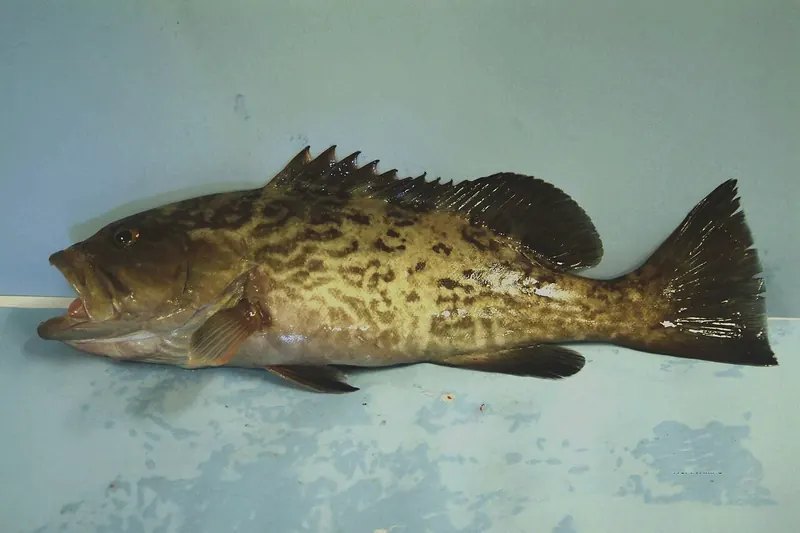
Photo: SEFSC Pascagoula Laboratory; Collection of Brandi Noble, NOAA/NMFS/SEFSC., Wikimedia Commons, Public domain, adjusted to 3:2
- Spawning
- Winter and spring in offshore spawning aggregations: mid January to early May in the South Atlantic and late January to mid April in the Gulf (NOAA Fisheries); English Wikipedia gives December to May between North Carolina and Florida, peaking in late March and early April, at about 70 m. All fish start as females and later become males: NOAA Fisheries gives maturity around age 4 and sex change around age 8, English Wikipedia maturity at 5 to 6 years and sex change usually at 10 to 11 years.
- Typical method
- Bottom fishing from a boat over ledges and reefs
- Top bait
- Live baitfish such as pinfish or sardines (rule of thumb)
How to recognise it
- Gray to brownish gray with dark blotches and wavy lines that look marbled on the back
- Pelvic, anal and tail fins with a bluish black edge; big males gray with a dark belly (charcoal belly)
- Square tail without extended tips, no yellow around the mouth
Easily confused with: The blotch pattern resembles the black grouper (Mycteroperca bonaci). Scamp (M. phenax) and yellowmouth grouper (M. interstitialis) have streamer tips on the tail, and the yellowmouth also has yellow around the mouth (English Wikipedia).
How to catch it
Methods: Bottom fishing from a boat over ledges and reefs, Live bait on a heavy bottom rig (rule of thumb), Trolling deep diving plugs (rule of thumb), Pull the fish off the bottom fast after the bite, or it holes up in the rocks (rule of thumb)
Baits: Live baitfish such as pinfish or sardines (rule of thumb), Squid, Cut bait, Deep diving plug
In the South Atlantic the fishery is closed from January through April (NOAA Fisheries); Gulf seasons change from year to year. Outside the closure, ledges in 10 to 40 m produce most fish (rule of thumb, depth from English Wikipedia).
Habitat and food
Western Atlantic with separate populations: in the north Bermuda and the US East Coast from North Carolina to the Yucatán Peninsula of Mexico, juveniles north to Massachusetts, almost absent from Cuba; in the south Brazil from Rio de Janeiro to Santa Catarina (English Wikipedia, FishBase). Juveniles live in estuaries and seagrass beds, adults farther offshore over rocky bottom, mostly at 10 to 40 m, recorded to 152 m (English Wikipedia); FishBase gives 30 to 160 m. One of the most common groupers on rocky ledges in the eastern Gulf of Mexico (FishBase).
Adults eat fish, including smaller gag, plus crabs, shrimp and cephalopods; the fish are mainly herrings, porgies, jacks and pompanos, drums and mullet. Juveniles under 20 cm eat crustaceans in shallow seagrass beds (English Wikipedia, FishBase).
Size and age
FishBase: max. 145 cm, common around 50 cm, maximum published weight 36.5 kg, maximum age 31 years. NOAA Fisheries: more than 3 feet long, up to 50 lb, up to 30 years. English Wikipedia repeats the FishBase values.
Protection and rules
In the USA, each state sets its own size limits, bag limits and seasons. Pescaday does not list these rules yet: check them with the fish and wildlife agency of the state you fish in. Fishing licence USA: agency by state
In Germany we found no minimum size or closed season for this species in any state fisheries regulation.
In the kitchen
Sought after food fish, targeted by commercial and recreational fishermen. Ciguatera poisoning has been reported after eating its flesh (English Wikipedia): follow local advisories.
Sources (3)
- fishbase.se/summary/Mycteroperca-microlepis.html
- en.wikipedia.org/wiki/Gag_(fish)
- fisheries.noaa.gov/species/gag-grouper
Last checked 2026-10-22. Found a mistake? Write to [email protected].
Know more?
Additions, photos of your catches or a mistake in the text: write to us and we will gladly credit you as a helper.
Send a tip