Species
Flathead catfish
The flathead catfish, also called mudcat or shovelhead, is North America's second-largest catfish: a homebody predator with a broad, flat head and protruding lower jaw that eats almost only live prey and lurks in the woody cover of big rivers (English and German Wikipedia).
Pylodictis olivaris
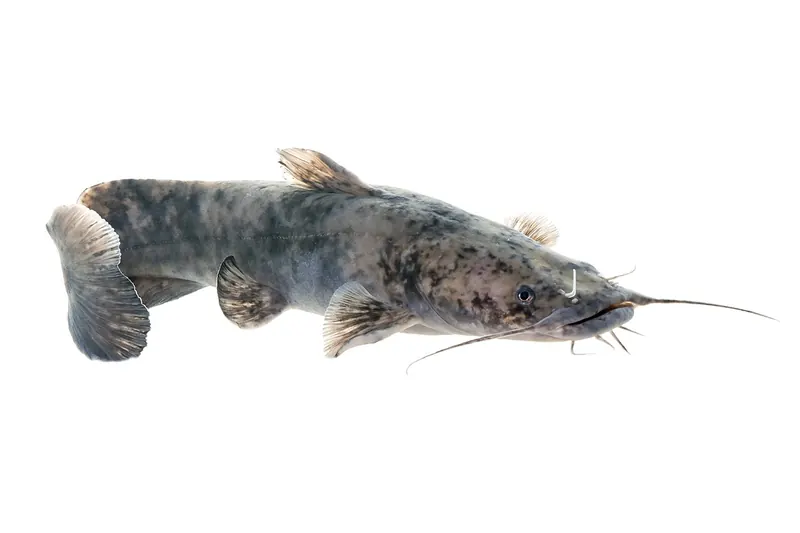
Photo: USFWS Mountain-Prairie, Wikimedia Commons, Public domain, adjusted to 3:2
- Spawning
- Late June and early July at 19 to 24 °C (66 to 75 °F) water temperature and steady current, in nests by submerged logs and debris; the male builds the nest, guards the clutch and fans it with oxygen; on average 2,640 eggs per kg of body weight, roughly 100,000 per female (Wikipedia). German Wikipedia gives June and July.
- Typical method
- Live bait fishing at woody cover and undercut banks (Wikipedia on habitat, rule of thumb)
- Top bait
- Live sunfish (where legal)
How to recognise it
- Broad, flat head, small eyes, lower jaw clearly protruding (Wikipedia)
- Olive to brown, often darkly mottled, belly white to yellow; upper tail lobe with a light margin or spot, especially in young fish (English and German Wikipedia)
- Tail only slightly notched, short rounded anal fin with 14 to 17 rays (Wikipedia)
Easily confused with: Channel and blue catfish: deeply forked tail, protruding upper rather than lower jaw and a much longer anal fin (Wikipedia, rule of thumb). Bullheads: smaller, with a square tail and without the broad flat head (rule of thumb).
How to catch it
Methods: Live bait fishing at woody cover and undercut banks (Wikipedia on habitat, rule of thumb), Bottom fishing at night in pools below eddies (rule of thumb), Float rig with live bait over brush piles (rule of thumb), Slowly hopping a jig with a curly tail along the bottom (rule of thumb)
Baits: Live sunfish (where legal), Live shad or minnow, Live small bullhead, where legal, Large curly tail grub on a jig head, Crayfish
In spring and summer most active from midnight to dawn, in fall and winter hardly at all (Wikipedia). Warm water above 19 °C (66 °F) brings the strongest appetite (Wikipedia).
Habitat and food
Lower Great Lakes and Mississippi basin from western Pennsylvania to the White-Little Missouri system in North Dakota, south to Louisiana; Gulf Slope from Mobile Bay to Mexico; transplanted elsewhere in the US (FishBase). Adults live in pools with logs and debris in small to large rivers, also lakes and reservoirs; young in rocky and sandy runs (FishBase). Prefers medium to large, warm rivers with steady, slow current, undercut banks and woody debris; home range usually less than 2 km (Wikipedia). In some waters where it was introduced it harms native species (German and English Wikipedia).
Prefers live prey: fish, insects, annelid worms and crustaceans, other catfish too; up to about 100 mm mainly insect larvae, from about 250 mm almost only fish, and from about six years no crayfish at all (Wikipedia). Appetite rises sharply from about 19 °C (66 °F) and stays high up to about 32 °C (90 °F); most flatheads stop eating at 11 °C (52 °F) (Wikipedia).
Size and age
FishBase: max. 155 cm, maximum published weight 55.8 kg, maximum age 25 years, mature at about 48 cm. Adults usually 38 to 114 cm (15 to 45 in), maximum age 28 years (Wikipedia); German Wikipedia gives up to 20 years. World angling record according to Wikipedia: 55.79 kg (123 lb) from Elk City Reservoir, Kansas, 1998; a fish taken by other methods from the Arkansas River in 1982 measured 175 cm (69 in) and weighed 63.45 kg (139 lb 14 oz).
Protection and rules
In the USA, each state sets its own size limits, bag limits and seasons. Pescaday does not list these rules yet: check them with the fish and wildlife agency of the state you fish in. Fishing licence USA: agency by state
In Germany we found no minimum size or closed season for this species in any state fisheries regulation.
In the kitchen
Anglers consider it good eating (rule of thumb); because even the young are cannibalistic, it plays hardly any role in aquaculture (Wikipedia).
Sources (5)
- fishbase.de/summary/Pylodictis-olivaris.html
- en.wikipedia.org/wiki/Flathead_catfish
- de.wikipedia.org/wiki/Flachkopfwels
- api.gbif.org/v1/species/2341077/vernacularNames
- tpwd.texas.gov/regulations/outdoor-annual/fishing/freshwater-fishing/b
Last checked 2026-10-22. Found a mistake? Write to [email protected].
Know more?
Additions, photos of your catches or a mistake in the text: write to us and we will gladly credit you as a helper.
Send a tip