Species
Dusky kob (mulloway)
Dusky kob, also kob or kabeljou in South Africa, mulloway or jewfish in Australia. A large silver-bronze croaker of the surf and estuaries and one of South Africa's most important angling fish.
Argyrosomus japonicus
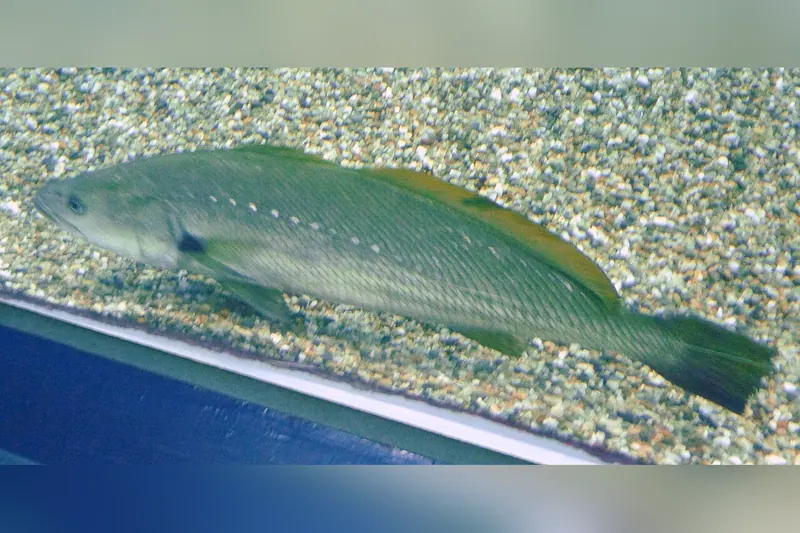
Photo: Show_ryu, Wikimedia Commons, CC BY-SA 3.0, adjusted to 3:2
- Spawning
- Fish from the Western and Eastern Cape migrate to KwaZulu-Natal to spawn in winter and spring (Wikipedia). Matures on average at 100 cm (FishBase).
- Typical method
- Surf fishing with natural bait (Wikipedia: kob under 110 cm are mainly caught by surf and estuary anglers)
- Top bait
- Live mullet
How to recognise it
- Silver with a bronze-green back and copper-coloured head
- Row of white spots along the lateral line
- Tail angular in juveniles, rounded in large fish
Easily confused with: Southern Africa has other kob species of the genus Argyrosomus; two new species were described there in 1995 (FishBase, main reference Griffiths and Heemstra 1995). South Africa's catch rules apply to all Argyrosomus species together (GN R1111, Annexure 7). The meagre (Argyrosomus regius) is the related species of the eastern Atlantic (German Wikipedia).
How to catch it
Methods: Surf fishing with natural bait (Wikipedia: kob under 110 cm are mainly caught by surf and estuary anglers), Estuary fishing with live baitfish or soft plastics, often at night (rule of thumb), Bottom fishing from a boat on deeper reefs, where the big fish hold (Wikipedia), Casting soft plastics around bridges, breakwaters and rocks (rule of thumb)
Baits: Live mullet, Squid, Sardine or cut bait, Large soft plastic, Shrimp
In KwaZulu-Natal during the spawning run in winter and spring (Wikipedia). Calm, discoloured water and night-time are considered good (rule of thumb).
Habitat and food
Indo-West Pacific: the south-east coast of Africa from the Cape of Good Hope to southern Mozambique, Pakistan and north-west India, South Korea, Japan and the Chinese coast to Hong Kong, and the whole southern coast of Australia (FishBase). In South Africa from False Bay to southern Mozambique, from the surf zone down to 120 m (Wikipedia). Adults live near shore beyond the surf zone, juveniles only inshore, entering estuaries at about 30 cm (FishBase). Main destinations for anglers are South Africa, Mozambique and Australia.
Predator that feeds throughout the water column: juveniles under 15 cm mainly eat mysid shrimp, larger fish take small and then larger fish and squid (Wikipedia).
Size and age
FishBase: max. 181 cm, maximum published weight 75 kg. Wikipedia gives up to 2 m and 82 kg, for South Africa 2 m and 80 kg; the largest fish caught in Australia weighed 42.5 kg, about half the South African record. The sources disagree.
Protection and rules
Size limits, bag limits, seasons and licences are set by each country, in the USA by each state. Pescaday does not list these rules: check them with your operator and the national authority before you fish. Notes with sources are given above under conservation status. Fishing travel guide
In the kitchen
An important food fish, also farmed (FishBase). Because of its threatened status, large spawning fish are best released (rule of thumb).
Sources (5)
- fishbase.se/summary/Argyrosomus-japonicus.html
- en.wikipedia.org/wiki/Argyrosomus_japonicus
- de.wikipedia.org/wiki/Adlerfisch
- acts.co.za/marine-living-resources-act-1998/r1111_annexure_7__recreati
- acts.co.za/marine-living-resources-act-1998/13__permits.php
Last checked 2026-10-22. Found a mistake? Write to [email protected].
Know more?
Additions, photos of your catches or a mistake in the text: write to us and we will gladly credit you as a helper.
Send a tip