Species
Dusky grouper
Dusky grouper: a massive dark brown rock dweller with pale marbling and a golden belly that can live to 60 years (FishBase) and whose numbers have fallen sharply.
Epinephelus marginatus
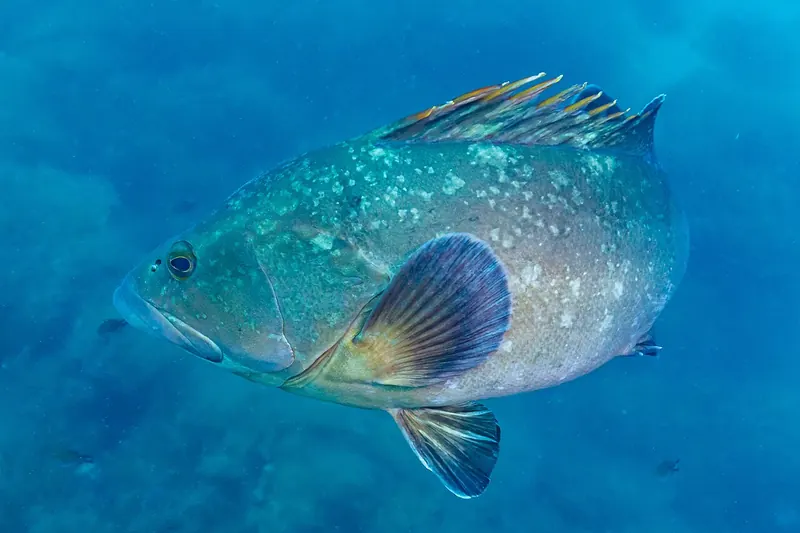
Photo: Diego Delso, Wikimedia Commons, CC BY-SA 4.0, adjusted to 3:2
- Spawning
- In the Mediterranean June to September in small aggregations of a few dozen fish at fixed sites, for example at the Medes Islands (Spain), off Lampedusa (Italy) and in Port-Cros National Park (France); off Brazil November to December (English Wikipedia). FishBase says summer, German Wikipedia March to June for the northeastern Atlantic. Hermaphrodite: starts as a female, mature at about 5 years, usually turns male at 9 to 16 years and 80 to 90 cm (English Wikipedia, FishBase).
- Typical method
- Bottom fishing from a boat over rock with live bait
- Top bait
- Live squid or octopus
How to recognise it
- Head and back dark reddish brown or grey, belly usually golden yellow
- Irregular pale greenish yellow or silvery grey blotches in vertical rows on head and body
- Large head with a wide mouth and protruding lower jaw, anal and tail fins with a narrow white edge (FishBase, English Wikipedia)
Easily confused with: Its genus is changing: a 2018 revision moved it to Mycteroperca as Mycteroperca marginata (German Wikipedia), while FishBase still lists it as Epinephelus marginatus. Other groupers live in the Mediterranean too; the same EU minimum conservation reference size applies to all Epinephelus species (Regulation (EU) 2019/1241, Annex IX Part A).
How to catch it
Methods: Bottom fishing from a boat over rock with live bait, Vertical jigging along reef edges, Slow trolling close over rocks, Gentle fight and quick release (rule of thumb)
Baits: Live squid or octopus, Live baitfish, Crabs, Large jig (rule of thumb)
Readily takes a bait (FishBase). In summer during spawning (June to September) the fish gather at fixed spawning sites (English Wikipedia); better not to target them there and then (rule of thumb).
Habitat and food
The whole Mediterranean and the eastern Atlantic from the southern Bay of Biscay to the southern tip of Africa, on to southern Mozambique and southern Madagascar; also southeastern Brazil, Uruguay and Argentina; strays to the British Isles and Normandy (FishBase). According to English Wikipedia it is otherwise not found north of Portugal in the eastern Atlantic. Rocky reefs from 8 to 300 m deep, usually down to 50 m (FishBase), often near Posidonia seagrass beds (English Wikipedia). Adults are solitary and territorial, juveniles live closer inshore down to rock pools (FishBase). Inside protected areas even large fish stay in shallow water (English Wikipedia).
Mainly crabs and octopus, plus mollusks and other crustaceans; the larger the fish, the more fish it eats, mostly reef fish (FishBase, English Wikipedia). Off Sardinia it has been seen hunting together with the Mediterranean moray (German Wikipedia).
Size and age
FishBase: max. 150 cm total length, maximum published weight 60 kg, maximum age 60 years; mean length at maturity 49.2 cm. English Wikipedia: up to 150 cm standard length, commonly 90 cm, up to 50 years. German Wikipedia: usually under 1 m, average 12 kg, up to 50 years. The sources differ on maximum age.
Protection and rules
Size limits, bag limits, seasons and licences are set by each country, in the USA by each state. Pescaday does not list these rules: check them with your operator and the national authority before you fish. Notes with sources are given above under conservation status. Licence pages: Spain, France, Italy, Croatia, Greece, Portugal. Fishing travel guide
In the kitchen
Considered a delicacy in some countries; the Spanish saying goes "De la mar el mero y de la tierra el carnero", from the sea the grouper, from the land the lamb (English Wikipedia). Given the reduced stocks, releasing it is the better choice (rule of thumb).
Sources (6)
- fishbase.se/summary/Epinephelus-marginatus.html
- en.wikipedia.org/wiki/Epinephelus_marginatus
- de.wikipedia.org/wiki/Brauner_Zackenbarsch
- api.gbif.org/v1/species/2388507/iucnRedListCategory
- legislation.gov.uk/eur/2019/1241/annex/IX/2020-01-31
- legislation.gov.uk/eur/2006/1967/article/17/2020-01-31
Last checked 2026-10-22. Found a mistake? Write to [email protected].
Know more?
Additions, photos of your catches or a mistake in the text: write to us and we will gladly credit you as a helper.
Send a tip