Species
Dogtooth tuna
Dogtooth tuna, also white tuna. A powerful reef predator with conical teeth that bolts straight for the bottom when hooked; it is fished mainly along walls and seamounts in the Indian Ocean and western Pacific.
Gymnosarda unicolor
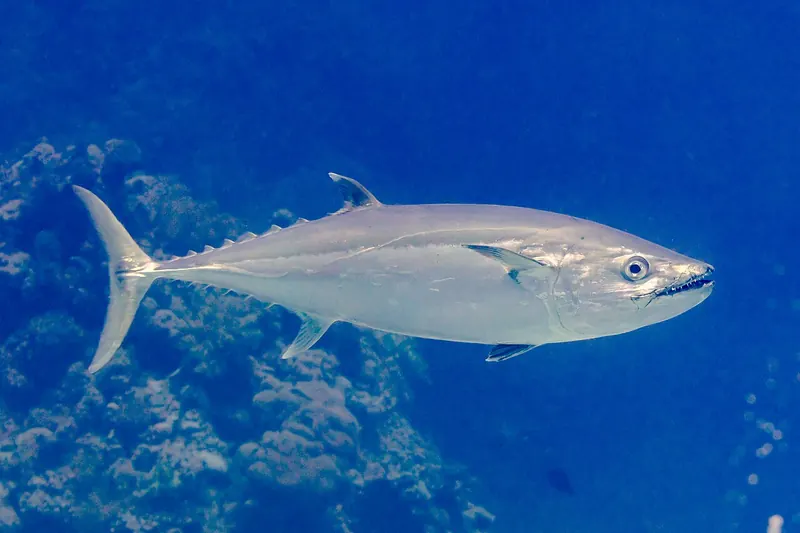
Photo: Diego Delso, Wikimedia Commons, CC BY-SA 4.0, adjusted to 3:2
- Spawning
- Little is known about reproduction; around Fiji it spawns in the summer months and matures from about 65 cm (German Wikipedia).
- Typical method
- High-speed jigging with metal jigs on drop-offs and seamounts (Wikipedia)
- Top bait
- Metal jig
How to recognise it
- Back and upper sides brilliant blue-black, silvery below, no lines or spots
- Large mouth with big conical teeth in both jaws
- Strongly wavy lateral line, body almost scaleless behind the corselet, pale tips on the second dorsal and anal fins
Easily confused with: True tunas (Thunnus) lack such big conical teeth and such a wavy lateral line (rule of thumb based on the FishBase description). Despite its name the dogtooth tuna is not a true tuna but a bonito (Wikipedia).
How to catch it
Methods: High-speed jigging with metal jigs on drop-offs and seamounts (Wikipedia), Trolling deep-diving plugs (Wikipedia), Drifting or trolling live baitfish such as rainbow runner (Wikipedia), Popping over shallow reefs (rule of thumb)
Baits: Metal jig, Deep-diving plug, Live baitfish, Popper
The sources give no season. When hooked the fish runs straight for the bottom and often cuts the line on the reef (Wikipedia), so use strong tackle and apply pressure at once (rule of thumb). Ask your operator about the season for each venue.
Habitat and food
Indo-Pacific from the Red Sea and East Africa to French Polynesia, north to Japan, south to Australia (FishBase), also around Madagascar (German Wikipedia); not at Hawaii (Wikipedia). An offshore species found mainly around coral reefs at 0 to 250 m (FishBase), smaller fish on shallow reefs, large ones on deep drop-offs, seamounts and steep walls (Wikipedia). Prefers 20 to 28 °C (FishBase). Popular destinations according to Wikipedia include Rodrigues (Mauritius), the Maldives, the Andamans, Bali, the Great Barrier Reef, Okinawa and Vanuatu, Fiji, Tonga, Samoa and Palau.
Predator that hunts mainly small schooling fish such as Decapterus, Caesio (fusiliers), Naso, Cirrhilabrus and Pterocaesio, plus squid (FishBase); also jacks such as the rainbow runner (Wikipedia). Usually solitary or in small groups of six or fewer (FishBase).
Size and age
FishBase: max. 248 cm fork length, commonly 190 cm, maximum published weight 131 kg. English Wikipedia gives a usual 40 to 120 cm and a maximum observed age of at least 20 years. According to German Wikipedia the largest fish so far weighed 131 kg at 2.04 m (Korea, 1982); around Fiji fish stay much smaller at 0.65 to 1 m and 5 to 15 kg.
Protection and rules
Size limits, bag limits, seasons and licences are set by each country, in the USA by each state. Pescaday does not list these rules: check them with your operator and the national authority before you fish. Notes with sources are given above under conservation status. Fishing travel guide
In the kitchen
Valued as a food fish in most of its range, marketed canned and frozen; adults may carry ciguatera toxin (FishBase, Wikipedia).
Sources (3)
- fishbase.se/summary/Gymnosarda-unicolor.html
- en.wikipedia.org/wiki/Dogtooth_tuna
- de.wikipedia.org/wiki/Einfarben-Thun
Last checked 2026-10-22. Found a mistake? Write to [email protected].
Know more?
Additions, photos of your catches or a mistake in the text: write to us and we will gladly credit you as a helper.
Send a tip