Species
Cutthroat trout
The cutthroat trout is the native trout of the American West: named for the red slash under the lower jaw and a favorite of fly anglers from the Pacific coast to Yellowstone (English and German Wikipedia).
Oncorhynchus clarkii
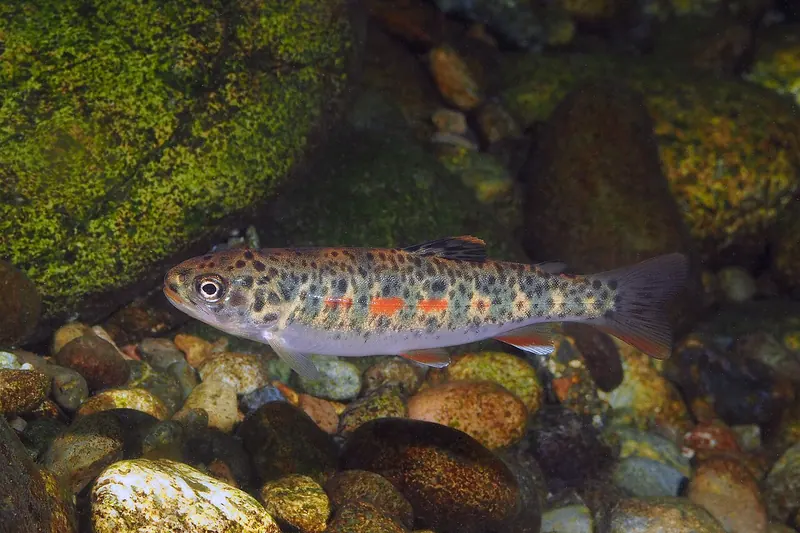
Photo: USFWS - Pacific Region, Wikimedia Commons, Public domain, adjusted to 3:2
- Spawning
- In spring, as early as February in coastal rivers and as late as July in high mountain lakes and streams, when the water reaches 6 to 8 °C (43 to 46 °F); the female digs a redd in gravel and lays 200 to 4,400 eggs depending on size, and the fry hatch after about a month (Wikipedia). Usually mature at three to five years (Wikipedia), according to FishBase from about 15 cm.
- Typical method
- Fly fishing with dry flies and nymphs in streams (Wikipedia)
- Top bait
- Dry fly (hopper, ant)
How to recognise it
- Red, pink or orange slash in the skin fold under the lower jaw (English and German Wikipedia)
- Upper jaw extends past the rear edge of the eye, small teeth at the base of the tongue (Wikipedia)
- Back golden, gray or green, spots below the lateral line more numerous toward the front, irregular spots on dorsal, adipose and tail fins (FishBase, Wikipedia)
Easily confused with: Rainbow trout and steelhead: usually without the red throat slash, but some coastal rainbow and redband trout also show reddish throat marks; the long upper jaw and the teeth at the base of the tongue of the cutthroat are more reliable (Wikipedia). Cutbow: fertile cross with rainbow trout that usually keeps the red slash (Wikipedia).
How to catch it
Methods: Fly fishing with dry flies and nymphs in streams (Wikipedia), Fly fishing for sea-run cutthroat on beaches, river mouths and estuaries of the Pacific coast, for example Puget Sound (Wikipedia), Light spinning with small spinners and spoons (rule of thumb), Drift boat fishing along wooded banks of large rivers (Wikipedia)
Baits: Dry fly (hopper, ant), Nymph, Streamer, Small spinner, Small spoon
Fly anglers fish for sea-run coastal cutthroat year round on beaches and river mouths (Wikipedia). Inland, summer with plenty of terrestrial insects is classic dry-fly time (rule of thumb); respect spawning closures in spring.
Habitat and food
Eastern Pacific and tributaries from Prince William Sound, Alaska to the Eel River in northern California, in most streams draining to the Pacific; anadromous or resident, 0 to 200 m deep, up to 23 °C (FishBase). In the broad sense also in the Cascades, the Great Basin and the Rocky Mountains into southern Alberta, with at least 25 genetically recognizable lineages (Wikipedia). Needs cold, clear, well-oxygenated water: shallow rivers with gravel bottoms or cool, moderately deep lakes; some coastal populations feed at sea (English and German Wikipedia).
Opportunistic feeder: larval, pupal and adult aquatic insects (caddisflies, stoneflies, mayflies, dipterans), terrestrial ants, beetles and grasshoppers that fall in, fish eggs, small fish and crustaceans; fish become more important with size. At sea and along beaches coastal fish eat sculpins, sand lance, salmon fry and herring (Wikipedia).
Size and age
FishBase: max. 99 cm, maximum published weight 18.6 kg, maximum age 13 years. Depending on water and subspecies 15 to 102 cm (6 to 40 in) (Wikipedia); stream fish weigh only 11 to 91 g, sea-run coastal fish average 0.9 to 2.3 kg (2 to 5 lb), lake populations under ideal conditions 5.4 to 7.7 kg (12 to 17 lb) (Wikipedia). World record according to Wikipedia: a Lahontan cutthroat of 19 kg (41 lb) and 99 cm (39 in) from Pyramid Lake, Nevada, December 1925.
Protection and rules
In the USA, each state sets its own size limits, bag limits and seasons. Pescaday does not list these rules yet: check them with the fish and wildlife agency of the state you fish in. Fishing licence USA: agency by state
In Germany we found no minimum size or closed season for this species in any state fisheries regulation.
In the kitchen
Flesh orange-red and of excellent flavor, fried, broiled or baked (FishBase). Where populations are protected, release is mandatory or customary (NPS, rule of thumb).
Sources (4)
- fishbase.de/summary/Oncorhynchus-clarkii.html
- en.wikipedia.org/wiki/Cutthroat_trout
- de.wikipedia.org/wiki/Cutthroat-Forelle
- nps.gov/yell/planyourvisit/fishing.htm
Last checked 2026-10-22. Found a mistake? Write to [email protected].
Know more?
Additions, photos of your catches or a mistake in the text: write to us and we will gladly credit you as a helper.
Send a tip