Species
Common sole
An oval, right-eyed flatfish of sand and mud bottoms, also called Dover sole. One of Europe's most expensive food fish and a night-time target for surf anglers.
Solea solea
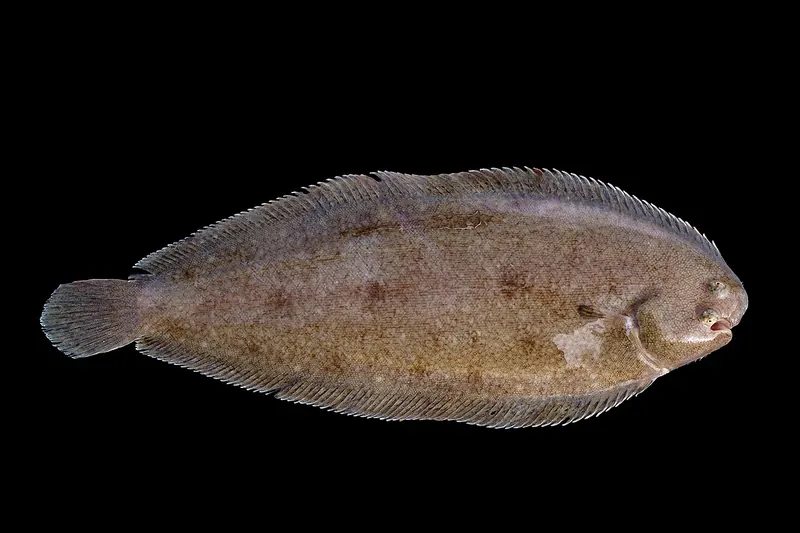
Photo: Hans Hillewaert, Wikimedia Commons, CC BY-SA 4.0, adjusted to 3:2
- Spawning
- In the North Sea, especially the Wadden Sea, Skagerrak and Kattegat, from April to June, in the Mediterranean in February (German Wikipedia); FishBase gives February to May, for example off Galicia, at water temperatures of 6 to 12 °C. Females lay 100,000 to 150,000 eggs; mature at 3 to 5 years and 25 to 35 cm (German Wikipedia).
- Typical method
- Surf fishing at night over sand (rule of thumb)
- Top bait
- Lugworm
How to recognise it
- Oval, elongated body with a rounded head, both eyes on the right side
- Upper side greyish brown to reddish brown with faint dark blotches, underside light grey to white
- Dorsal and anal fins form a long fringe joined to the tail by a membrane; outer part of the pectoral fin on the eyed side sooty black
Easily confused with: The far less valuable lemon sole is easily mistaken for common sole (German Wikipedia). Plaice, flounder and dab also have their eyes on the right but a more diamond-shaped body and no fin fringe running into the tail. The sand sole (Pegusa lascaris) also turns up in North Sea catches.
How to catch it
Methods: Surf fishing at night over sand (rule of thumb), Bottom fishing with small hooks from the beach and groynes (rule of thumb), Bottom fishing from a boat over sand and mud (rule of thumb), Light bottom rig with a long leader so the bait lies on the seabed (rule of thumb)
Baits: Lugworm, Ragworm, Small pieces of clam or mussel, Shrimp, Small fish strip
At night, as common sole feed after dark (German Wikipedia); close to shore in summer, in deeper water in winter (FishBase). Calm, warm nights after a storm with coloured water are considered good (rule of thumb).
Habitat and food
Eastern Atlantic from Trondheim Fjord southward including the North Sea and western Baltic, the Mediterranean, Sea of Marmara and southwestern Black Sea, south to Senegal and Cape Verde (FishBase). Lives close to shore on sandy and muddy bottoms at 0 to 150 m, usually 10 to 60 m (FishBase); English Wikipedia reports it down to 200 m. Moves to deeper water in winter; the Wadden Sea is the most important nursery, and juveniles stay near the coast for their first 2 to 3 years (FishBase).
A solitary night feeder; eats bristle worms, thin-shelled clams and small crustaceans and finds prey with thread-like sensory papillae on the blind side of the mouth (German Wikipedia, FishBase).
Size and age
FishBase: max. 70.0 cm (standard length), common 35.0 cm, maximum published weight 3.0 kg, maximum age 26 years. German Wikipedia gives a maximum of 60 to 70 cm, usually 35 cm; males usually stay somewhat smaller.
Protection and rules
We found no minimum size or closed season for this species in any state fisheries regulation. Local water rules may still apply.
In Germany, closed seasons and minimum sizes are set by each state and can be stricter for single waters. All German rules by state, with the legal source. Outside Germany, the local rules apply: licence and agency by country.
In the kitchen
Firm white flesh, usually served whole, steamed or fried (German Wikipedia); chefs prize its mild, buttery flavour and how easily it fillets (English Wikipedia).
Sources (6)
- fishbase.de/summary/Solea-solea.html
- en.wikipedia.org/wiki/Common_sole
- de.wikipedia.org/wiki/Seezunge
- gesetze-rechtsprechung.sh.juris.de/perma?d=jlr-NNLSH00002ADBNN00000000
- landesrecht-mv.de/bsmv/document/jlr-NNLMV000075CFNN00000000090
- voris.wolterskluwer-online.de/browse/document/9ba895b6-842c-3ba7-8df0-
Last checked 2026-10-22. Found a mistake? Write to [email protected].
Know more?
Additions, photos of your catches or a mistake in the text: write to us and we will gladly credit you as a helper.
Send a tip