Species
Common dentex
Common dentex: the predator among the seabreams, with large canine teeth at the front of both jaws; a prized catch for boat anglers over rocky ground in the Mediterranean.
Dentex dentex
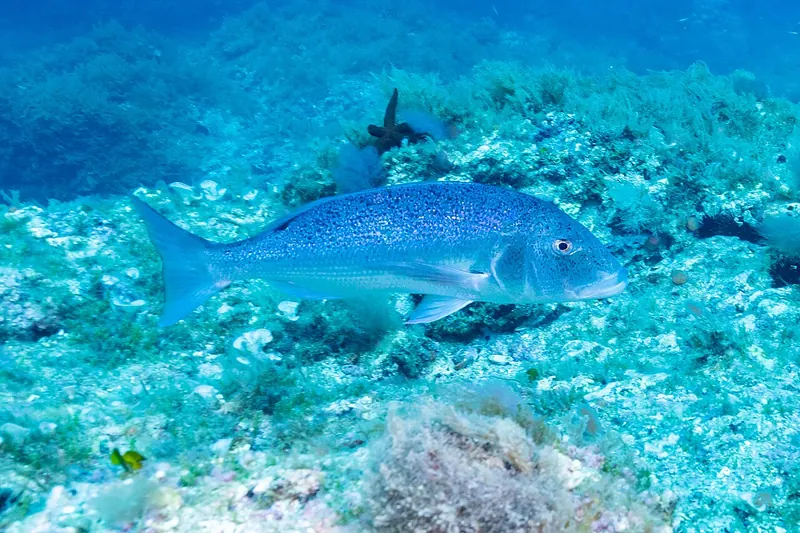
Photo: Diego Delso, Wikimedia Commons, CC BY-SA 4.0, adjusted to 3:2
- Spawning
- In the Mediterranean March to May near the coast (FishBase, German Wikipedia). The otherwise solitary large fish then gather in groups for two to three weeks in warmer water near the surface (English Wikipedia). Separate sexes, some juveniles hermaphroditic; a study off Mallorca found maturity at 2 to 4 years (English Wikipedia).
- Typical method
- Slow trolling with live squid or baitfish over rocky ground
- Top bait
- Live squid or cuttlefish
How to recognise it
- Large canine teeth at the front of both jaws, all teeth pointed, no molars (FishBase, English Wikipedia)
- Oval, compressed body, large fish blue grey with fading dark spots
- Juveniles grey with black spots on the back and upper flanks, turning pink with age (English Wikipedia)
Easily confused with: Pink young dentex can be confused with the common pandora. The pandora has pointed front teeth but molars behind them, a straight head profile and small blue spots on the upper back (English Wikipedia). The common dentex is one of eleven species in the genus Dentex (German Wikipedia).
How to catch it
Methods: Slow trolling with live squid or baitfish over rocky ground, Vertical fishing and jigging along reef edges, Bottom fishing from a boat with dead baitfish, Casting deep diving plugs along rocky shores (rule of thumb)
Baits: Live squid or cuttlefish, Live baitfish such as horse mackerel, Squid strips, Jig, Deep diving plug (rule of thumb)
In spring during spawning (March to May) the large fish gather near the coast for a few weeks (FishBase, English Wikipedia). Otherwise look over rock at 15 to 50 m (FishBase); dawn and dusk are considered best (rule of thumb).
Habitat and food
Eastern Atlantic from the British Isles to Cape Blanc in Mauritania, exceptionally to Senegal, plus the Canary Islands and Madeira; in the Mediterranean common mainly south of 40° N, for example off Spain and North Africa (FishBase). English Wikipedia says throughout the Mediterranean and into the western Black Sea, rare around the British Isles. Over rock and rubble, 0 to 200 m deep, usually 15 to 50 m (FishBase). Much more abundant inside marine protected areas than outside (English Wikipedia).
An active predator: fish, mollusks and cephalopods such as squid and cuttlefish (FishBase, English and German Wikipedia).
Size and age
FishBase: max. 100 cm total length, common 50 cm, maximum published weight 14.3 kg; mean length at maturity 34.6 cm. FishBase also cites a spearfisherman's report of a fish of about 1.60 m and 42 kg from Corfu whose identification cannot be verified. German Wikipedia: up to 1 m and 14 kg. The sources give no maximum age.
Protection and rules
Size limits, bag limits, seasons and licences are set by each country, in the USA by each state. Pescaday does not list these rules: check them with your operator and the national authority before you fish. Notes with sources are given above under conservation status. Licence pages: Spain, France, Italy, Croatia, Greece, Portugal. Fishing travel guide
In the kitchen
A highly valued, expensive food fish, sold fresh or frozen (FishBase, English Wikipedia). Spain and Bosnia and Herzegovina report aquaculture production to the FAO (English Wikipedia).
Sources (5)
Know more?
Additions, photos of your catches or a mistake in the text: write to us and we will gladly credit you as a helper.
Send a tip