Species
Bluefish
Bluefish, also called tailor or chopper: a fast, toothy schooling predator that drives bait schools into the surf along the US East Coast (the bluefish blitz).
Pomatomus saltatrix
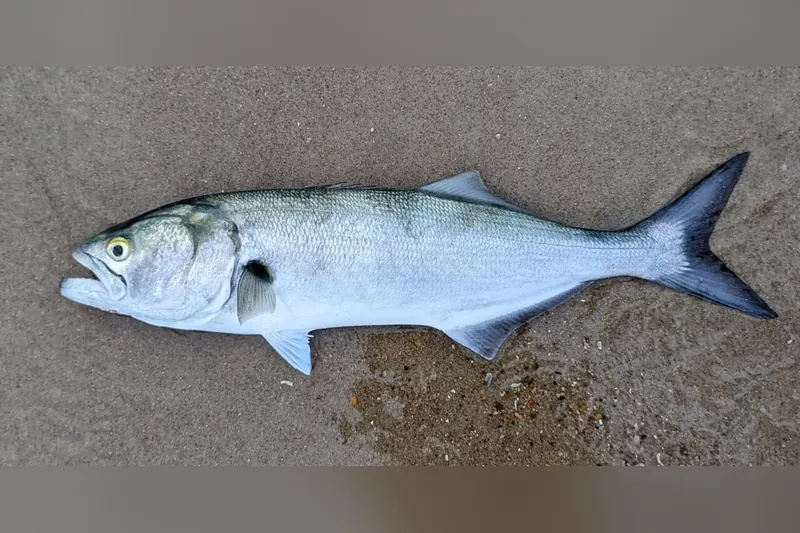
Photo: Conway Hawn, Wikimedia Commons, CC BY 4.0, adjusted to 3:2
- Spawning
- Spawns several times in spring and summer in the open ocean; 400,000 to 2 million eggs depending on size (NOAA Fisheries, FishBase). Mature at age 2 and 15 to 20 inches (NOAA Fisheries); FishBase gives 30 cm. The Western Atlantic has at least two populations separated by Cape Hatteras (English Wikipedia).
- Typical method
- Casting metal lures and spoons into the schools (rule of thumb)
- Top bait
- Menhaden (bunker), fresh or cut
How to recognise it
- Grayish blue to blue green back, silvery sides, white belly
- Strong, prominent jaw with a single row of even, knife edged teeth
- Two separate dorsal fins, the first low with short spines; black spot at the pectoral fin base
Easily confused with: Hard to confuse: the only living species of the family Pomatomidae (English and German Wikipedia). Name trap in German: the saithe (pollock) is sometimes also called Blaufisch, and Blaubarsch is also the name of the small aquarium fish Badis badis (German Wikipedia).
How to catch it
Methods: Casting metal lures and spoons into the schools (rule of thumb), Topwater poppers over feeding fish (rule of thumb), Trolling from a boat (rule of thumb), Bottom and surf fishing with cut bait, always with a wire or heavy leader because of the teeth (rule of thumb)
Baits: Menhaden (bunker), fresh or cut, Small baitfish such as silversides, Squid strips, Metal jigs, Poppers
On the US East Coast the recreational peak runs from May through October, with over 70 percent of the catch in July and August (NOAA Fisheries). Fish winter off Florida, reach Massachusetts by June and leave the waters north of Cape Cod in October (English Wikipedia). Surface blitzes give the schools away (rule of thumb).
Habitat and food
Nearly worldwide in warm temperate and subtropical seas: Western Atlantic from Canada and Bermuda to Argentina, plus the Eastern Atlantic with the Mediterranean and Black Sea, the Indian Ocean, Australia and New Zealand; absent from the eastern Pacific (FishBase). Pelagic over the shelf at 0 to 200 m (FishBase), most common along surf beaches and rocky headlands in clean, high energy water, adults also in estuaries and brackish water (FishBase, English Wikipedia). On the US coast from Maine to eastern Florida; schools move north in spring and summer and south in fall and winter (NOAA Fisheries).
Hunts in loose groups for schooling fish such as menhaden and other herrings, anchovies, silversides and mullet, plus squid and shrimp; cannibalistic, and often kills more prey than it can eat (English Wikipedia, NOAA Fisheries, FishBase).
Size and age
FishBase: max. 130 cm, common around 60 cm, maximum published weight 14.4 kg, maximum age 14 years. English Wikipedia: typically 30 to 60 cm, fish over 20 lb (9 kg) are exceptional, age up to 9 years; German Wikipedia also gives 9 years, NOAA Fisheries up to 12 years, 31 lb and 39 inches. IGFA all-tackle world record: 31 lb 12 oz (14.4 kg) near Hatteras, North Carolina (English Wikipedia). The sources differ on maximum age.
Protection and rules
In the USA, each state sets its own size limits, bag limits and seasons. Pescaday does not list these rules yet: check them with the fish and wildlife agency of the state you fish in. Fishing licence USA: agency by state
In Germany we found no minimum size or closed season for this species in any state fisheries regulation.
In the kitchen
Good, fairly oily meat, baked or smoked; small snapper blues are usually fried. Goes rancid quickly, so keep it cold and eat it soon (English Wikipedia). Because of mercury (about 0.4 ppm on average) and PCBs the US FDA advises young children and women of childbearing age to eat no more than one serving per week (English Wikipedia).
Sources (5)
- fishbase.se/summary/Pomatomus-saltatrix.html
- en.wikipedia.org/wiki/Bluefish
- de.wikipedia.org/wiki/Blaufisch
- de.wikipedia.org/wiki/Blaubarsch
- fisheries.noaa.gov/species/bluefish
Last checked 2026-10-22. Found a mistake? Write to [email protected].
Know more?
Additions, photos of your catches or a mistake in the text: write to us and we will gladly credit you as a helper.
Send a tip