Species
Black drum
Black drum: a heavy, deep bodied drum with many chin barbels that crushes oysters and crabs with its throat teeth and drums loudly in the spawning season.
Pogonias cromis
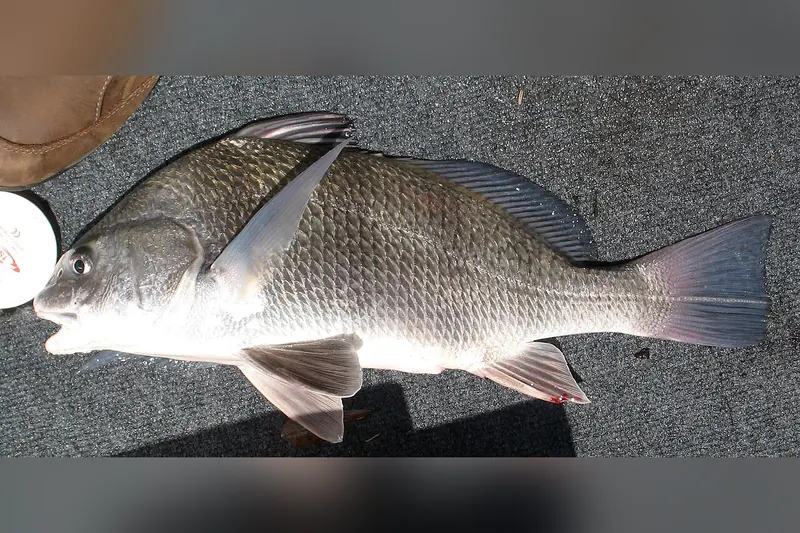
Photo: Chaotic42 (talk), Wikimedia Commons, CC BY-SA 3.0, adjusted to 3:2
- Spawning
- Spring, in and around estuaries, in Texas mostly in February and March; mature by the end of the second year (English Wikipedia). For mating calls the fish make drumming tones of 100 to 500 Hz with the swim bladder (English Wikipedia, German Wikipedia). FishBase gives 64.5 cm length at first maturity.
- Typical method
- Bottom fishing in the surf and in estuaries
- Top bait
- Shrimp
How to recognise it
- Many short, fairly stiff barbels under the lower jaw
- Deep body, dark gray to black, large scales
- Juveniles light with bold dark vertical bars that fade at 12 to 24 inches (English Wikipedia)
Easily confused with: Young fish with their bars look like sheepshead, but have chin barbels instead of the obvious incisor teeth (English Wikipedia). The red drum has no barbels, is copper red and has a black eyespot at the tail base (TPWD). Sources disagree on the number of bars: four to five (English Wikipedia), six to eight (German Wikipedia).
How to catch it
Methods: Bottom fishing in the surf and in estuaries, Bait just off the bottom at oyster beds, jetties and bridge pilings, Chumming with fish scraps, Occasionally spoons and jigs
Baits: Shrimp, Squid (less bait stealing by catfish and croakers), Half or quarter blue crab with the top shell removed (for big fish), Clams (rule of thumb)
Year round in estuaries; in Texas spawners gather in February and March (English Wikipedia). Big fish often hold near oyster beds, so East and Southeast Coast fishing advice is to find an oyster bed (English Wikipedia).
Habitat and food
Western Atlantic from Nova Scotia to Florida, the Gulf of Mexico, rarely the Antilles and the southern Caribbean coast; common between Delaware Bay and Florida and most abundant on the Texas coast (English Wikipedia). Usually in or near brackish water over sand and sandy mud, especially at large river mouths and in mangroves; juveniles enter estuaries, big fish hold in the saltier part near oyster beds (FishBase, English Wikipedia). Since 2019 the South American population has been treated as a separate species, Pogonias courbina (English Wikipedia); German Wikipedia still gives the old range to central Argentina.
Larvae eat zooplankton, juveniles under 20 cm worms and small fish, adults mainly clams, oysters and crabs (English Wikipedia, FishBase). It feels for prey on the bottom with its barbels, crushes shells with its pharyngeal teeth and in shallow water feeds head down with the tail showing above the surface (English and German Wikipedia).
Size and age
FishBase: max. 170 cm, common around 50 cm, maximum published weight 51.3 kg, maximum age 43 years. English Wikipedia: mostly 5 to 30 lb (2 to 14 kg), the largest fish just over 113 lb (51 kg); studies report fish over 60 kg on the Atlantic coast and ages up to 60 years, while in a Louisiana sample of 1,357 fish the largest weighed 22.6 kg and the oldest was 44 years. German Wikipedia: 1.7 m, over 50 kg, over 40 years. The sources differ on maximum age.
Protection and rules
In the USA, each state sets its own size limits, bag limits and seasons. Pescaday does not list these rules yet: check them with the fish and wildlife agency of the state you fish in. Fishing licence USA: agency by state
In Germany we found no minimum size or closed season for this species in any state fisheries regulation.
In the kitchen
Edible, moderate in flavor and not oily; small fish taste much like red drum. Fish over 15 lb (6.8 kg) get tough and coarse, so many anglers release them. The large scales are hard work, so fish are often filleted with skin and scales on and the fillet cut off afterwards (English Wikipedia).
Sources (5)
- fishbase.se/summary/Pogonias-cromis.html
- en.wikipedia.org/wiki/Black_drum
- de.wikipedia.org/wiki/Schwarzer_Trommler
- tpwd.texas.gov/huntwild/wild/species/blackdrum/
- asmfc.org/species/black-drum
Last checked 2026-10-22. Found a mistake? Write to [email protected].
Know more?
Additions, photos of your catches or a mistake in the text: write to us and we will gladly credit you as a helper.
Send a tip