Species
Atlantic bonito
Atlantic bonito: a small relative of the tunas with oblique dark stripes on the back that hunts baitfish in fast schools and is a favorite of trolling and spinning anglers in the Mediterranean.
Sarda sarda
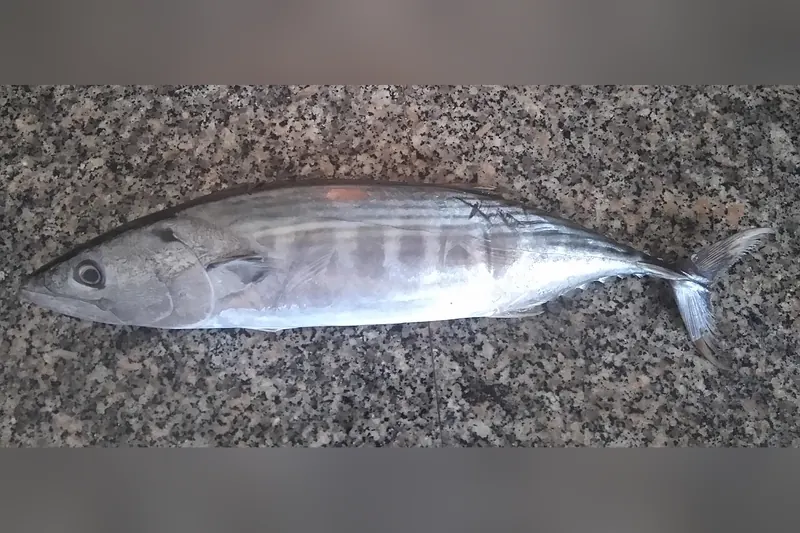
Photo: Habib M'henni, Wikimedia Commons, CC BY-SA 4.0, adjusted to 3:2
- Spawning
- In the Mediterranean and off Morocco May to July (German Wikipedia); off New York in June (English Wikipedia). Eggs and larvae drift in open water (FishBase).
- Typical method
- Trolling small feathers, spoons or plugs (English Wikipedia: often taken while trolling for tuna)
- Top bait
- Metal jig or casting jig
How to recognise it
- Oblique dark stripes on the back, steeper than in other bonitos (FishBase); German Wikipedia counts 5 to 11 stripes
- Spindle shaped tuna body with a large mouth, two closely spaced dorsal fins
- 6 to 9 small finlets above and below the tail base, a corselet of scales behind the head (German Wikipedia)
Easily confused with: The striped bonito (Sarda orientalis) has nearly horizontal stripes on its back and a longer upper jaw (English Wikipedia). The skipjack tuna (Katsuwonus pelamis) has its stripes on the belly instead of the back (English Wikipedia only mentions the name, the feature is a rule of thumb). Canned "bonito del norte" is albacore, not bonito (English Wikipedia).
How to catch it
Methods: Trolling small feathers, spoons or plugs (English Wikipedia: often taken while trolling for tuna), Casting heavy spoons and metal jigs to feeding schools, Drift fishing with cut bait or sardine, Shore fishing from jetties and headlands when schools come close (rule of thumb)
Baits: Metal jig or casting jig, Spoon, Small trolling lure (feather, squid skirt), Sardine or cut bait, Small squid (rule of thumb)
Bonito travel in large schools and often jump clear of the water (English Wikipedia); in the Mediterranean they spawn May to July (German Wikipedia). Feeding schools and gulls at the surface give them away, especially in the morning (rule of thumb).
Habitat and food
Eastern Atlantic from Oslo to Port Elizabeth (South Africa), plus the Mediterranean and Black Sea; western Atlantic from Nova Scotia to Florida and the northern Gulf of Mexico, then from Colombia and Venezuela and south of the Amazon to northern Argentina; absent from most of the Caribbean (FishBase, German Wikipedia). A summer visitor to the North Sea (German Wikipedia). Schools in open coastal water and enters estuaries; FishBase and German Wikipedia give a depth of 80 to 200 m, tolerates 12 to 27 °C (FishBase).
A predator: small schooling fish such as mackerel, silversides and sand lances, plus squid and shrimp; also cannibalistic and able to swallow fairly large prey (FishBase, English and German Wikipedia).
Size and age
FishBase: max. 91.4 cm fork length, common 50 cm, maximum published weight 11 kg, maximum age 5 years; mean length at maturity 37.8 cm. English Wikipedia: up to 75 cm and then 5 to 6 kg, world record 8.3 kg (18 lb 4 oz) from the Azores. The FishBase maximum weight is above that record; the sources disagree.
Protection and rules
Size limits, bag limits, seasons and licences are set by each country, in the USA by each state. Pescaday does not list these rules: check them with your operator and the national authority before you fish. Notes with sources are given above under conservation status. Licence pages: Spain, France, Italy, Croatia, Greece, Portugal. Fishing travel guide
In the kitchen
A popular food fish in the Mediterranean, its flesh between tuna and mackerel (English Wikipedia). Fish under about 1 kg (palamut) are often grilled as steaks, larger ones (torik) are preserved in Turkey as lakerda; in Algeria and Spain it is often made into escabeche (English Wikipedia). Many anglers rate it below tuna because of its oilier flesh (English Wikipedia). FishBase lists reports of ciguatera poisoning.
Sources (5)
Know more?
Additions, photos of your catches or a mistake in the text: write to us and we will gladly credit you as a helper.
Send a tip