Species
Lake trout
The lake trout, also called mackinaw or laker, is the largest char: a slow-growing coldwater fish of deep lakes in Canada, Alaska and the Great Lakes, in summer caught almost only by trolling deep (English and German Wikipedia).
Salvelinus namaycush
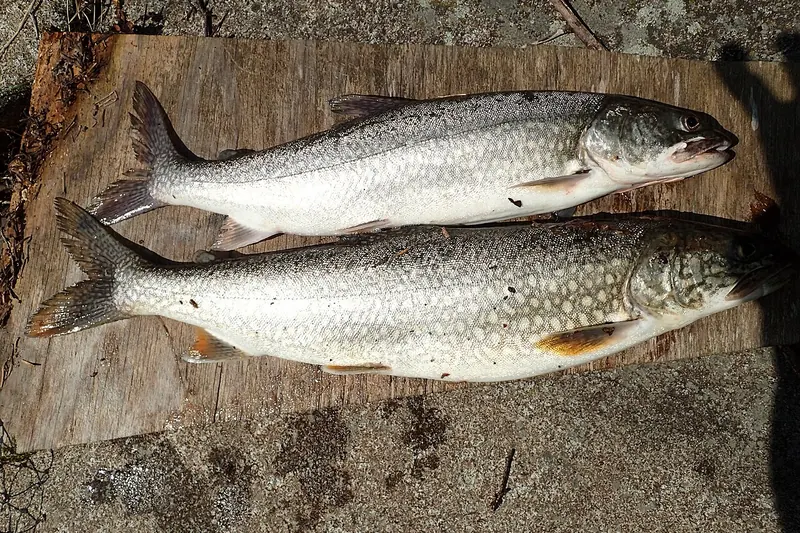
Photo: Allan Harris, Wikimedia Commons, CC0, adjusted to 3:2
- Spawning
- In fall over rock: in southern Lake Superior most fish spawn in October and early November on rocky shoals less than 20 fathoms deep (USGS study 1955). Spawning takes place mostly at night, peaking between dusk and 9 or 10 pm; every year in the south, only every other year in arctic lakes such as Great Bear Lake (FishBase).
- Typical method
- Deep trolling with downriggers or copper line (German Wikipedia)
- Top bait
- Large spoon
How to recognise it
- Dark green to gray or nearly black back, densely covered with whitish to yellowish spots, never pink or red spots (FishBase)
- Deeply forked tail (FishBase)
- Adipose fin present; pectoral, pelvic and anal fins sometimes with a white leading edge (English and German Wikipedia, FishBase)
Easily confused with: Brook trout: red spots with blue halos, worm-like markings on the back and an almost square tail instead of the deep fork (rule of thumb). Splake: a usually sterile cross between a male brook trout and a female lake trout, stocked in lakes (Wikipedia). It differs from European chars by its dark, pale-spotted body and deeply forked tail (FishBase).
How to catch it
Methods: Deep trolling with downriggers or copper line (German Wikipedia), Ice fishing with a jig or bait fish (German Wikipedia), Casting and fly fishing from shore in spring after ice-out (German Wikipedia), Vertical jigging over drop-offs and humps (rule of thumb)
Baits: Large spoon, Dead bait fish on a rig, Heavy jig with soft swimbait, Trolling spoon behind a flasher, Streamer (fly)
In spring after ice-out and in fall it holds close to shore, in summer it sits sluggish in deep, cold water, and in winter it bites well through the ice (German Wikipedia).
Habitat and food
Native to Atlantic, Arctic and Pacific drainages from northern Canada and Alaska to New England, the Great Lakes and northern Montana, widely introduced; 3 to 61 m deep, usually 18 to 53 m, at 4 to 13 °C (FishBase). Lives in cold, oxygen-rich lakes, in summer often at 20 to 60 m (Wikipedia); in winter, spring and late fall also near the surface, under the ice and in shallow water (German Wikipedia). Introduced among other places to Argentina, Chile and Alpine lakes in Europe (German Wikipedia); in Yellowstone Lake it is considered invasive (Wikipedia).
Eats freshwater sponges, crustaceans, insects, fish (preferring ciscoes) and small mammals; some populations feed on plankton all their lives, grow more slowly and stay smaller (FishBase, Wikipedia).
Size and age
FishBase: max. 150 cm, commonly 50 cm, maximum published weight 32.7 kg, maximum age 50 years, mature at about 52 cm. The largest documented fish weighed almost 46 kg (102 lb) at 130 cm (50 in) and came from a gillnet according to Wikipedia, from Lake Athabasca according to German Wikipedia; IGFA rod-and-reel record according to Wikipedia: 33 kg (72 lb) and 150 cm (59 in), Great Bear Lake 1995. Fish of 15 to 40 lb (6.8 to 18.1 kg) are not uncommon, average length is 24 to 36 in (61 to 91 cm) (Wikipedia); German Wikipedia gives mostly 1 to 3 kg for today's catches, clearly more in northern Canada and Alaska.
Protection and rules
In the USA, each state sets its own size limits, bag limits and seasons. Pescaday does not list these rules yet: check them with the fish and wildlife agency of the state you fish in. Fishing licence USA: agency by state
In Germany we found no minimum size or closed season for this species in any state fisheries regulation.
In the kitchen
One of the most sought-after food fish in North America: flesh white to salmon-colored depending on diet, firm and dry, close to salmon in taste (German Wikipedia); FishBase describes it as usually yellow or cream-colored.
Sources (6)
- fishbase.de/summary/Salvelinus-namaycush.html
- en.wikipedia.org/wiki/Lake_trout
- de.wikipedia.org/wiki/Amerikanischer_Seesaibling
- api.gbif.org/v1/species/2351327/vernacularNames
- pubs.usgs.gov/publication/1000146
- nps.gov/yell/planyourvisit/fishing.htm
Last checked 2026-10-22. Found a mistake? Write to [email protected].
Know more?
Additions, photos of your catches or a mistake in the text: write to us and we will gladly credit you as a helper.
Send a tip