Species
Greater amberjack
Greater amberjack, the largest of the jacks, at home on reefs and wrecks in the Gulf of Mexico and known as the reef donkey for its stubborn fight.
Seriola dumerili
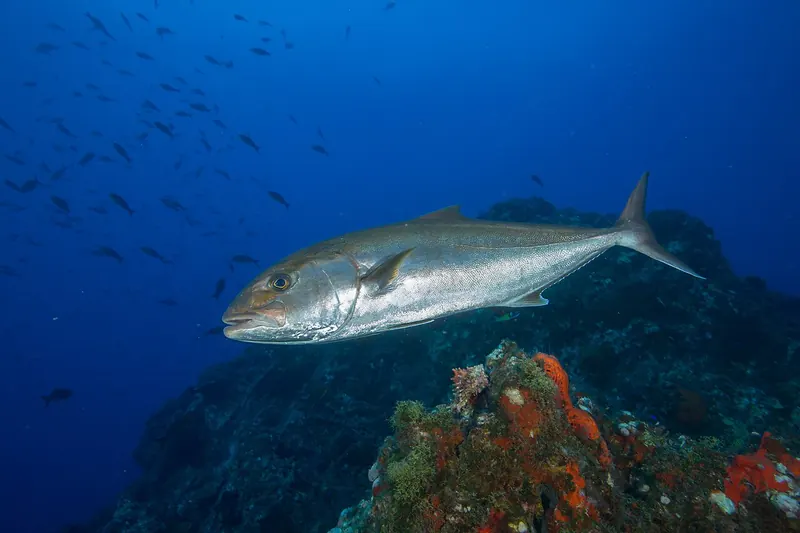
Photo: NOAA Photo Library, Wikimedia Commons, CC BY 2.0, adjusted to 3:2
- Spawning
- Spawns in summer near the coast (FishBase). Off Florida spawning peaks in April and May; a female spawns about every four to five days over roughly 60 days and releases 18 to 59 million eggs per season; in the western Atlantic males mature at three years and 80 cm, females at four years and 83 cm (Wikipedia). FishBase gives a mean length at maturity of 90.8 cm.
- Typical method
- Vertical fishing over wrecks and reefs with natural bait or jigs (rule of thumb)
- Top bait
- Live baitfish (blue runner, bigeye scad)
How to recognise it
- Amber stripe along the middle of the side, blue-grey to olive back, silvery white belly (FishBase)
- Dark stripe from the upper jaw through the eye to in front of the first dorsal fin (Wikipedia)
- Second dorsal and anal fins only slightly raised at the front, no keels on the tail base (FishBase, German Wikipedia)
Easily confused with: In the Gulf of Mexico federal rules list lesser amberjack, almaco jack and banded rudderfish as a separate group without a closed season (NOAA Fisheries), while greater amberjack has a minimum size and a season, so release it if in doubt. Off West Africa it is confused with Seriola carpenteri (FishBase).
How to catch it
Methods: Vertical fishing over wrecks and reefs with natural bait or jigs (rule of thumb), Surface trolling with lures and natural baits (Wikipedia), Bycatch when bottom fishing for snapper and grouper (Wikipedia), Heavy tackle, pull the fish away from the structure at once (rule of thumb)
Baits: Live baitfish (blue runner, bigeye scad), Squid, Heavy speed jig, Popper, Sardine
Larger fish hold deeper, usually at 18 to 72 m (Wikipedia). In Gulf federal waters the recreational season is short, see rules; dates change from year to year.
Habitat and food
Almost worldwide in tropical and warm temperate seas; in the western Atlantic from Nova Scotia and Bermuda to Brazil including the Gulf of Mexico and the Caribbean, in the eastern Atlantic to Morocco and in the Mediterranean, in the Indo-Pacific from South Africa to Japan, Hawaii and New Caledonia (FishBase). Depth 1 to 385 m, usually 18 to 72 m (FishBase). Alone or in small to medium schools around reefs, caves, drop-offs, rocky outcrops and wrecks; fish under 3 kg also in shallow water (Wikipedia). In warmer seas mostly below 100 m (German Wikipedia). Juveniles live offshore under drifting sargassum and debris (FishBase).
Mainly fish such as bigeye scad, plus invertebrates (FishBase); also sardines, cephalopods and crustaceans. Juveniles eat plankton and from about 20 cm mainly fish (Wikipedia).
Size and age
FishBase: max. 190 cm, commonly around 100 cm, maximum published weight 80.6 kg, maximum age 15 years. Wikipedia gives the same sizes but up to 17 years of life; German Wikipedia max. 1.90 m and 80 kg.
Protection and rules
In the USA, each state sets its own size limits, bag limits and seasons. Pescaday does not list these rules yet: check them with the fish and wildlife agency of the state you fish in. Fishing licence USA: agency by state
In Germany we found no minimum size or closed season for this species in any state fisheries regulation.
In the kitchen
Important food fish, fresh and frozen, fried, broiled or baked (FishBase); used for sushi and sashimi in Japan (Wikipedia). Ciguatera has been reported in some areas (FishBase). Tapeworms occasionally occur; they are harmless to humans but unappetising (Wikipedia).
Sources (6)
- fishbase.se/summary/Seriola-dumerili.html
- en.wikipedia.org/wiki/Greater_amberjack
- de.wikipedia.org/wiki/Gro%C3%9Fe_Bernsteinmakrele
- ecfr.gov/current/title-50/chapter-VI/part-622/subpart-B/section-622.37
- ecfr.gov/current/title-50/chapter-VI/part-622/subpart-B/section-622.38
- fisheries.noaa.gov/southeast/rules-regulations/fishing-regulations-and
Last checked 2026-10-22. Found a mistake? Write to [email protected].
Know more?
Additions, photos of your catches or a mistake in the text: write to us and we will gladly credit you as a helper.
Send a tip