Species
Zander
Europe's largest freshwater member of the perch family: a shy predator with long fangs that sees well in murky water and at night.
Sander lucioperca
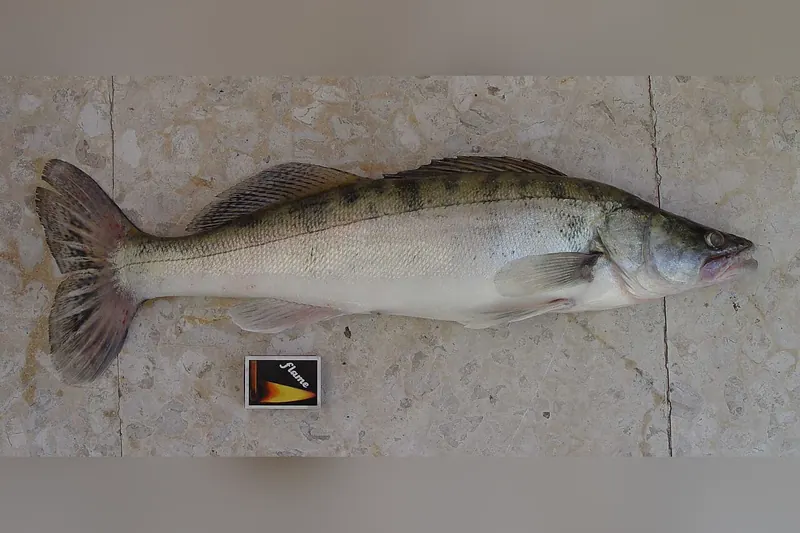
Photo: eLNuko, Wikimedia Commons, Public domain, adjusted to 3:2
- Spawning
- April to June (general guide, varies by region)
- German Red List
- not threatened
- Typical method
- Lure fishing on the bottom (jigging)
- Top bait
- Soft plastic shad
How to recognise it
- Slim, spindle-shaped body with a pointed head
- Two dorsal fins, the front one with spiny rays
- Long fangs in a deeply split mouth, grey-green flanks with bands
Easily confused with: Looks like the European perch, but is much slimmer, has long fangs and no reddish pelvic fins.
How to catch it
Methods: Lure fishing on the bottom (jigging), Bottom fishing with a bait fish, Fly fishing with a sinking line
Baits: Soft plastic shad, Plug (crankbait), Twister tail, Dead, slender bait fish
Mainly in the evening and at night; good months are May and June after spawning and September to December.
Habitat and food
Slow-flowing rivers, canals, lakes and lagoons, preferring large waters from around four to five metres deep. Also found in the brackish water of the Baltic Sea.
Hunts smaller, slender fish such as roach, silver bream, perch or bleak.
Size and age
Usually 40 to 50 cm, rarely up to 130 cm and 19 kg; can live 10 to 20 years (Wikipedia). Largest zander caught on rod and line in Germany according to Wikipedia: 106 cm and 15 kg (Danube, 2000).
Protection and rules
Zander: closed season and minimum size by German state
These rules apply in Germany only. Fishing in the UK, the USA or elsewhere? The local rules apply there (link below).
- Baden-Württembergminimum size 45 cm · closed season 01.04. to 15.05.minimum size 50 cm · closed season 01.02. to 30.04. only in some waters
- Bavariaminimum size 50 cm · closed season 15.02. to 30.04.
- Berlinminimum size 45 cm · closed season 01.01. to 31.05.
- Brandenburgminimum size 45 cm · closed season 01.04. to 31.05.
- Bremenminimum size 40 cm · closed season 01.02. to 15.05.
- Hamburgminimum size 45 cm · closed season 01.02. to 31.05. only in some waters
- Hesseminimum size 50 cm
- Mecklenburg-Western Pomeraniaminimum size 45 cmminimum size 40 cm · closed season 23.04. to 22.05. (coast) only in some watersminimum size 45 cm · closed season 23.04. to 22.05. (coast)
- Lower Saxonyminimum size 35 cm · closed season 15.03. to 30.04.minimum size 40 cm · closed season 15.03. to 15.05. (coast)
- North Rhine-Westphaliaminimum size 40 cm · closed season 01.04. to 31.05.
- Rhineland-Palatinateminimum size 45 cm · closed season 15.03. to 15.05.minimum size 45 cm · closed season 01.04. to 31.05. only in some watersminimum size 45 cm · closed season 01.01. to 14.06. only in some waters
- Saarlandminimum size 45 cm · closed season 15.02. to 31.05.minimum size 45 cm · closed season 01.01. to 14.06. only in some waters
- Saxonyminimum size 50 cm · closed season 01.02. to 31.05.
- Saxony-Anhaltminimum size 50 cm · closed season 15.02. to 31.05.
- Schleswig-Holsteinminimum size 45 cm · closed season 15.03. to 15.05.minimum size 40 cm (coast) only in some watersminimum size 40 cm · closed season 15.02. to 15.05. (coast) only in some waters
- Thuringiaminimum size 45 cm · closed season 01.04. to 31.05.
From the official state fisheries regulations, retrieved 2026-10-11. All rules by state
In Germany, closed seasons and minimum sizes are set by each state and can be stricter for single waters. All German rules by state, with the legal source. Outside Germany, the local rules apply: licence and agency by country.
In the kitchen
Regarded as a top-quality food fish with firm, white flesh; the fillets are boneless and great for pan-frying.
Sources (3)
- de.wikipedia.org/wiki/Zander
- fishbase.se/summary/Sander-lucioperca.html
- rote-liste-zentrum.de/detail/pdf/91301
Last checked 2026-10-18. Found a mistake? Write to [email protected].
Know more?
Additions, photos of your catches or a mistake in the text: write to us and we will gladly credit you as a helper.
Send a tip