Species
White bass
The white bass, also called sand bass or silver bass, is a silvery schooling predator of the reservoirs and big rivers of the US Midwest and South, famous for its spring spawning run into tributaries (Wikipedia).
Morone chrysops
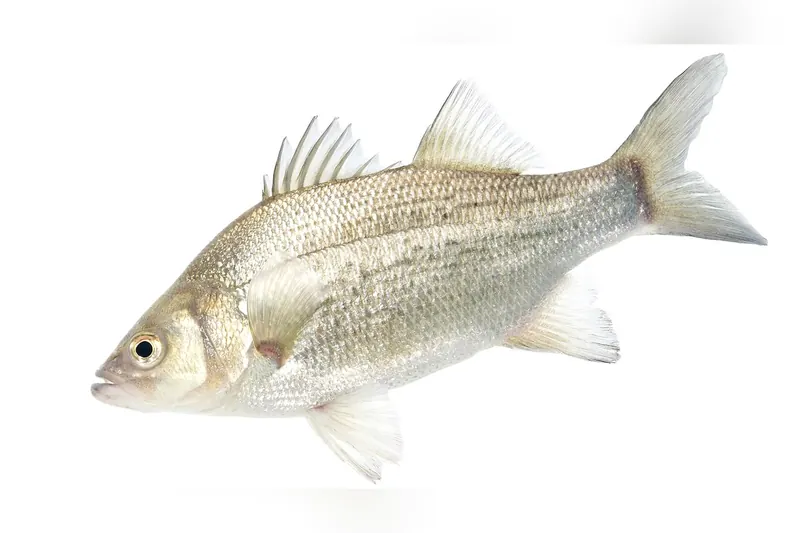
Photo: USFWS Mountain Prairie, Wikimedia Commons, Public domain, adjusted to 3:2
- Spawning
- Mid-March to late May at 12 to 20 °C (54 to 68 °F), usually in moving water of a tributary, also on windswept lake shores, in daylight; a female releases 242,000 to 933,000 sticky eggs over plants, logs, gravel or rocks, with no parental care (Wikipedia). Spawns near the surface (FishBase).
- Typical method
- Casting during the spring run in tributaries and below dams (Wikipedia on spawning, rule of thumb)
- Top bait
- Small spinner
How to recognise it
- Silver-white to pale green, dark back, narrow dark stripes running lengthwise on the sides (Wikipedia)
- Deep, laterally compressed body with large, rough scales (Wikipedia)
- Two separate dorsal fins, the front one spiny, the rear one soft; notched tail (Wikipedia)
Easily confused with: White perch (Morone americana): spiny and soft parts of the dorsal fin are joined (Wikipedia). Striped bass and hybrid striped bass (wiper): two tooth patches at the back of the tongue, the white bass only one (Wikipedia); the hybrid has broken stripes (German Wikipedia, article on the hybrid).
How to catch it
Methods: Casting during the spring run in tributaries and below dams (Wikipedia on spawning, rule of thumb), Casting to schools busting bait on the surface in summer (rule of thumb), Vertical jigging with spoons or jigs over schools in open water (rule of thumb), Float fishing with a live minnow or worm (Wikipedia)
Baits: Small spinner, Small soft swimbait on a jig head, Spoon or jigging spoon, Live minnow, Worm
In spring during the spawning season from mid-March to late May, when fish move into tributaries and shallow areas (Wikipedia). In summer and fall the schools roam open water in reservoirs (rule of thumb).
Habitat and food
Native to the St. Lawrence and Great Lakes, the Red River (Hudson Bay) and the Mississippi basin from Quebec and South Dakota to Louisiana, plus from the Mississippi in Louisiana to the Rio Grande in Texas and New Mexico; lives in lakes, ponds and pools of small to large rivers, 0 to 13 m deep at 12 to 32 °C (FishBase). Widespread especially in the Midwest and stocked in many waters, particularly in the South; established in Manitoba since the 1960s (Wikipedia). Lives mainly in large reservoirs and rivers, and spawns in shallow rivers and creeks (Wikipedia).
A carnivore that feeds by sight: main prey are calanoid and cyclopoid copepods, daphnia and Leptodora (Wikipedia). Juveniles eat cladocerans, copepods and midge larvae, adults fish such as shad and silversides (FishBase); according to Wikipedia only the largest white bass eat fish.
Size and age
FishBase: max. 45 cm, commonly 31.8 cm, maximum published weight 3.1 kg, maximum age 9 years, mature at about 28 cm. Most grow to 10 to 12 inches (25 to 30 cm), some to 17 inches (43 cm) or more (Wikipedia; its introduction says 12 to 15 inches). IGFA record according to Wikipedia: 3.09 kg (6 lb 13 oz), shared by fish from Orange Lake, Virginia (1989) and the Amite River, Louisiana (2010).
Protection and rules
In the USA, each state sets its own size limits, bag limits and seasons. Pescaday does not list these rules yet: check them with the fish and wildlife agency of the state you fish in. Fishing licence USA: agency by state
In Germany we found no minimum size or closed season for this species in any state fisheries regulation.
In the kitchen
White flesh, kept as a food fish (rule of thumb); hybrids with striped bass are a popular food fish (German Wikipedia, article on the hybrid). State fish of Oklahoma (Wikipedia).
Sources (5)
Know more?
Additions, photos of your catches or a mistake in the text: write to us and we will gladly credit you as a helper.
Send a tip